

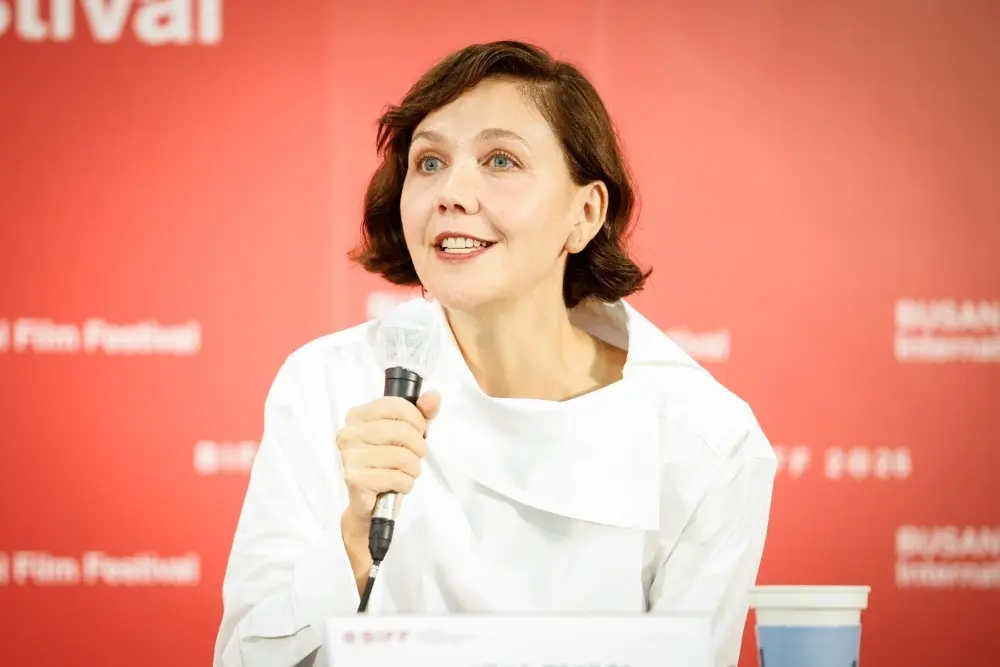
Appearing before an eager crowd of international journalists, filmmakers, and cinephiles at a press conference during the Busan International Film Festival on Wednesday, acclaimed filmmaker and actor Maggie Gyllenhaal delivered a masterclass on leadership, creative humility, and the collaborative nature of filmmaking. Reflecting on her career transition from in-demand actress to award-winning writer-director, Gyllenhaal shared candid insights into what separates truly visionary directors from those who struggle behind the camera. According to Gyllenhaal, the best directors she has worked with throughout her career—who almost invariably turned out to be the most commercially and critically successful—shared a fundamental trait: they deeply understood the immense value of drawing upon the minds, talents, and diverse perspectives of the creative people surrounding them on set.
"It was the people who were very scared, or just not very smart, who tried to squash other people’s voices," Gyllenhaal remarked during the panel discussion, drawing nods of agreement from industry professionals in attendance.
The philosophy of open collaboration is one that Gyllenhaal has championed since she first stepped behind the camera for her feature-length directorial debut, the psychological drama The Lost Daughter. When making that film, her primary anxiety and driving focus was ensuring that every single individual on her set—ranging from the principal actors and the director of photography to the production designer, the gaffer, and the entire crew—felt entirely free and empowered to contribute their unique ideas and expertise.
Elaborating on this inclusive philosophy, Gyllenhaal explained that acknowledging her ultimate authority as the director actually freed her from feeling threatened by other people’s brilliance. "The truth is, it is ultimately up to me as the director. I have the power, so there’s no reason to squash anyone else’s voice," she stated. "I mean, it’s just so obvious that the movie that I will make that includes all the minds of the people on my crew, at least as things I can draw from, is going to be exponentially better than the movie I can make trying to recreate something I imagined all alone by myself in my room."
Gyllenhaal traveled to Busan to present her latest project, Flesh Impact, a provocative and imaginative short film that she wrote and directed. The ambitious project stars legendary actress Ellen Burstyn as Marilyn Monroe at the age of 100, while movie star Dakota Johnson portrays the iconic screen siren in her radiant youth. The genesis of the project stemmed from an unexpected invitation: it began as a high-profile commission from Genesis, the luxury automotive brand and a longtime, dedicated sponsor of the Busan International Film Festival, to commemorate what would have marked Marilyn Monroe’s 100th birthday in June.
When the luxury brand first approached her with the concept, Gyllenhaal admitted that she knew Monroe primarily through the well-documented, enduring prism of her image as a timeless global screen icon. Consequently, she asked for a week to deliberate and determine whether she genuinely had anything fresh or meaningful to say about the tragic Hollywood legend. She spent those seven days deeply immersed in reading biographical texts about Monroe and intensely re-watching her classic films.
The resulting pitch was as daring as it was unconventional. "I don’t think that when Genesis came to me and asked for a film about Marilyn Monroe to celebrate what would have been her 100th birthday that they imagined she would actually be 100 years old in the movie," Gyllenhaal recalled with a smile. "I thought, ‘Okay, I have this idea. They’re never going to go for it.’"
To her surprise and delight, Genesis instantly approved the bold pitch. Capitalizing on her creative momentum, Gyllenhaal sat down and finished writing the screenplay within a single weekend. Alongside Burstyn and Johnson, the star-studded short film also features accomplished performances from Peter Sarsgaard and Sepideh Moafi. Flesh Impact made its highly anticipated world premiere out of competition at the prestigious Venice Film Festival, drawing substantial critical attention. Discussing the emotional core of the short, Gyllenhaal emphasized that while the film serves as a conceptual tribute to Monroe, it functions equally as a sincere celebration and honoring of the extraordinary careers of both Ellen Burstyn and Dakota Johnson.
The transition from a prolific acting career into producing, and eventually writing and directing, felt entirely natural to Gyllenhaal in hindsight. Growing up, the cinematic landscape featured very few prominent women directors, making acting the most obvious and accessible outlet for a young woman who deeply loved movies and possessed a burning desire to tell complex stories.
"It felt satisfying and exciting for a long time, and then I think I hit the edge of what I was able to do as an actress," she reflected. Her official leap into writing and directing commenced eight years ago with the development of The Lost Daughter, an experience that unlocked a profound sense of comfort and inspiration. She noted that she has felt significantly more at ease and creatively fulfilled behind the camera ever since making that pivotal career shift.
A deep appreciation for the cinematic arts is deeply ingrained in Gyllenhaal’s family lineage. Film is, quite literally, the family business. Her father is the established filmmaker Stephen Gyllenhaal, while her mother, Naomi Foner, is an accomplished screenwriter. Reminiscing about her childhood, Gyllenhaal shared that her family maintained a beloved weekly ritual of going to the movies together almost every Friday night.
That lifelong immersion in storytelling has fostered enduring professional and personal collaborations with her family members. Highlighting her mother’s unique trajectory, Gyllenhaal noted, "My mom directed her first film as a grandmother. I think she might be the only person to have directed her first film as a grandmother." She affectionately praised her mother as "probably the best note-giver that I have." Similarly, she spoke warmly of her brother, actor Jake Gyllenhaal—who appeared in The Bride—describing him as a close confidant whose distinctly different artistic tastes she regards as an invaluable gift.
Looking toward the horizon, Gyllenhaal revealed that she has already commenced writing two nascent creative projects, describing herself as being "in that very exciting place where I’m kind of like, ‘What is this going to ultimately be about, you know?’" This creative momentum follows reports from Variety in June indicating that she is slated to direct and produce a feature film adaptation of Rachel Kushner’s acclaimed novel Creation Lake for Warner Bros., the studio that also backed The Bride.
Addressing the broader landscape of gender equity and representation within the global film industry, Gyllenhaal redirected attention toward her outspoken remarks delivered earlier at the Venice Film Festival. Serving there as the president of the competition jury, she had publicly pointed out the stark disparity highlighted by the fact that only a single female filmmaker had a movie selected for the main competition, underscoring the ongoing work still required to ensure true parity for women directors on the world stage.