

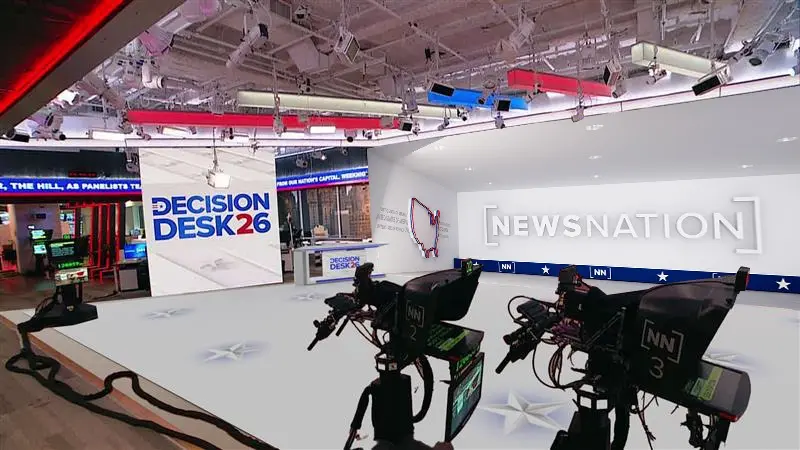
As media organizations map out their strategies for the upcoming 2026 midterm elections, NewsNation is taking a distinctly different approach to its broadcast. The Nexstar-owned cable news network has announced a recipe for its five-hour election night coverage on November 3 that leans heavily on statistics, data transparency, and rapid on-the-ground reporting while stripping away the traditional punditry and roundtable chatter that have long defined broadcast news marathon coverage.
Instead of filling the airwaves with familiar opinion makers repeating standard talking points, the network aims to keep viewers intensely engaged with real-time results and comprehensive reporting from across the nation. For NewsNation executives and producers, the goal is to give audiences so much substance that they will not even miss the usual noise.
"I think what we aren’t going to have is a lot of noise," says Page Lobdell, executive producer of special projects and events for NewsNation, during a recent interview discussing the network’s election night blueprint. "All the opinion and the commentary and the talking heads sitting around a table giving their talking points, we are going to want to cut that out."
This philosophy underpins a broader strategy to borrow a page from the playbook of sports broadcasting, specifically drawing inspiration from the fast-paced "whip-around" format popularized by programming like the NFL’s "RedZone." Just as sports fans appreciate a broadcast that zips dynamically from stadium to stadium to catch crucial touchdowns and game-changing plays as they happen, NewsNation hopes to deliver a similar viewing experience for politics. The format is designed to drop viewers directly into important electoral moments, competitive races, and breaking developments the exact second they occur.
At the core of this data-driven strategy is Decision Desk HQ, a trusted tabulator of voting data that has built a strong industry track record for calling key races early and accurately. Rather than relying on closed-door estimations, NewsNation plans to pull back the curtain on how those predictions are made. Data-miners from Decision Desk HQ will operate out of a dedicated "war room" located at Georgetown University, offering viewers rare, behind-the-scenes glimpses into the complex methodologies used to analyze incoming statistics and formulate projections.
This emphasis on visibility aligns with a modern media landscape where audiences are accustomed to instant information, quantitative metrics, and prediction markets. Chris Stirewalt, NewsNation’s political editor, notes that this level of openness represents a necessary evolution in political journalism.
"More transparency is better," Stirewalt says. "We live in an era of data. We live in an era of prediction markets. People have an expectation of what they are going to get and when they are going to get it. We can do that."
When NewsNation goes live on Tuesday night, it will enter a crowded and competitive arena. The network will vie for the attention of exhausted and eager voters alongside much larger, legacy broadcast rivals such as CNN and NBC News, as well as a growing host of nimble start-ups led by independent digital content creators, many of whom cut their teeth in traditional media organizations. Despite the fierce competition, Stirewalt and his colleagues believe their unique formula provides a distinct competitive edge.
The partnership with Decision Desk HQ has already proven its mettle during high-stakes national events. Most notably, data supplied by the firm helped position NewsNation as the very first television network to correctly project Donald Trump as the winner of the presidential election in 2024. While leadership refuses to chase hollow speed records at the expense of accuracy, they express supreme confidence in their analytical partnership.
"I can’t promise you we are going to be first calling the House. I can’t promise you we are going to be first calling the Senate majority. I think we are going to be right before we are going to be first," Stirewalt explains. "I can tell you that the track record says if you are a betting person, you might put your wager on DDHQ and NewsNation."
The embrace of the whip-around format reflects a wider trend across the contemporary television landscape. While the format originated and achieved massive popularity among sports die-hards with Sunday afternoon NFL coverage, it has steadily bled into other genres of live television. In recent years, NBC Sports introduced its "GoldZone" format to help viewers effortlessly dip in and out of the multitude of simultaneous events during its extensive Olympic broadcasts. Similarly, local CBS television stations have played an instrumental role in powering streaming formats that dynamically transport viewers to breaking news events unfolding across different regions of the country as covered by local newsrooms.
For a cable news network, Election Night also serves as a crucial platform to showcase its regular roster of talent and broader operational footprint. NewsNation’s prominent evening anchors—Chris Cuomo, Elizabeth Vargas, Leland Vittert, and Katie Pavlich—will jointly anchor the night’s proceedings directly from Washington, D.C. Meanwhile, Chris Stirewalt and Connell McShane will be stationed in New York, ready to deep-dive into the numbers, stats, and shifting electoral maps.
To support the anchors, NewsNation is leveraging the massive resources of Nexstar, tapping into a vast network of dozens of local television stations scattered across the country while deploying its own dedicated corps of correspondents to key regions.
"We have a camera in a campaign headquarters at nearly every single race across the country," Lobdell notes, emphasizing the breadth of their on-the-ground deployment.
The network’s on-air team will certainly have no shortage of complex storylines and historical parallels to study as the results roll in. One major question facing political analysts is whether early voting trends and results on the East Coast will serve as reliable bellwethers for how the rest of the nation will cast its ballots. Stirewalt has stated that he intends to keep a particularly close eye on battlegrounds like Ohio and North Carolina to determine whether those states are ultimately tilting red or blue.
Beyond individual race outcomes, the coverage will examine the broader tea leaves regarding the future trajectory of both the Democratic and Republican parties. Observers will be watching to see how the Democratic Party handles potential internal friction from left-wing insurgents, mirroring the disruptive rise of the Tea Party movement within Republican ranks years prior. On the other side of the aisle, analysts will look closely at what Republican voting patterns reveal about the ongoing political appeal and influence of Vice President JD Vance.
Navigating these multifaceted storylines requires a disciplined commitment to quantitative reporting rather than endless pontification. As Stirewalt emphasizes, respecting the intelligence of the audience means prioritizing hard facts over repetitive speculation.
"We are not going to make you hear the same tired arguments again and again," Stirewalt says. "What people want are results."