



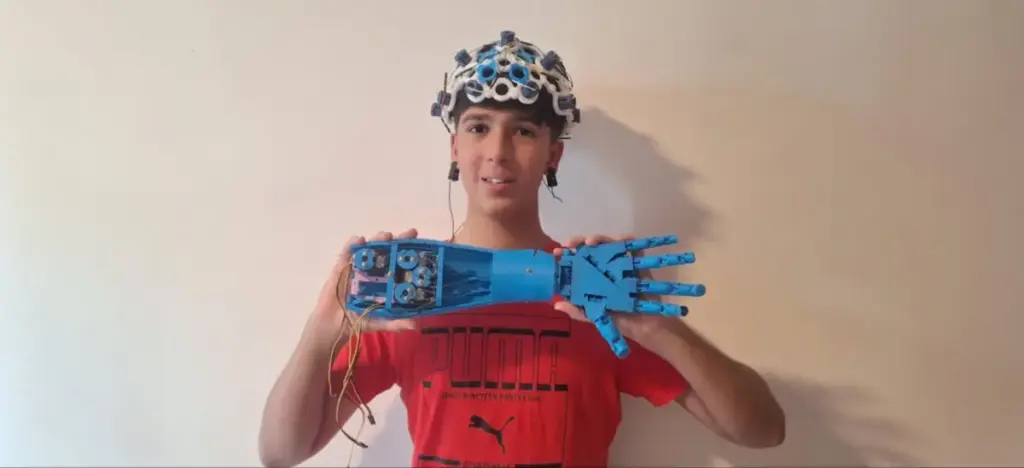
Aarav Sharma is still hard at work. For those who follow the cutting edge of young maker innovations, Sharma first gained attention when he was just 14 years old for building an impressive 3D-printed, brain-controlled robot arm. That project showcased an extraordinary aptitude for advanced electronics, neurotechnology, and mechanical design at a remarkably early age.
Now, Sharma has pushed his research and development even further. Rather than resting on the success of his robotic arm, he has spent the intervening months expanding his technological ambitions beyond physical actuation and into a comprehensive communication system.

With the backing of a sponsorship from OpenBCI, an open-source brain-computer interface platform, Sharma has successfully engineered a six-command Steady State Visually Evoked Potential system. To understand the technology, it helps to think of it as a form of internal eye tracking driven directly by brain waves. As Sharma explains, SSVEP is a specialized type of brain-computer interface where different visual targets flash at distinct frequencies. When a user focuses their attention on a specific target, an electroencephalography headset detects the matching neural response in the user’s brain and seamlessly translates it into a digital command.
To make the system practical and efficient for everyday communication, Sharma integrated word suggestions powered by an OpenAI language model. This integration dramatically accelerates typing speeds while ensuring that the human user maintains absolute control over the final output. In practical testing, the system has demonstrated impressive efficiency, allowing users to compose and respond with full sentences in under five seconds.
The engineering process behind the six-command system involves rigorous data collection and analysis. Describing his methodology for offline EEG data collection, Sharma notes that users complete roughly 60 trials where the system prompts them to focus on one of the six flashing targets. He then evaluates how system accuracy changes when varying amounts of EEG data are utilized, employing time-frequency representation graphs to verify the detected frequencies and utilizing confusion matrices to analyze which targets are occasionally confused by the algorithm.

Looking ahead, Sharma is already setting his sights on the next phase of development. He plans to transition the user interface away from a traditional computer screen and onto augmented reality glasses. Moving the interface to AR glasses aims to deliver a significantly more portable, practical, and accessible real-world experience for users relying on neural interfaces for communication.
Those interested in following the ongoing evolution of Sharma’s neurotechnology projects can find more information and technical updates at his official portfolio website, aaravinnovate.com/bci-neurova.