

If there is anything universally understood about Boston, it is that the city intimately knows its seafood. Anchored by its historic coastal location and storied fishing heritage, the metropolis has long sustained itself on a steady supply of lobster rolls, freshly shucked oysters, and fried clams served by the bucket. Yet, over the past decade, a quiet culinary transformation has taken root across the city and its surrounding neighborhoods. Alongside the classic clam shacks and maritime traditions, a robust and sophisticated sushi culture has emerged, captivating both international travelers and local connoisseurs.
This modern sushi renaissance benefits not only from New England’s abundant local fisheries but also from sophisticated global supply chains. Today, high-end establishments can reliably source specialized ingredients, including exceptional catches flown in straight from Japan. A closer examination of Boston’s culinary landscape reveals a thriving ecosystem of destination dining rooms worthy of special occasions alongside intimate neighborhood spots seamlessly integrated into the regular takeout routines of locals. Unlike the canonical lobster roll, which largely adheres to a single traditional format, Boston’s sushi scene runs the gamut from rigorous Edomae tradition to wildly inventive modern artistry. While visitors will always seek out the city’s classic fried clams, the modern culinary itinerary now demands dedicated time for top-tier omakase counters and Michelin-recognized excellence.

O Ya
To understand the foundations of Boston’s serious sushi culture, one must begin with O Ya. Situated inside a century-old former firehouse in the Leather District, the restaurant has commanded respect since it was established in 2007 by James Beard Award-winning chef Tim Cushman and his co-founder and wife, Nancy Cushman. At the core of the experience is a meticulous 20-course omakase centered around nigiri and sashimi, though traditional definitions of sushi are deliberately challenged here. Each bite is composed with the rhythm and crescendo of a musical piece, reflecting Tim Cushman’s background as a professional musician. The result is a dining experience that feels deeply considered yet playfully inventive, complemented by one of the most robust sake programs in the country. As O Ya approaches its twentieth anniversary in 2027, it remains the benchmark against which newer iterations of Boston sushi are measured.
Café Sushi Shoten
Great sushi does not always require an opulent setting or an hours-long time commitment, a philosophy championed by Café Sushi Shoten. Long a favorite in Cambridge, the establishment successfully pivoted to a takeout-focused model during the pandemic, turning what might have been a limitation into a defining feature. The resulting cuisine is meticulous, reliable, and remarkably fresh. Patrons can easily secure beautifully prepared bento boxes and signature rolls without committing to a multi-hour tasting menu, cementing its status as an essential neighborhood staple for local residents and students alike.

Umami Omakase
Chef Gary Lei brings a compelling background to the local culinary circuit, having immigrated to the United States in 2010 to work at Denver’s popular Sushi Den before relocating to Boston. Following a five-year tenure at Uni, Lei launched his own Cambridge venture in 2019: Umami Omakase. Rooted in culinary tradition yet welcoming of new-world creativity, Lei’s 18-course omakase embraces theatrical presentation without sacrificing precision. Diners encounter elaborate garnishes, including caviar-topped nigiri, duck breast served beneath a cloche, and decadent cuts of Japanese A5 wagyu. The experience is further elevated by flexible sake pairings spanning three, four, or five glasses.
Zuma Boston
For diners seeking the vibrant energy of a high-end social lounge, the Boston outpost of Zuma delivers. Located inside the Four Seasons Hotel One Dalton Street, it stands as one of only six locations across the United States. Designed for lingering over cocktails and sharing contemporary izakaya-inspired plates, Zuma offers polished surroundings, a lively dining room, and an atmosphere geared toward a glamorous night out. While the sushi program remains strong and contemporary, the overarching appeal lies in the complete social package.

Momi Nonmi
Having trained at Uni before opening his own doors in 2017, Chef Chris Chung operates Momi Nonmi in Cambridge’s Inman Square. Despite its enduring popularity among dedicated sushi fans, the 25-seat establishment retains the intimate feel of a hidden gem. The menu presents an inventive fusion that exists nowhere else in Boston, blending traditional Japanese techniques with elements of Chung’s native Hawaii. Guests might transition seamlessly from expertly sliced sashimi to Spam musubi or glazed duck drumettes. Furthermore, by keeping the kitchen open until midnight on Thursdays and Saturdays, the restaurant fills a vital niche for late-night dining in the area.
Wa Shin
Nestled within Bay Village—a tiny residential neighborhood often overshadowed by the Back Bay and the South End—Wa Shin brings renewed energy to Stuart Street. The restaurant’s pedigree stems from Chef Sky Zheng, who trained under Master Chef Daisuke Nakazawa, a prominent protégé of legendary sushi craftsman Jiro Ono. The rigorous training Chef Zheng received at New York’s Sushi Nakazawa is prominently displayed at Wa Shin’s elegant hinoki wood counter, where the omakase offerings are precise, inspired, and heavily influenced by seasonal New England produce.

Yoshida Omakase
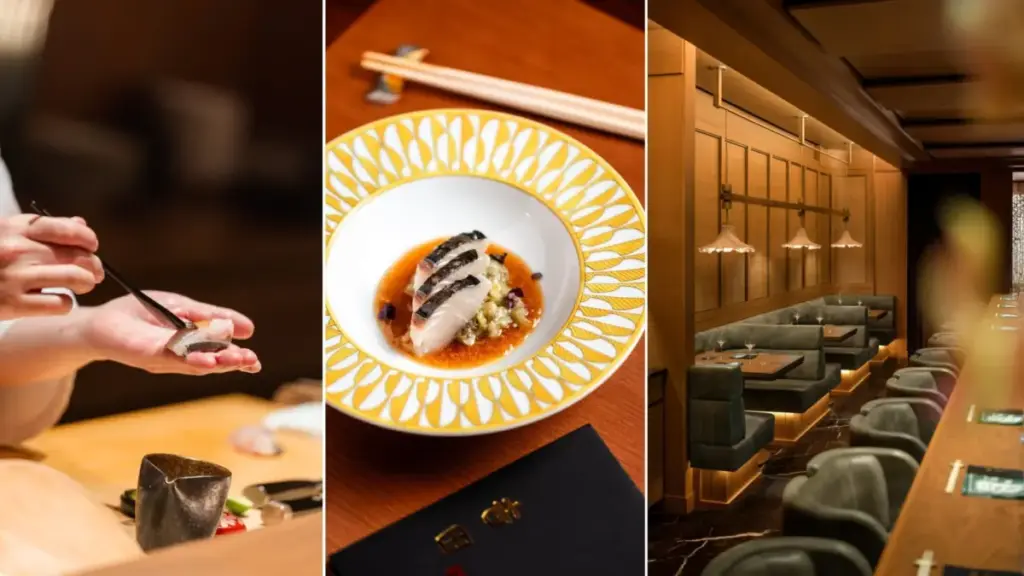
While Zuma captures high-energy social dining, Yoshida Omakase serves as its refined, quiet luxury counterpart. Designed by architect David Rockwell, the interior functions as a Deco-inflected jewel box featuring woven wood paneling, ribbed glass, fluted mirrors, and hand-painted rice field artwork, down to the use of Hermès tableware. It stands as one of the most visually stunning dining rooms in the city, providing an appropriate backdrop for Chef Tony Cao’s Edomae-style preparations, which utilize authentic ingredients and precise dry-aging techniques to highlight the natural flavors of the fish.
Three 1 One
Concealed behind an unassuming door on the ground floor of a South End brownstone, Three 1 One operates as an intimate omakase counter that achieved significant acclaim last year by earning the city’s sole Michelin star. Chef-proprietor Wei Fa Chen trained under renowned chef Masa Takayama at New York City’s Masa before establishing the ten-seat counter in Boston, quickly transforming it into one of the most exclusive reservations in town. The 18-course journey commences with inventive appetizers, such as tilefish featuring signature crispy fried scales, before transitioning into traditional sushi anchored by rare and specialized cuts of fish.

Uni
Long before the current wave of omakase counters swept through Boston, Uni was pushing culinary boundaries from its subterranean location beneath the Eliot Hotel in Back Bay. The restaurant has historically embraced a creative interpretation of Japanese cuisine, exemplified by its signature "Uni spoon," a decadent pairing of creamy sea urchin and briny caviar. While unconventional, the approach is undeniably inventive, and the kitchen’s legacy is further underscored by the number of Boston sushi chefs who received their formative training within its walls.
Somenya
Operating locations in Boston’s Chinatown and Quincy’s Wollaston Square area, Somenya has cultivated a loyal local following by offering an approachable and moderately priced menu. While the kitchen specializes in soba and udon, its comprehensive selection of izakaya and sushi dishes allows diners to sample a broad spectrum of flavors. Offering items such as scallop sashimi with salmon roe and yuzu alongside torched salmon maki rolls at accessible price points, Somenya pairs its raw bar options with comforting bowls of karaage chicken and beef curry udon.

Washoku Renaissance
Tucked away inside Foundation Kitchen—a shared commercial kitchen and food hall space in Sullivan Square—Washoku Renaissance operates as an unassuming yet remarkable omakase counter in Charlestown. Led by Chef Youji Iwakura, the eight-seat operation focuses on traditional kaiseki, emphasizing multi-course seasonality and artistic presentation. By blending imported Japanese products with local New England catches, the hidden counter offers an exceptional fine-dining experience within an unexpected industrial setting.
Fuji at High Street Place
Located inside the bustling High Street Place food hall, Fuji proves that exceptional sushi does not require a formal, high-priced dining room. The menu ranges from classic nigiri and sashimi to elaborate specialty creations like the High Street Roll, which combines tuna belly, salmon belly, uni, and fresh truffle. Accompanied by multiple varieties of uni and a curated selection of Japanese whisky and sake, Fuji offers a casual yet high-quality alternative for diners on the go.

Blue Ribbon Sushi
Situated on the ground floor of the Hotel Commonwealth in Kenmore Square, Blue Ribbon Sushi demonstrates the enduring appeal of meticulous Japanese preparation in a bustling neighborhood. The establishment’s success rests on fundamental details, including scratch-made miso soup, hand-grated wasabi, house-pickled ginger, and proprietary soy sauce aged in oak casks for two years, providing a reliable destination for both locals and visitors catching events at nearby Fenway Park.
Tora Japanese Restaurant
Opened in Chinatown in 2017, Tora caters directly to fish aficionados seeking straightforward execution over pomp and circumstance. While standard nigiri and maki rolls are readily available, the restaurant’s focal point is its kaisen-don rice bowls laden with assorted raw fish. The kitchen also ventures into creative preparations, offering grilled yellowtail collar and hamachi sashimi drizzled with sesame dressing and a hint of truffle oil, alongside poke bowls and hot entrées like broiled eel over rice.

Lola 42
Operating as a sister restaurant to Nantucket’s Lola 41, Lola 42 embraces a global philosophy centered broadly on cuisines along the 41st parallel. The menu transcends traditional boundaries, pairing specialty sushi with international dishes such as Korean beef bulgogi, cavatelli bolognese, and lobster fried rice, reflecting the modern evolution of American sushi culture.
Matsunori
Tailored to the fast-paced environment of the Fenway neighborhood, Matsunori operates on a no-reservations model centered around made-to-order hand rolls served individually to ensure the nori remains crisp. Despite the casual format, the kitchen maintains rigorous standards, sourcing exceptional ingredients including A5 wagyu directly from co-owner Kevin Liu’s family farm in Miyazaki, Japan.

Akami Omakase
Located in Coolidge Corner within neighboring Brookline, Akami Omakase offers an unpretentious omakase counter that prioritizes accessibility and value. Featuring multi-course tasting menus at approachable price points, the intimate dining room maintains a chef-led focus on ingredient progression, blending occasional modern techniques like blow-torched touches with a predominantly old-school philosophy.