



The rapid evolution of the fresh pet food market has transformed how dog owners approach nutrition, presenting a clear choice between two primary storage and delivery models: gently cooked frozen food shipped to the door, and steam-cooked refrigerated food purchased off store shelves. While both options prioritize real meat, fresh vegetables, and complete nutrition over traditional dry kibble, the practical differences between frozen delivery and refrigerated retail shape every aspect of a dog owner’s daily feeding routine.
At the center of this evolving landscape are Freshpet, the long-standing market leader visible in retail refrigerator cases across North America, and Get Real, a line launched by e-commerce giant Chewy in September 2025. Both brands cater to the rising demand for fresh, cooked meals, yet they rely on fundamentally different supply chains, storage mechanics, and product philosophies. Understanding how these structural differences play out in daily life helps clarify which feeding system best suits a given household and pet profile.
Get Real vs. Freshpet at a Glance
While both brands center their recipes on real meat proteins and fresh vegetables, the way each reaches a dog’s bowl dictates household storage, meal planning, and shopping habits.
Get Real relies entirely on a frozen direct-to-consumer model. Formulated with certified pet nutritionists and made using human-grade ingredients, each meal is gently cooked, frozen immediately to preserve freshness, and delivered in insulated packaging directly through Chewy’s subscription network. Because it remains frozen until needed, Get Real allows pet owners to store extended supplies without taking up daily refrigerator shelf space.
Freshpet, by contrast, pioneered the refrigerated pet food aisle in traditional brick-and-mortar stores. Steam-cooked at the company’s dedicated manufacturing facilities, Freshpet products are kept continuously chilled throughout their journey from factory to retail refrigerator. Available at major grocery chains, pet specialty stores, and big-box retailers—as well as through the company’s direct delivery service—Freshpet functions much like fresh human groceries, requiring immediate refrigeration upon purchase and adherence to printed sell-by dates.

Nutritiously, both brands overlap significantly. Each line is fully cooked rather than raw, uses animal proteins and vegetables as primary ingredients, and offers recipes formulated to meet complete and balanced dietary standards. However, key variations emerge in ingredient complexity, format choices, shelf life, and retail accessibility.
Frozen Fresh vs. Refrigerated Fresh: The Core Difference
The distinction between frozen fresh food and refrigerated fresh food begins on the production line and dictates how long meals stay fresh, where they are stored, and how much advance planning feeding requires.
Get Real’s frozen supply chain starts with gentle cooking, after which portions are packaged and rapidly frozen. Orders ship packed in dry ice, maintaining solid freezing throughout transit. Once received, unopened packages can remain in a home freezer indefinitely until ready for use. To serve, pet owners transfer packs to the refrigerator, where thawing takes between 12 and 24 hours for standard 5-ounce and 12-ounce packages, and up to 35 to 48 hours for larger 24-ounce packs. Once completely thawed, Get Real recipes must be consumed within three to five days. This freeze-and-thaw cycle pauses the freshness timeline, giving owners total control over when a pack’s shelf-life clock begins ticking.
Freshpet takes the uninterrupted cold-chain route. Its recipes are steam-cooked and rely on continuous refrigeration rather than freezing or chemical preservatives to maintain food safety. Unopened Freshpet packages remain fresh in the home refrigerator until the manufacturer’s sell-by date. Once opened, products like Freshpet’s Slice & Serve rolls or bagged meals generally need to be used within seven days, though select specialty offerings carry a tighter five-day limit. While Freshpet acknowledges that owners can freeze unused portions if necessary, the company notes its recipes are optimized to be served fresh directly from the fridge.
This operational divide means frozen fresh food prioritizes long-term inventory control and delivery ease, while refrigerated fresh food emphasizes immediate grab-and-serve convenience straight from the grocery aisle.
Freshpet: Market Presence, Product Lines, and Retail Distribution
Freshpet has established an extensive physical footprint across North America, housing its products in branded refrigerators inside major retail outlets, including PetSmart, Petco, Walmart, Target, Kroger, Publix, Costco, and Whole Foods Market.
The company operates dedicated, wholly owned manufacturing plants in Bethlehem, Pennsylvania, and Ennis, Texas. According to published corporate specifications, Freshpet recipes are guided by a specialized Nutrition Council that includes board-certified veterinary nutritionists. The brand emphasizes formulas built around real poultry, beef, and fish, combined with whole fruits and vegetables, while avoiding artificial or chemical preservatives.
Freshpet organizes its portfolio across several distinct product lines catering to diverse preferences and dietary requirements:
- Freshpet Select: The brand’s foundational line, featuring widely distributed Slice & Serve rolls, multi-protein sliced meals, and specialized puppy formulas.
- Freshpet Vital: A premium line sold primarily in pet specialty stores, focused on simplified ingredient lists, all-life-stages nutrition, and targeted puppy recipes.
- Homestyle Creations: Gently prepared recipes offering customized meal building through standalone proteins, grain-inclusive mixes, and fresh vegetable toppers.
- Healthy Mixers: Formulated specifically to complement existing meals, offering texture and flavor variation for kibble-fed dogs.
The flagship Slice & Serve roll format remains one of Freshpet’s defining features, allowing owners to cut customized portions from a concentrated log of cooked food. In addition to retail store availability, the brand offers Freshpet Delivery, a direct-to-home service providing custom-portioned meal plans for households seeking home delivery without switching to a frozen format.
Get Real: Chewy’s Direct-to-Consumer Fresh Food Strategy
Introduced in September 2025, Get Real represents Chewy’s entry into the gently cooked fresh dog food category. Available exclusively through Chewy’s online platform in select markets, Get Real operates on a streamlined philosophy: minimal ingredients, human-grade standards, and subscription convenience.
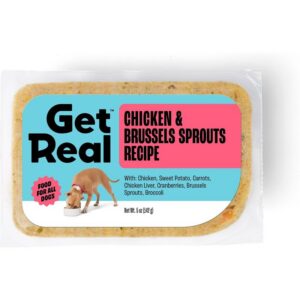
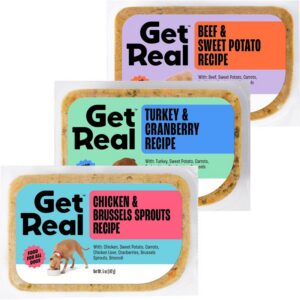
Every Get Real recipe adheres to a strict formulation limit of 10 primary ingredients or fewer, supplemented by essential vitamins and minerals. The initial product lineup focuses on three targeted recipes:
- Chicken & Brussels Sprouts Recipe: A lean protein formulation paired with green vegetables for daily maintenance.
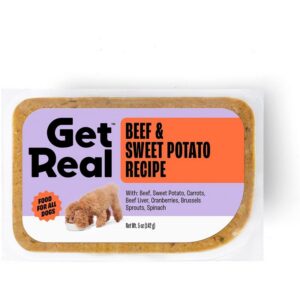
- Beef & Sweet Potato Recipe: A nutrient-dense option incorporating beef, sweet potato, carrots, and nutrient-rich beef liver.
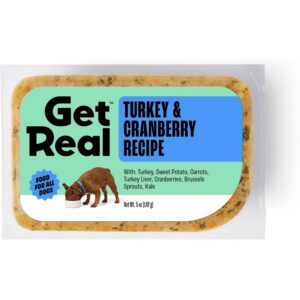
- Turkey & Cranberry Recipe: A wholesome poultry alternative blended with cranberries and essential micronutrients.
All three Get Real formulations meet the Association of American Feed Control Officials (AAFCO) nutrient profiles for all life stages, explicitly including the growth of large-breed dogs expected to weigh 70 pounds or more as adults. This allows a single recipe to support a puppy through adult maintenance without requiring a dietary transition.
Get Real packages its food in three functional sizes: a 5-ounce mixer pack tailored for kibble topping, along with 12-ounce and 24-ounce full-meal packs. Meals are ordered through Chewy’s automated subscription service, allowing owners to customize delivery schedules, adjust volume, or pause orders directly within their main Chewy account alongside daily supplies like treats, toys, and medications. For dogs trying the brand for the first time, a sampler pack featuring two packages of each core recipe is available to assess palatable preferences before committing to a full plan.
Recipe Profiles and Nutritional Breakdown
Nutritional analysis reveals how each brand approaches macronutrient balance, ingredient sourcing, and recipe complexity.
Get Real publishes detailed guaranteed analyses and exact caloric counts for all its offerings. Across its three main recipes, guaranteed analysis figures per 12-ounce pack illustrate balanced profiles:
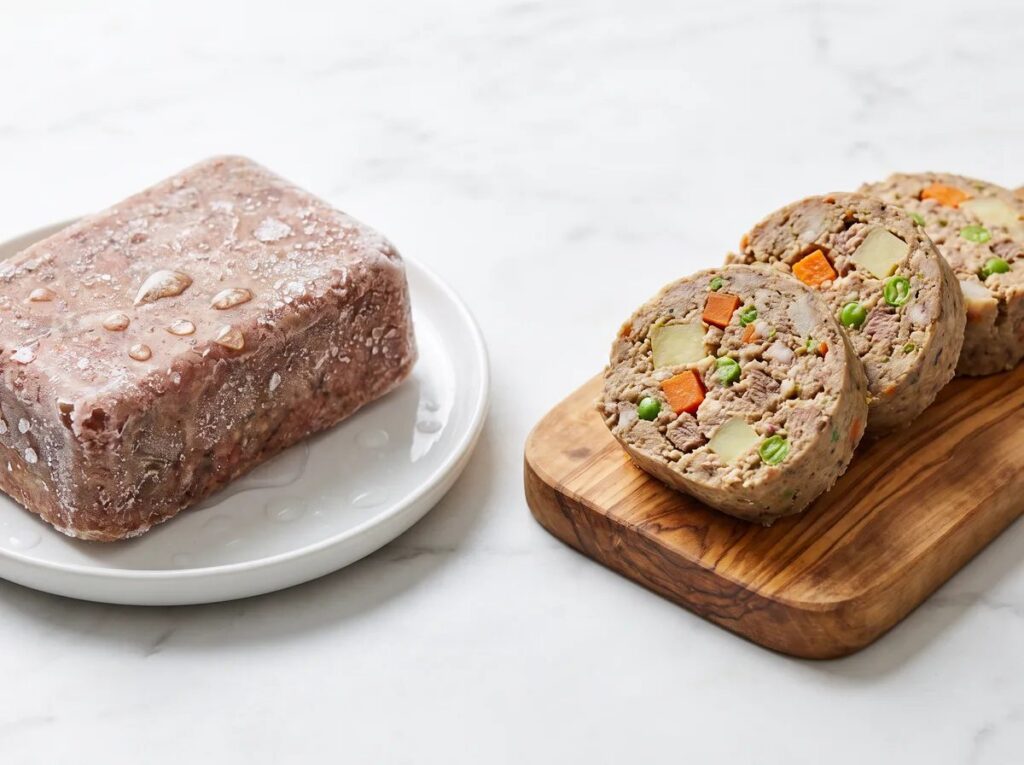
The Chicken & Brussels Sprouts Recipe contains a minimum of 10 percent crude protein and 8.5 percent crude fat, with maximum limits of 1 percent crude fiber and 75 percent moisture, providing 428 kilocalories per 12-ounce pack.
The Beef & Sweet Potato Recipe delivers a minimum of 9 percent crude protein and 7 percent crude fat, capped at 1.5 percent fiber and 75 percent moisture, yielding 451 kilocalories per pack.
The Turkey & Cranberry Recipe offers a minimum of 8 percent crude protein and 10 percent crude fat, with maximums of 1 percent fiber and 75 percent moisture, totaling 474 kilocalories per pack.
Get Real’s simple ingredient lists make protein tracking and allergen management straightforward. For instance, its beef recipe leads directly with beef, sweet potato, carrots, and beef liver, followed by cranberries, Brussels sprouts, spinach, sunflower oil, salmon oil, and a balanced vitamin-mineral premix.
Freshpet provides a much broader variety of nutritional profiles due to its expansive catalog. Options span grain-free formulas, grain-inclusive recipes utilizing brown rice or oatmeal, single-protein rolls, and multi-protein shredded bags. Because ingredient lists vary significantly between product lines—such as a Vital grain-free roll versus a Select grain-inclusive recipe—owners analyzing Freshpet must evaluate guaranteed analysis statements package by package.
Feeding Options: Full Meals, Toppers, and Calorie Management
Both Get Real and Freshpet accommodate dogs eating 100 percent fresh food diets as well as dogs using fresh food as a meal enhancement. However, their packaging formats handle these feeding styles differently.
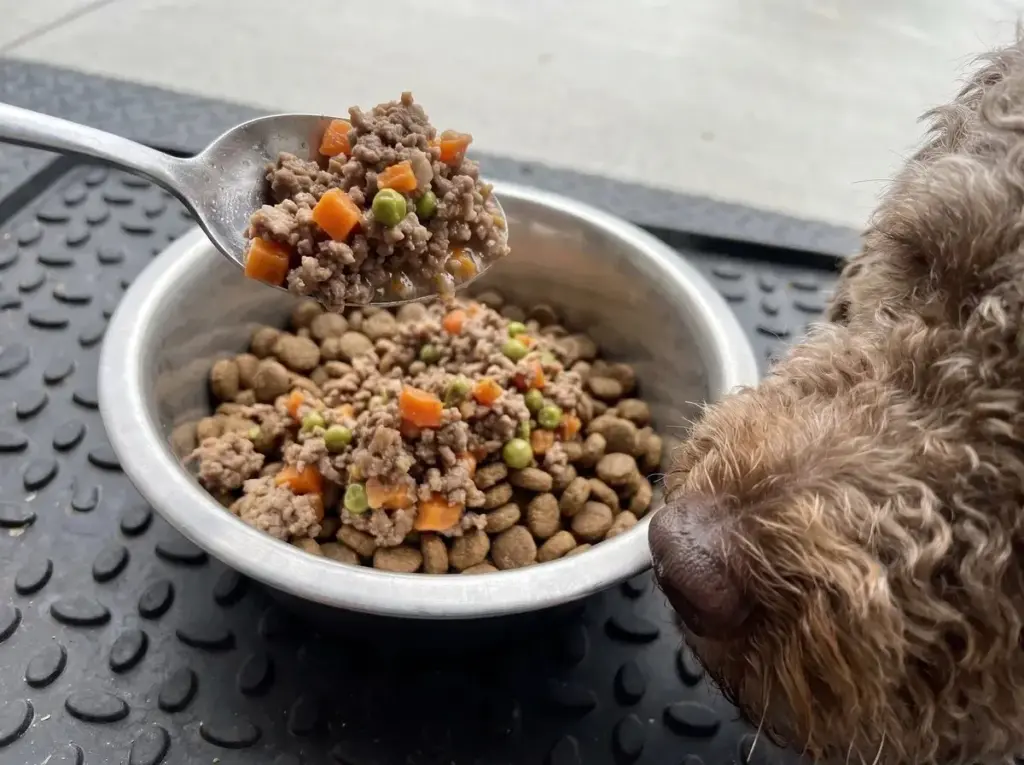
Get Real incorporates topping directly into its packaging design. The dedicated 5-ounce mixer pack is measured specifically to top or mix into dry kibble, eliminating the need to measure out small portions from larger containers. For full-meal feeders, the 12-ounce and 24-ounce packs align with daily recommended caloric intakes calculated during Chewy’s subscription setup based on the dog’s age, weight, activity level, and breed.
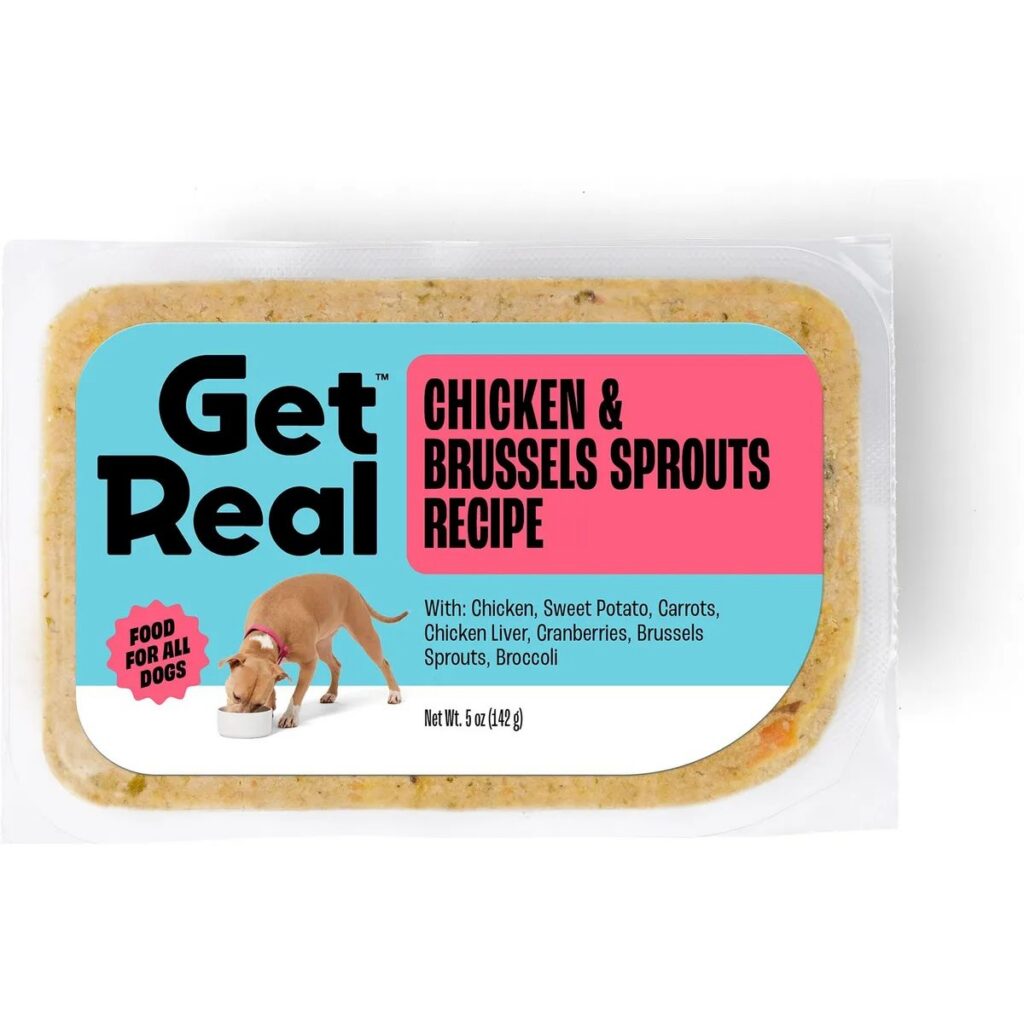
Freshpet handles toppers through its Healthy Mixers line or by slicing smaller portions from its standard rolls and bagged meals. Because Freshpet rolls are packaged as solid logs, owners must manually slice and weigh portions to calculate proper daily feeding amounts.
Regardless of which brand is chosen, integrating fresh food into a dog’s routine requires careful caloric budgeting to avoid unintended weight gain. When adding a topper, owners should reduce the dog’s primary kibble intake by an equivalent caloric amount. For example, adding a 5-ounce Get Real Beef & Sweet Potato mixer (188 kilocalories) requires deducting approximately 188 kilocalories—roughly half a cup of standard dry kibble—from the dog’s daily bowl.
Dietary changes should always be made slowly. Both veterinary experts and manufacturer guidelines recommend transitioning to a new fresh food over a period of seven to ten days. Sensitive dogs benefit from an extended 10-to-14-day timeline. Owners should start by mixing a small portion (roughly 25 percent) of the new fresh food with the current diet, gradually increasing the ratio every few days while monitoring stool consistency, appetite, and overall energy.
Storage, Shelf Life, and Handling Guidelines
Managing fresh dog food requires strict adherence to safe food handling and cold-chain maintenance at home.
For Get Real, insulated shipping boxes containing dry ice must be unpacked immediately upon arrival. Frozen packages should be placed directly into the freezer. To thaw, packs should sit in the main compartment of the refrigerator for 12 to 24 hours for smaller sizes, or 35 to 48 hours for 24-ounce packs. Once thawed, food must remain refrigerated and be fully consumed within three to five days. If a pack thaws partially during shipping but remains at or below 40 degrees Fahrenheit, it can safely be placed back in the freezer or kept in the fridge. Any package left at room temperature for more than two hours should be discarded.
Freshpet products must go directly into the refrigerator immediately after purchase. Unopened rolls and bags remain safe until the printed sell-by date. Once the package seal is broken, standard rolls and bagged meals should be fed within seven days, while select specialized line items carry a five-day limit. Freshpet recommends keeping opened rolls tightly wrapped in their original casing or stored in an airtight container to prevent drying and maintain flavor.
Homes with ample freezer storage often find the frozen model more manageable, as bulk shipments can sit frozen for weeks without cluttering the main refrigerator. Conversely, homes with limited freezer capacity but routine weekly store runs often benefit from the immediate usability of refrigerated products like Freshpet.
Matching the Brand to the Routine: Household Dynamics and Pet Needs
Deciding between Get Real and Freshpet ultimately comes down to household convenience, shopping preferences, storage availability, and specific pet health requirements.
Get Real offers a strong fit for pet owners who:
- Prefer automated direct-to-home delivery bundled into an existing Chewy account.
- Have dedicated freezer space to store multi-week meal supplies.
- Seek simple, limited-ingredient formulas (10 ingredients or fewer) for easier digestion management.
- Want an AAFCO all-life-stages diet that accommodates large-breed puppies through adulthood without formula changes.
- Prefer pre-portioned 5-ounce topper packs to avoid manual slicing or measuring.
Freshpet presents an ideal choice for pet owners who:
- Prefer purchasing pet food during regular, local grocery or pet store shopping trips.
- Have limited freezer space but consistent refrigerator room for weekly use.
- Value a wide variety of formats, including sliced rolls, grain-inclusive options, and specialized small-dog formulas.
- Want immediate, grab-and-serve convenience without waiting for frozen food to thaw.
- Desire localized, off-the-shelf access without relying on shipping carriers or delivery schedules.
Whether opting for Chewy’s frozen delivery model or Freshpet’s refrigerated retail presence, transitioning to gently cooked fresh food offers high digestibility, high palatability, and real-food nutrition. Evaluating home storage space, meal preparation habits, and dietary goals ensures a smooth transition that keeps both dog and owner satisfied.