
By Alexandra Gillespie
Updated November 12, 2026
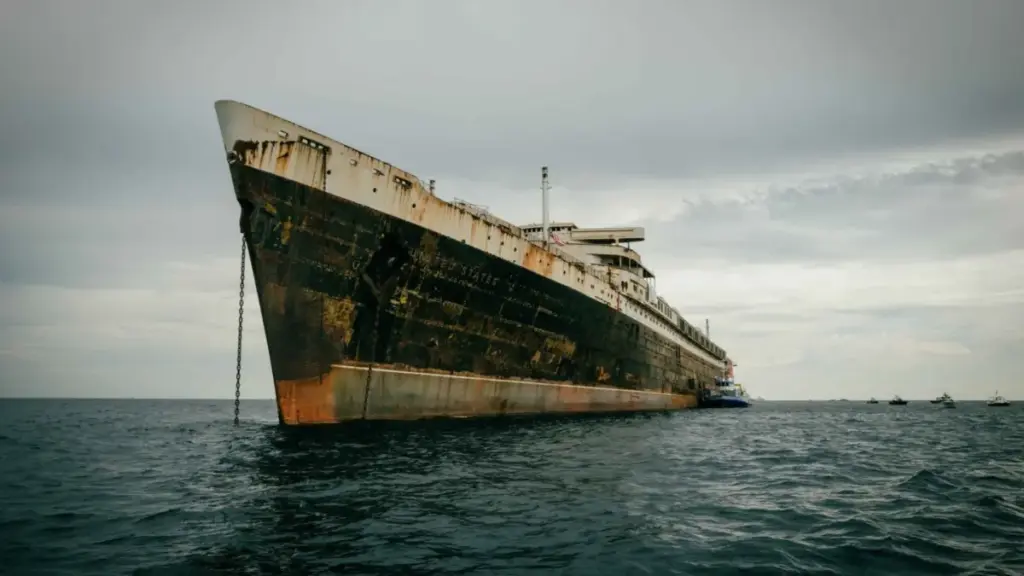
As it turns out, it takes a monumental effort to sink a 990-foot ocean liner that was once the pride of the American maritime fleet.
The SS United States was originally scheduled to begin its descent into the Gulf of Mexico at 1 p.m. Central Time on Wednesday, November 11. However, last-minute preparations and safety checks pushed that timeline back to nearly 5 p.m. By 4:45 p.m., every valve was wide open, and the waters of the Gulf began pouring into the cavernous hull. What followed was four more hours of tense watching as the historic ship stubbornly refused to leave the surface. She finally slipped beneath the waves at 8:59 p.m., resting twenty-two nautical miles southwest of Destin, Florida, while tilting hard to her port side.
From a nearby spectator boat, witnesses watched the fastest ocean liner ever built make the slowest exit imaginable. On her maiden voyage back in 1952, she shattered the Queen Mary’s transatlantic record by roughly ten hours, capturing the coveted Blue Riband for the United States for the first time since 1892. On Veterans Day, more than seven decades later, the iconic ocean liner needed approximately four hours just to submerge completely.
With this deliberate and controlled scuttling, the SS United States officially becomes the world’s largest artificial reef. In doing so, she surpasses the USS Oriskany, an aircraft carrier that had held the prestigious title since its own purposeful sinking in 2006. This dramatic underwater transformation marks a complex second life for the vessel—part marine habitat restoration project and part high-stakes tourism bet—following years of failed commercial rescue plans, mounting financial pressures, and a contentious last
-minute legal battle.
The World’s Largest Artificial Reef Now Rests Off Florida
The decision to scuttle the vessel off the Florida Panhandle comes down to a calculated combination of marine habitat creation and regional tourism development. The seafloor off Destin and Fort Walton Beach consists predominantly of sand and shell, leaving natural reef structures remarkably scarce. To address this, the Okaloosa County tourism department laid out an ambitious five-year, $12 million strategic plan designed to establish Destin-Fort Walton Beach as the undisputed dive capital of Florida. A portion of this funding is derived directly from tourist-development tax revenue, supplemented by regional partnerships with entities such as Visit Pensacola and the Coastal Conservation Association’s Florida chapter, which signed on to support a multiyear marketing campaign promoting the sunken liner as a premier global diving destination.

Furthermore, the SS United States is slated to join the established Florida Panhandle Shipwreck Trail. Originally created by the state in 2012 to stimulate local tourism in the wake of the devastating Deepwater Horizon oil spill, the trail began with twelve historic wrecks situated off Pensacola, Destin, Panama City, and Port St. Joe. It has since expanded to include more than twenty wrecks, encouraging visiting divers to collect passport-style stickers at each designated site. These large vessels form part of a broader local initiative that has seen the county sink 48 large vessels since the 1970s to bolster marine life and recreational diving opportunities.
The SS United States now rests upright on the sandy seafloor in approximately 180 feet of water. Early sonar scanning indicates that she landed evenly, placing her upper decks roughly 50 to 60 feet beneath the surface. According to county officials, this depth profile ensures that recreational divers of varying skill levels will be able to safely explore her upper decks.
Why Was the SS United States Sunk Off Florida?
The journey of the SS United States to the bottom of the Gulf of Mexico is the culmination of decades of deferred preservation dreams. While maritime enthusiasts and preservationists once nurtured grand visions of converting the 990-foot icon into a floating hotel, convention center, or museum, the ship steadily deteriorated over the years until civic leaders and owners faced a stark binary choice: the scrapyard or an artificial reef.
The majestic liner was abruptly withdrawn from active passenger service in 1969 amid shifting economic realities in transatlantic travel. She subsequently spent nearly thirty subsequent years docked at a pier in Philadelphia, where a succession of potential buyers and investors failed to secure the necessary capital to repurpose her vast interior.
For decades, various owners hunted for a viable second act for the ship. In 2016, Crystal Cruises conducted a comprehensive feasibility study exploring a potential return to active sea service, ultimately concluding that the engineering and regulatory obstacles were insurmountable. By the time a legal rent dispute resulted in an official eviction order requiring the historic ship to vacate its Philadelphia berth by late 2024, the nonprofit SS United States Conservancy stated it was left with only two feasible paths forward: scrapping or intentional reefing. Although preservationists steadfastly argued that transforming the ship into a land-based museum remained a viable alternative, the conservancy ultimately sold the deteriorating liner to Okaloosa County, Florida, for $1 million.
To prepare the vessel for scuttling, Okaloosa County invested more than $13 million covering complex environmental remediation, towing operations, marine insurance, deployment logistics, and financial contributions toward a planned land-based museum dedicated to preserving the history of the ocean liner. County leadership has vigorously defended the expenditure, framing the project as both a vital environmental asset and a sound economic development opportunity. Local tourism officials have projected that the community will recoup its financial investment within just a couple of years through heightened dive tourism.
However, the path to the seafloor was fiercely contested. A last-minute lawsuit nearly derailed the sinking operation when the SS United States Preservation Foundation filed an emergency federal lawsuit against the Army Corps of Engineers in Pensacola. The plaintiffs argued that the federal agency failed to adequately evaluate the potential environmental hazards posed by the ship’s toxic marine coatings under federal environmental protection laws. Three days prior to the scheduled scuttling, a federal judge denied the emergency request for an injunction, citing a lack of a formal affidavit and the prohibitive financial costs associated with halting the meticulously planned operation. An earlier, separate legal challenge brought by a New York advocacy group had already been dismissed by the courts in 2025.

Is Sinking a Ship Good for the Environment?
Environmental considerations surrounding the scuttling of large naval and commercial vessels have long been a subject of intense debate among marine scientists, preservationists, and regulatory agencies. When executed according to rigorous environmental protocols, sinking a properly cleaned vessel can provide a stable physical foundation for new marine ecosystems, offering shelter and substrate for fish and other ocean-dwelling organisms.
Ahead of the deployment, specialized maritime crews thoroughly drained and cleaned the fuel tanks of the SS United States, and no explosives were utilized during the scuttling process. County representatives reported that approximately 99 percent of the Polychlorinated Biphenyls (PCBs)—toxic chemical compounds historically found in heavy industrial paints and sealants—were successfully removed from the vessel prior to sinking, though independent verification of that exact figure by outside watchdogs has been a point of discussion.
A central environmental question has focused on the ship’s old zinc-chromate primer, which contains hexavalent chromium. Preservationists who fought to keep the ship topside warned that the compound would inevitably leach into the marine environment. Conversely, county officials and supporting environmental scientists noted that hexavalent chromium typically converts underwater into a less toxic, stable form. A Drexel University oceanographer characterized the environmental risk as somewhat overblown, while acknowledging that continuous monitoring remains prudent.
The nearby USS Oriskany serves as a prominent historical precedent for such artificial reef projects. While the aircraft carrier quickly transformed into a thriving marine habitat teeming with fish and coral growth, long-term environmental monitoring programs also detected elevated PCB concentrations in certain resident fish populations near the wreck, underscoring the complexities inherent in repurposing historic industrial structures as underwater reefs.
How Do Artificial Reefs Help Marine Life?
The ecological evolution of an artificial reef follows a predictable biological sequence. Algae, barnacles, and encrusting sponges settle onto the bare steel surfaces first, creating a foundational layer that attracts stony corals, small reef-dwelling fish, and eventually larger predatory marine species. To measure this biological progression scientifically, researchers from the Woods Hole Oceanographic Institution have deployed a long-term monitoring initiative tracking approximately 132 tagged observation points across the wreck, with the overarching goal of gathering a decade of continuous ecological data.
Marine biologists continue to debate whether artificial reefs genuinely generate new fish populations or simply concentrate existing marine life from surrounding areas for recreational and commercial anglers. Existing research concerning Gulf red snapper populations leans toward true habitat creation, though much of that data originates from decommissioned oil and gas platforms and smaller artificial reefs rather than a single massive ocean liner.
Scientists emphasize that this deployment represents the creation of an entirely new marine habitat rather than the restoration of a damaged natural ecosystem. Because the ship was deliberately placed on a seabed composed primarily of sand and shell, no existing natural reef habitats were disturbed or destroyed during the scuttling process.

What Happens Next?
While the vast majority of the historic ship now rests on the floor of the Gulf of Mexico, select components were salvaged for public exhibition. The vessel’s two signature sixty-five-foot aluminum funnels, one of its massive bronze propellers, and its radar mast were preserved and transported to land, destined for display at a dedicated museum facility near Destin. Everything else now belongs to the dynamic marine environment of the Gulf.
Although maritime enthusiasts and local divers gathered with the hope of exploring the wreck within its first twenty-four hours on the seafloor, rough sea conditions that originally prompted the expedited sinking timeline also kept dive boats out of the water. Local charter operators and visiting divers are preparing to descend upon the site as soon as safety clearance is granted by dive masters, leaving the coveted title of the vessel’s very first recreational visitor still up for grabs.
How to Dive the SS United States
The exact date when recreational divers will be granted official access to the new dive site depends entirely on final safety sweeps conducted by professional technical divers who must clear the wreck of any residual hazards before general access is permitted.
Local charter operations in the Florida Panhandle have expressed optimism about running trips to the site, with outfitters like Niuhi Dive Charters reporting inquiries from certified divers around the world. Because the vessel’s top deck rests at an anticipated depth of 50 to 60 feet, the site is theoretically accessible to divers holding a standard Open Water certification. However, marine professionals suggest that an Advanced Open Water certification—which extends recreational depth limits—provides a more versatile experience for exploring the upper superstructure.
Wreck diving and Nitrox specialty certifications are widely recommended additions for those planning to explore the upper decks in greater detail. Meanwhile, the deeper internal passageways and lower levels of the massive hull remain strictly the domain of highly trained technical divers equipped with specialized decompression and trimix training.
Trips to the site require a full-day offshore excursion. Located approximately twenty-two nautical miles southwest of Destin-Fort Walton Beach, the artificial reef is most easily accessed via charter boats launching from Destin ports, such as those operated by Niuhi Dive Charters and ScubaTech Destin aboard vessels like the Sea Cobra.