


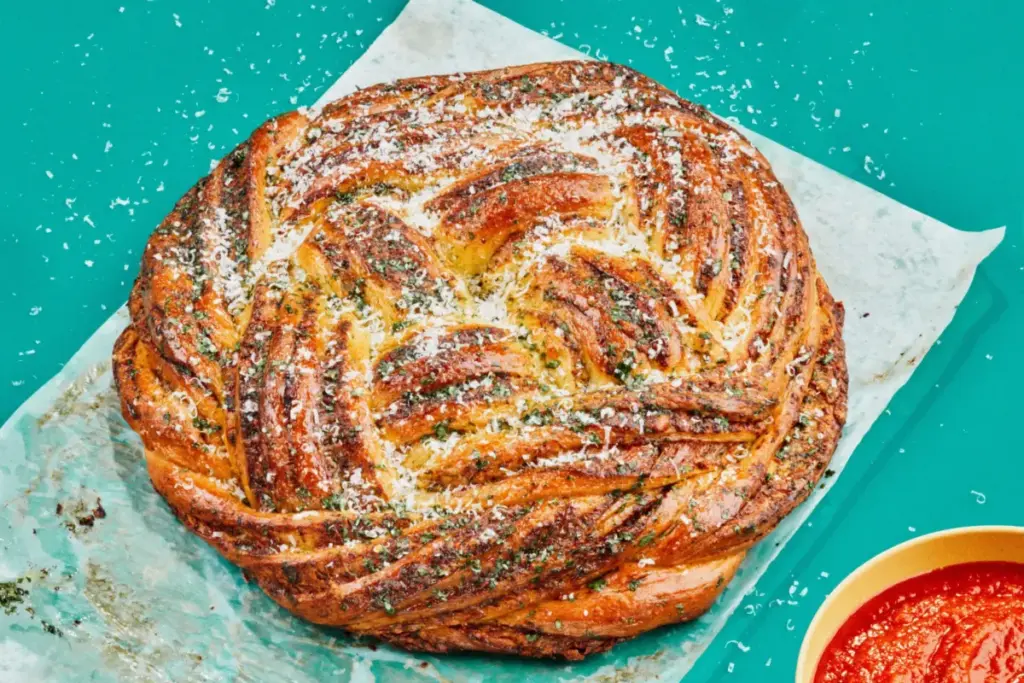
In the ever-evolving landscape of modern baking, traditional boundaries continue to blur as bakers experiment with classic formats by introducing unexpected flavor profiles. Among the most compelling developments in contemporary artisanal baking is the transformation of traditionally sweet breakfast pastries into rich, savory centerpieces. A prime example of this culinary crossover is the savory garlic and Parmesan babka, a sophisticated yeast-raised bread that merges the intricate, laminated twisting technique of Eastern European baking with the robust, aromatic elements of Italian-American garlic bread.
This ambitious baked good requires patience, precision, and an appreciation for foundational bread-making techniques. Far from a casual weeknight project, the creation of a savory babka demands careful attention to dough development, precise butter incorporation, and an intricate shaping process that results in a visually striking, golden-brown loaf dripping with melted cheese, herbaceous parsley, and pungent garlic.
Crafting the Enriched Dough Foundation
The process begins with the creation of an enriched dough, which serves as the sturdy yet tender vehicle for the heavy garlic and cheese filling. Bakers start by whisking together dry ingredients in a large mixing bowl, combining one and a quarter ounces of instant dry yeast, a quarter cup of sugar, kosher salt—specifying either two teaspoons of Diamond Crystal or one and a quarter teaspoons of Morton kosher salt—and four cups of all-purpose flour.
In a separate small bowl, two large eggs are beaten with one cup of warm water until fully combined. This liquid mixture is then poured directly into the dry ingredients. To build the rich, brioche-like crumb characteristic of babka, ten tablespoons of unsalted room-temperature butter are added to the bowl. Using a sturdy rubber spatula or clean hands, the mixture is worked until a shaggy dough forms, a process that typically takes six to eight minutes of initial combining.
Once the shaggy mass comes together, it is covered with a lid or plate and allowed to rest for ten minutes. This crucial resting period allows the flour to fully hydrate and relaxes the gluten network, making the subsequent kneading phase significantly easier.
The rested dough is then turned out onto a lightly floured surface and kneaded by hand, with additional flour incorporated strictly as needed to prevent sticking. This vigorous kneading continues for eight to twelve minutes until the dough transforms into a smooth, elastic ball. The dough is returned to the bowl, covered tightly with plastic wrap, and left to rise at room temperature until it has doubled in size, which usually takes about two hours.
For home cooks looking to manage their time more efficiently, the recipe accommodates advanced preparation. The dough can be prepared a full day ahead; it is simply allowed to sit at room temperature for one hour before being transferred to the refrigerator to chill overnight.
Developing the Aromatic Filling and Assembly
While the dough rises, preparations begin for the dense, flavorful filling that defines the savory nature of the loaf. A single head of garlic is separated and peeled. Two cloves are set aside for a finishing touch later in the process, while the remaining ten cloves are transferred to the food processor.
To create the rich spread, the processor is loaded with the garlic cloves, six tablespoons of unsalted room-temperature butter, one teaspoon of garlic powder, one teaspoon of sugar, half a teaspoon of crushed red pepper flakes, six ounces of finely grated Parmesan cheese yielding about three cups, one cup of packed parsley leaves with tender stems, and an additional measure of kosher salt. The ingredients are processed just until the butter turns smooth and the parsley is finely chopped. Alternatively, bakers lacking a food processor can achieve a similar result by finely chopping the garlic and parsley by hand with a chef’s knife and thoroughly mixing them with the remaining ingredients in a small bowl.
With the filling ready, the risen dough is turned out onto a lightly floured work surface. Using a rolling pin and dusting both the dough and the surface as needed to prevent sticking, the baker rolls the dough into a roughly twenty-by-fourteen-inch rectangle, oriented with a short side facing the workspace.
An offset spatula is then employed to spread the garlic and butter mixture evenly across the surface of the dough. The sheet is cut in half lengthwise, and each resulting section is rolled tightly into a log, starting from the long side much like the procedure for making cinnamon rolls. This yields two twenty-inch-long logs. Using a serrated knife and long, gentle sawing motions, these logs are sliced cleanly in half lengthwise, exposing the marbled layers of dough and filling on the inside. If the butter and dough have become overly soft during this handling phase, chilling the logs for fifteen minutes prior to slicing is recommended to maintain structural integrity.
Weaving and Proofing the Complex Loaf
The architectural centerpiece of the baking process involves a complex weaving technique designed to showcase the layers of cheese and garlic. Two of the dough strands are laid out on a large piece of parchment paper so that they run parallel to the workspace, with the cut, filled sides facing upward and spaced slightly apart. The remaining two strands are placed perpendicularly over the first set, also facing upward and spaced apart.
The baker then weaves the strands by alternating them under and over one another. A strand resting underneath is picked up and lifted over the adjacent strand. This movement is repeated with the remaining under-strand, working counterclockwise around the center until reaching the starting point. The process is then reversed by working back around in the opposite direction, placing under-strands over again until completing the circuit. Finally, the ends are tucked underneath the loaf and pinched securely to adhere.
The assembled babka, resting on its parchment paper, is slid onto a large rimmed baking sheet. It is covered loosely with plastic wrap and left to puff up in a warm spot for about one hour, depending on the ambient temperature of the kitchen. The dough may not completely double in volume during this secondary proof. To determine if the babka is fully ready for the oven, the plastic wrap is removed, and the dough is gently poked with a wet finger. If the indentation springs back gradually and leaves a shallow mark, the loaf has reached optimal proofing.
Baking and Final Garlic Oil Infusion
An oven rack is positioned in the center of the oven, and the appliance is preheated to 375 degrees Fahrenheit. In a small bowl, one large egg is beaten with a large pinch of kosher salt to create an egg wash. Using a pastry brush, the babka is gently coated with the wash to promote a shiny, deeply browned crust.
The loaf is baked until it turns a rich golden brown, taking approximately thirty-five to forty minutes. To ensure precise doneness, an instant-read thermometer inserted into the center of the babka should register 190 degrees Fahrenheit.
Just before the babka finishes baking, the two reserved garlic cloves are finely grated into a small saucepan. Two tablespoons of extra-virgin olive oil and a pinch of kosher salt are added, and the mixture is cooked over low heat, stirring occasionally, just until the oil is warm—about two minutes. After removing the pan from the heat and allowing it to cool slightly, two tablespoons of finely chopped parsley are stirred into the infused oil.
Upon removing the babka from the oven, it is carefully slid onto a wire rack and immediately brushed with the freshly prepared garlic oil while still hot. The loaf is then topped generously with additional grated Parmesan cheese. To complete the culinary presentation, the warm savory babka is served alongside a bowl of marinara sauce on the side for dipping, offering a comforting and flavorful eating experience rooted in classic Italian-American flavor combinations executed through advanced baking craftsmanship.