


When Disney Research first unveiled its BDX bipedal robotic characters—famously dubbed Besh, Grek, and Oskar—at the Nvidia GTC conference in San Jose in March 2024, they immediately captivated audiences. Presented by Moritz Bächer under the banner of advanced bipedal character design, the droids stood out not because they performed routine automated tasks, but because of how effortlessly onlookers interacted with them. Within seconds, crowds ceased to see the complex machinery, motors, and underlying control loops; instead, they perceived distinct personalities wrapped in iconic science-fiction aesthetics.
For many robotics enthusiasts and Star Wars costuming groups, seeing the droids sparked an immediate desire to acquire one for charitable hospital visits and public appearances. While most observers admired them from afar as closed-source corporate marvels, a dedicated group of makers decided to reverse-engineer the vision. Spearheaded by software engineer Jaime Machuca and later expanded into a multi-disciplinary collaborative effort, the OpenBDX project has successfully transformed Disney’s research paper into a fully functional, open-source bipedal robot platform.
The initial inspiration came from Disney’s published academic paper detailing the design, actuation mechanics, and control strategies of the characters. While the paper provided a crucial conceptual map, it left numerous practical engineering details unresolved. Machuca began the arduous process by focusing on the mechanical design to reduce unknowns. Utilizing Shapr3D on an iPad paired with an Apple Pencil, Machuca translated the research concepts into actionable CAD layouts centered around the exact actuators outlined by Disney.
As the project grew beyond a solo endeavor, key collaborators joined to tackle its immense complexity. Mimir Reynisson brought vital hardware, firmware, and runtime expertise, designing custom printed circuit boards like the PuddleDuck chest board, which allowed Nvidia Jetson modules to seamlessly communicate with high-performance motor buses. Later, mechanical engineer Florian Bieregger joined the team to redesign crucial leg components, replacing early printed parts with CNC-machined alternatives to withstand the demanding physical stresses of bipedal locomotion.

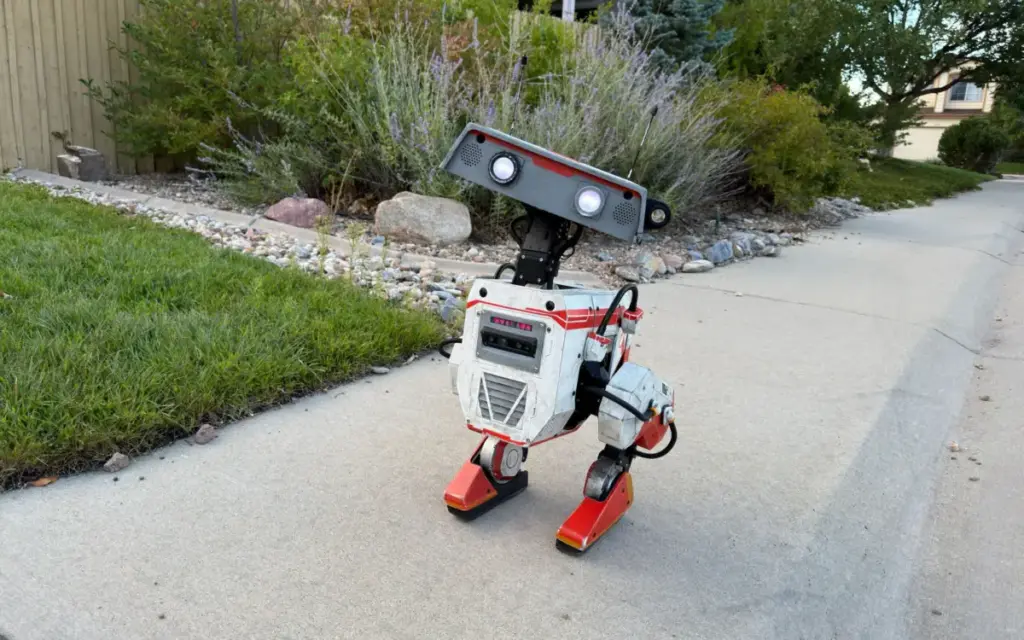
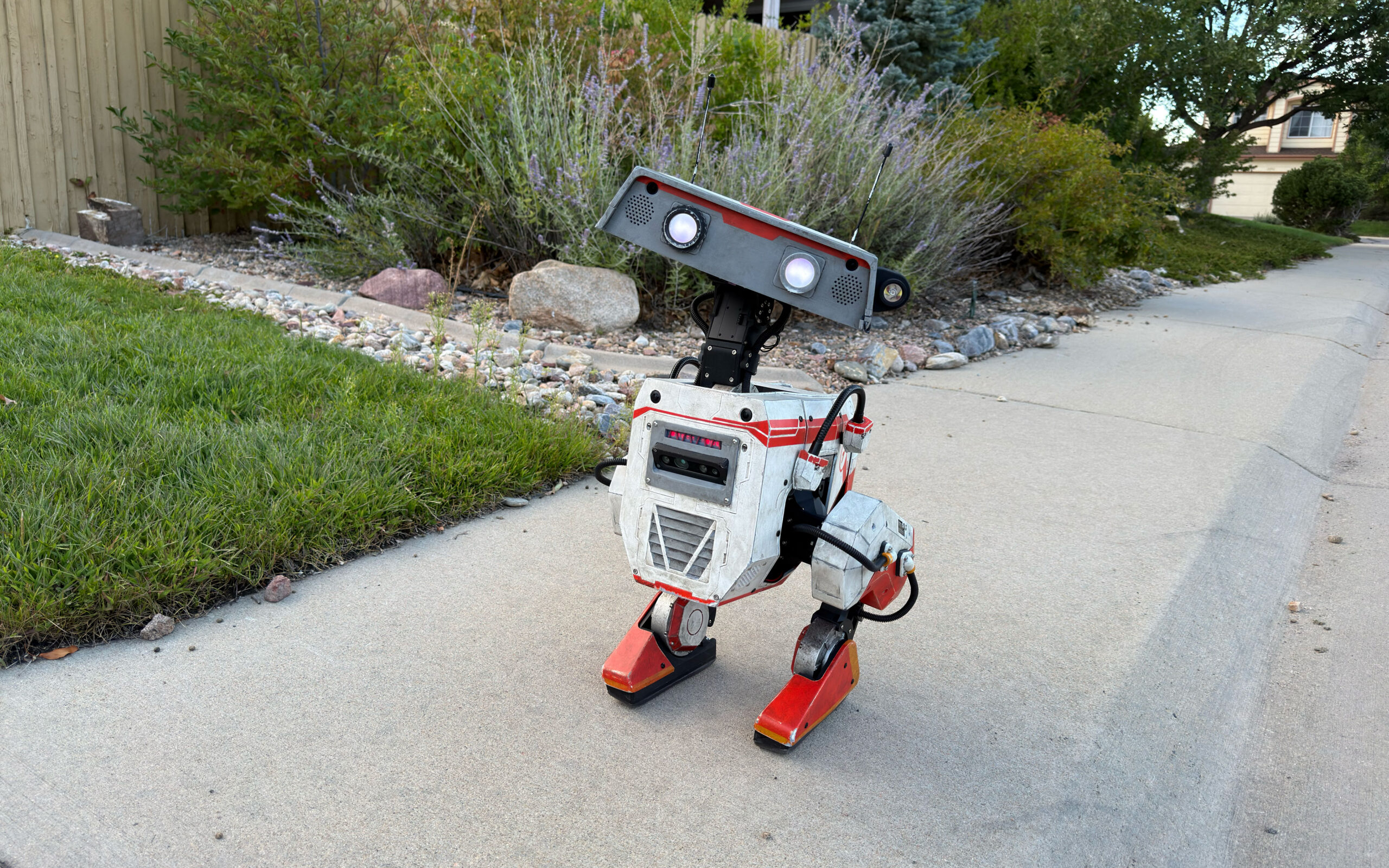
Mechanically, OpenBDX diverges sharply from traditional astromech-style droids, sharing far more in common with advanced humanoid robots. To achieve realistic movement and dynamic stability, each leg features five degrees of freedom encompassing hip yaw, hip roll, hip pitch, knee, and ankle joints. Because the feet lack a dedicated ankle roll joint, custom-angled foot pads provide passive mechanical compensation. The upper body incorporates an additional four degrees of freedom controlling neck pitch, head pitch, head yaw, and head roll, alongside micro-servos dedicated to animating the antennas.
The actuation hardware relies heavily on high-torque components, utilizing Unitree A1 motors for the knee, hip pitch, and hip roll joints, while Unitree Go-M8010-6 actuators handle the ankles, hip yaw, and neck pitch. The head relies on Dynamixel XH540 servos, and computational power is distributed across two Nvidia Jetson Orin NX modules housed independently in the chest and head, communicating via Ethernet. This dual-compute setup provides ample processing headroom for advanced perception, mapping, state estimation, and navigation stacks without compromising time-critical motor control loops.

Achieving stable bipedal walking presented the project’s most formidable hurdle. Unlike wheeled or stationary droids that can be easily teleoperated via remote control, a 14-joint bipedal robot requires continuous, synchronized coordination that is impossible for a human operator to manage manually in real time. To solve this, the OpenBDX team turned to reinforcement learning. Using simulation environments like MJLab, Isaac Lab, and Isaac Sim, developers trained walking policies through polynomial imitation references generated by proprietary gait-authoring tools.
The training pipeline incorporates rigorous domain randomization, altering physical parameters such as weight, friction, and motor response to ensure that policies trained in simulation translate effectively to the physical hardware. Once trained, the policies are exported as ONNX models and executed on the chest-mounted Jetson Orin NX via the PuddleDuck runtime. Operators issue high-level commands—such as forward velocity, lateral movement, turn rate, and body posture—while the neural network handles the complex low-level balance and joint adjustments necessary to keep the droid upright.

To enhance the robot’s expressive capabilities without disrupting locomotion, the team developed Duckmation, a dedicated timeline-based animation tool. Duckmation allows builders to choreograph intricate emotes—including body leans, head turns, antenna flicks, sound effects, eye states, and lighting changes—and layer them directly on top of live movement policies. This integration ensures that the droid can continue walking, turning, or navigating a room while simultaneously performing expressive character behaviors.
Prior to deploying new code or custom animations to physical hardware, developers utilize WaddleScope, a browser-based MuJoCo simulator and policy player. WaddleScope enables builders to test walking policies, evaluate click-to-goal navigation, and preview Duckmation emotes within a virtual environment, minimizing the risk of costly hardware damage. Furthermore, the platform allows community members to share and test policies and animations directly through web browsers, fostering a collaborative ecosystem even for enthusiasts who have yet to assemble a physical unit.

Since launching its official web hub, OpenBDX has expanded rapidly, registering over 1,300 verified users and sparking the construction of at least 25 individual droids worldwide. By providing comprehensive build guides, downloadable STL files, custom studio software, and pre-trained control policies, the project has evolved from a solitary replication attempt into a thriving global community. What began as a fleeting glimpse of advanced industrial robotics at a technology conference has successfully crossed the threshold into the maker space, proving that complex bipedal character animation is increasingly within reach of open-source engineering.