


As the returns rolled in throughout a momentous Tuesday night, an unmistakable wave of ebullience rippled through Democratic strongholds nationwide. The sheer scale of the electoral margins caught many seasoned analysts by surprise, bearing a resemblance to the massive political realignments of past generations, yet eclipsing them in raw breadth and impact.
Historical comparisons immediately surfaced among political observers. In 2006, a war-weary American electorate delivered a profound rebuke to the ruling party over the conflict in Iraq. But even that sweeping victory paled in comparison to the seismic shift witnessed on Tuesday. Going further back, the monumental gains made by Democrats in 1974—unfolding in the immediate aftermath of Richard Nixon’s resignation in disgrace—offered another touchstone. Yet, because the Democrats already commanded majorities in both chambers of Congress during that era, the structural realignment of the electorate was not quite as profound as the transformation unfolding now.
Conversely, history shows that major reversals can cut both ways. In 1994, Democrats suffered a crushing defeat that surrendered control of both congressional chambers to the opposition, though that political earthquake did little to dent the underlying popularity of Bill Clinton, who cruised to re-election two years later. Similarly, Democrats lost both chambers in 1946 following an economic recession, yet Harry Truman managed to tough out a historic re-election victory in 1948.
For the current administration, however, the political landscape offers no such path to redemption. Donald Trump’s sweeping political liabilities ultimately dragged down candidates across the board, casting a long, heavy shadow over his allies. This failure now hangs like a millstone around the neck of the vice-president as the administration heads toward an ignominious conclusion. Political analysts note that the entrenched Washington establishment—often referred to by critics as a swamp that defies standard drainage efforts—will likely see JD Vance thrashing about like a desperate mastodon, attempting to navigate hostile waters until he is inevitably forced to face an extinction event of his own during the political cycles leading into early 2028.
Among the myriad results of what many are already calling the Earthquake of 2026, the night decisively tees up the Democratic party to recapture the White House in the 2028 presidential election. Of course, such an outcome is far from a foregone conclusion in modern American politics. Nevertheless, it will prove exceptionally difficult for a wounded Republican party—limping forward with a lack of significant legislative accomplishments and struggling to magically produce a winning standard-bearer from the wreckage—to mount an effective defense. Furthermore, the political dynamics are complicated by the reality that Donald Trump will likely do everything in his power to prevent any charismatic, independent-minded rival from emerging within his own party’s ranks.
Across the country, hundreds of victory speeches delivered on Tuesday night shared common threads. Candidates expressed deep gratitude to long-suffering family members, marveled at the sheer size and intensity of the blue wave, and immediately signaled a readiness to get to work on behalf of their constituents. Across nearly every jurisdiction, the primary mandate was clear: lower the cost of living. Economic pressures and the burden of rising everyday expenses were the overwhelming forces driving the electorate toward this massive surge.
Yet, listening closely to the podiums across America, it became evident that something much larger was occurring than mere partisan exultation.
Many victory speeches deliberately looked past the short-term impact of electoral wins to address the deep, systemic dysfunction within a political framework that has long fattened lobbyists and special interests while ignoring the basic, fundamental needs of everyday people. Speakers and crowds alike voiced a profound rage against healthcare disparities, underfunded educational systems, compromised environmental protections, and the immense, unchecked efforts of the ultra-wealthy to buy elections with corporate cash.
This rising tide of sentiment hinted at a potential long-term realignment capable of cutting deep into the MAGA base—a voting bloc that has felt aggrieved for years, yet ultimately found itself putting faith in political promises that failed to materialize.
The rhetoric heard on Tuesday went far beyond standard partisan talking points. It sprang from an anger that has been quietly building across the American heartland for years. It was visceral, targeted squarely at a political system that persistently favors the well-connected and their high-priced lobbyists while attempting to marginalize and demean everyone else. A powerful undercurrent of people power coursed through these addresses, with several speakers invoking the timeless final line of the Gettysburg Address to remind listeners of a government "of the people, by the people, and for the people."
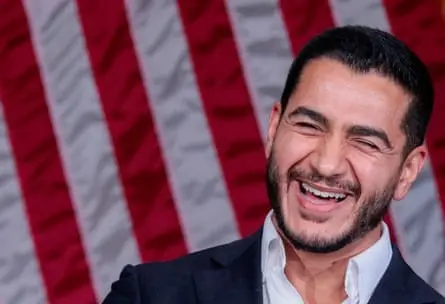
In Michigan, Abdul El-Sayed took the stage to the roar of an electrified crowd simply upon the introduction of his name. He drew another massive wave of applause when he contrasted what he called "this beautiful movement" with "an astroturfed corporate-funded advertising campaign built to deceive and distract." Drawing a sharp line in the sand, he issued a direct warning to corporate lobbies: "To special interests… we are coming for your system of politics."
While openly acknowledging the frequent attacks leveled against his name and his faith throughout the campaign, El-Sayed articulated a hopeful vision of an America that is "big enough for all of us" and deeply invested in the needs of its own working people rather than funding endless foreign wars. Gleefully looking forward to the formalities of taking office, he joked about being sworn in by Vance and sparked a roar of laughter and cheers by shouting a playful nod to regional college sports rivalries: "Wolverine one, Buckeye zero!"
In Georgia, Jon Ossoff celebrated before a rapturous crowd, training his political firepower on what he termed "the depravity, corruption and incompetence of the failed lame-duck president." At the same time, he offered a steady vision of renewed hope for millions of citizens.
"If at times, these last two years, amidst the ceaseless onslaught of brutality and indecency, you doubted whether our republic would survive, let tonight’s results give you courage that the first light of dawn is on the horizon," Ossoff declared.

At the same time, he struck a sober note of caution, acknowledging that institutional "brokenness" remains deeply entrenched even in the glow of victory. "Amidst our celebration tonight, we must acknowledge that the underlying crisis gripping our republic remains, and that therefore our most vital work lies ahead."
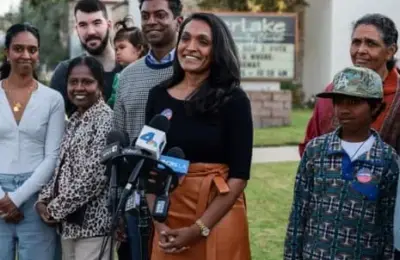
Also in Georgia, Keisha Lance Bottoms delivered a boisterous and energetic speech after being introduced by her daughter—part of a broader generational theme on a night that proved especially poignant for mothers and daughters, mirroring Gina Hinojosa’s moving public tribute to her grandmother in Texas.
History weighed heavily on Bottoms’ remarks. She noted the striking historical irony that she hails from the very same town as Alexander Stephens, the vice-president of the Confederacy. Signaling that a genuinely new era has finally begun, she reached out broadly to all Georgians she intends to serve, explicitly including traditional Republican-leaning constituencies such as rural veterans struggling to access proper healthcare and family farmers fighting desperately to hold onto ancestral land.
Bottoms also championed caregivers "who can’t afford healthcare and need Georgia to finally expand Medicaid," concluding with a resonant and thunderous promise that drew a standing ovation: "No amount of money will ever… never ever ever!… overcome the power of the people!"
In Texas, Gina Hinojosa invoked the memory of her abuela, who instilled in her a foundational lesson: "Know your worth." She insisted that the electoral outcome was much more than a routine win for the Democratic party. "This victory is so much bigger," she explained, detailing how the new political momentum will directly support young people, teachers, working parents, and the primary caretakers of future generations.
Education formed the centerpiece of Hinojosa’s address. She expressed deep anger at the ways state leadership in Texas has strong-armed local school districts, announcing to a massive cheer her determination to hold the state’s educational leadership accountable. Speaking with the fierce focus of a parent, she outlined her unwavering commitment to the children of Texas who, while unable to vote, form the bedrock of her social compact. "To the children of Texas, your schools will not close. You will be invested in, and you will grow up in a Texas where you are lifted up every single day to reach your God-given potential."
Observers noted the stark contrast between this message and the rhetoric emerging from the modern Republican party—a political apparatus critics describe as increasingly top-heavy, male-dominated, and mean-spirited. Hinojosa captured this sentiment effectively by noting that state government has long felt like "something that is done to you, not with you, or for you, or by you."
Also in the Lone Star State, James Talarico displayed the distinctive eloquence that marked his unconventional campaign, standing in sharp contrast to the comparatively charisma-challenged remarks of figures like Ken Paxton. Talarico celebrated "the politics of love" in cadence and language reminiscent of the civil rights movement, directly confronting a broken political system that poured vast financial resources into defeating him. Comparing the disproportionate spending of figures like Elon Musk to the biblical story of Goliath, he urged his supporters to "always bet on the underdog!"
Addressing the constant barrage of personal attacks he faced from both human actors and automated AI smear campaigns, Talarico dismissed the negative tactics as "the final howls of a dying establishment… the death rattle of a status quo that knows its days are numbered."
He extended a warm welcome to former Trump voters who crossed party lines to support his coalition, alongside the broad cross-section of disenfranchised citizens who built his movement: teachers, nurses, farmers, ranchers, parents struggling to put food on the table, and young couples desperately trying to find the financial footing to buy a home.
Echoing themes raised by Ossoff, Talarico spoke candidly about a society that has repeatedly broken its basic promises to its citizens. "There is something broken in America," he explained. "Our economy is broken, our political system is broken, even our relationships with each other feel broken… and that’s because the most powerful people in the world want it that way."
In a stirring narrative, he shared memories of his grandfather, a Baptist preacher who instilled in him the foundational New Testament commandments to love God and love one’s neighbor, emphasizing that "there is no love of God without love of neighbor." Following that philosophical thread, he reminded his listeners that every human being is created with inherent dignity.
After years of political rhetoric focusing on physical and religious divisions, the message resonated deeply, bearing the distinct philosophical fingerprints of Dr. Martin Luther King Jr. By skillfully weaving scripture into a call for systemic change, Talarico insisted that "the real fight in this country is not left versus right; it is top versus bottom."
Taken together, the speeches delivered on election night across Michigan, Georgia, Texas, and beyond suggest that Tuesday’s outcome was far more than a standard political victory. For millions of Americans, it represents a genuine awakening—the potential dawn of a new political era shaped by a fresh generation of leaders focused squarely on reviving the American Dream.