

The stock market has long been a source of both immense wealth creation and profound existential dread. As major indexes continue to reach unprecedented heights driven largely by the frenzy surrounding Artificial Intelligence, investors find themselves grappling with a familiar psychological dilemma. When the market crashes, retirement portfolios shrink, triggering immediate panic. But when it climbs to record valuations, the anxiety often shifts to an anticipatory dread: the belief that a massive correction is inevitable, and that this current boom—built on the back of rapid technological speculation—is merely a digital-age bubble waiting to burst.
For those who have managed to tune out the daily drumbeat of financial media, the basic narrative of the artificial intelligence boom can be summarized swiftly. AI technologies are advancing at a breathtaking pace, drawing billions in capital investments from major tech conglomerates, venture capitalists, and retail investors alike. Yet beneath the enthusiasm lies a persistent worry. Market participants fear that while AI is undoubtedly a transformative invention, the mania surrounding its adoption is moving too fast and reaching valuations that outstrip immediate economic realities.

This dynamic evokes memories of the dot-com crash of the early 2000s, a historical parallel that carries personal resonance for many who lived through it. That particular boom helped launch careers and pave the way toward early retirement for some, only to be followed by a severe market correction that threatened jobs and financial stability. Today, as questions swirl about the sustainability of current market cycles, financial commentators and long-time retirement advocates are stepping up to address these anxieties through public forums, speaking engagements, and written commentaries.
Will Market Bubbles Ruin Long-Term Retirement?
Achieving long-term financial independence often brings a sense of comfort, yet external anxieties have a way of piercing that tranquility. Conversations with peers frequently reveal a deep-seated unease about the state of the world, whether centered on geopolitical instability, inflation eroding purchasing power, escalating national debt, or the looming threat of technological disruption.

A retrospective look at similar periods of heightened anxiety reveals how cyclical these worries truly are. Two decades ago, in the mid-2000s, investors were gripped by an entirely different set of catastrophic predictions. At the time, public discourse was dominated by concerns over geopolitical conflicts in the Middle East, surging national deficits, high inflation, and a notoriously overvalued housing market that ultimately culminated in the Great Financial Crisis of 2008. Beyond finance, societal worries included the outsourcing of domestic labor to overseas markets and fierce debates over "Peak Oil"—the widespread fear that global fossil fuel supplies would inevitably plummet while demand skyrocketed.
Yet, looking back over a twenty-year horizon reveals a vastly different reality. Despite the severity of the Great Financial Crisis—the deepest market downturn since the Great Depression—broad economic indicators and long-term stock market performance continued upward over time. Historical charts demonstrate that disciplined investments weathered both the 2008 collapse and subsequent disruptions, such as the pandemic-related market shock of 2020, delivering substantial long-term growth.

Simultaneously, broader global indicators improved remarkably over the same two decades. The proportion of the global population living in extreme poverty dropped significantly, infant mortality rates were halved, and technological advancements made clean energy economically viable. Solar power generation saw exponential cost reductions, establishing itself as a dominant source of new energy capacity, while electric vehicle adoption surged globally.
Prosperity Stems from Productivity, Not Financial Speculation
When confronting modern economic anxiety—whether driven by surging national debt, potential stock market corrections, or the unknown trajectory of artificial intelligence—pessimists often overlook a fundamental economic truth: true prosperity does not originate within the financial system or the stock market, which fundamentally operate as metrics and valuation tools built on digital networks. Instead, enduring prosperity is rooted in productivity.

The fundamental mechanics of capitalism are inherently volatile, characterized by choppy waters and wide swings in market sentiment. Beneath these surface-level fluctuations, however, real people continue to perform tangible labor, invent new tools, and solve complex problems. Economic systems and financial markets are human inventions; if a system experiences a severe correction due to shifting valuations, societies have repeatedly demonstrated the capacity to adapt, restructure, and resume productive work.
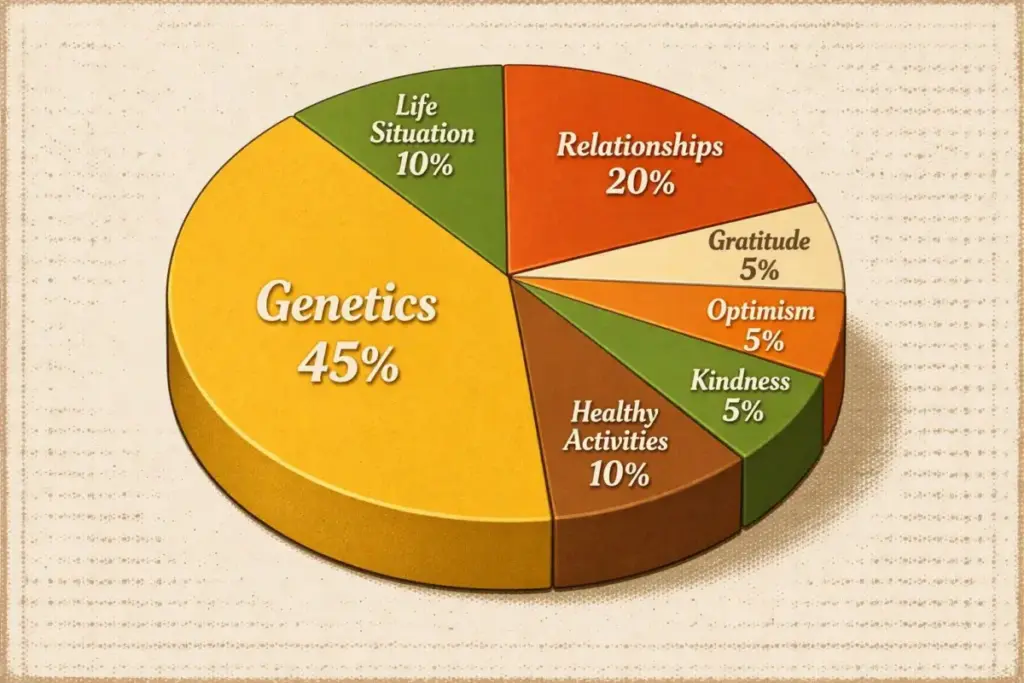
Standard of living, economic growth, and the feasibility of early retirement are all anchored in high productivity. Furthermore, once basic human needs and minimum standards of living are met, additional accumulation of wealth yields diminishing returns regarding overall human happiness. Psychological and sociological research indicates that happiness is heavily influenced by non-financial factors, including genetics, close interpersonal relationships, lifelong optimism, and physical well-being.

Confronting the Evolutionary Roots of Fear
Despite historical evidence demonstrating resilience through multiple economic crises, background anxiety remains a persistent companion for many individuals. From an evolutionary perspective, human beings function largely as danger-detection machines. This pervasive background fear evolved as a vital survival mechanism to protect early humans from physical threats, predators, and environmental scarcity.
However, a psychological quirk of this detection machinery is that when immediate physical dangers are mitigated, the human mind frequently continues scanning for new targets of concern. Once scarcity is overcome, anxiety shifts toward social standing, community integration, macroeconomic trends, tax strategies, or even minor community grievances. In modern financial contexts, this manifests as persistent worrying about market corrections, regulatory changes, or the long-term viability of retirement portfolios, even among individuals who have achieved substantial financial security.

Recognizing the root causes of these fears is a critical step toward mitigating them. Personal history, childhood experiences with economic scarcity, and past trauma often heavily influence an adult’s relationship with money and risk. By identifying specific fears, analyzing realistic worst-case scenarios, and taking proactive measures, individuals can replace vague anxieties with concrete understanding. Taking action makes the unfamiliar familiar, fostering resilience and confidence in the face of uncertainty.
Filtering out the constant stream of sensationalized media reporting also plays a vital role in psychological well-being. Daily news cycles frequently prioritize the most alarming stories to capture attention, which can distort perceptions of actual risk. Fostering positive behaviors, engaging in physical activity, and surrounding oneself with optimistic, productive peers helps align modern lifestyles with the environments humans evolved to inhabit.

Viewing Technological Shifts Through the Lens of Experimentation
Adopting a mindset that treats life transitions as experiments can fundamentally alter how individuals approach uncertainty. Whether navigating minor daily changes or major life decisions like career shifts, relocations, or early retirement, viewing outcomes as data-gathering experiments reduces the emotional weight of fear.
This experimental framework applies directly to the current era of artificial intelligence. While rapid technological disruption generates understandable apprehension, framing AI through the lens of economics and technology reveals it as a powerful tool for cognitive efficiency. Similar to past technological revolutions—such as the advent of the internet or the proliferation of mobile computing—AI functions as a transformative lever for productivity.

Increased productivity ultimately drives broader economic prosperity by reducing costs and fostering the creation of entirely new industries. At the same time, technological shifts inevitably displace certain types of labor, leading to structural transitions within the workforce. The distribution of economic rewards frequently favors those who own or adapt to the new technologies, mirroring historical shifts in manufacturing and digital commerce.
Ultimately, artificial intelligence represents another chapter in the ongoing evolution of human capability and economic adaptation. By addressing the root causes of fear, focusing on productivity rather than speculative noise, and embracing change as an experimental process, individuals can navigate market uncertainties with greater clarity, resilience, and long-term peace of mind.