

What, exactly, is the measure of greatness when it comes to comic strips? The daily newspaper comic is a remarkably limiting art form, constrained by a strict economy of space where creators have only a few panels—and sometimes just a single panel—to deliver a joke. Because of its inherent brevity, it is easy to trivialize the medium as simply the "funny papers," a daily, disposable cultural artifact designed to offer a quick, lighthearted diversion after reading the heavy reality of the actual news.
Yet, history has proven that comic strips are capable of achieving far more than mere brief amusement. Characters like Snoopy from Peanuts and Jim Davis’s Garfield have transcended the printed page to become an indelible part of the global cultural fabric. Comic strips are clearly capable of greatness. And since greatness is possible within such narrow constraints, what, then, defines a truly great comic strip?
The first editorial and critical instinct is often to look for something "deep." Comic strips like Charles Schulz’s Peanuts and Bill Watterson’s Calvin and Hobbes occasionally ventured far outside traditional comedy to examine the human condition, offering thoughtful, philosophical observations about the world. But that rubric does not apply to every master of the craft. For a strip like Garfield, greatness comes down to a relentlessly clever, highly relatable gag. For an adventure-oriented strip like Prince Valiant, which specialized in highly detailed, picturesque illustrations, greatness is properly measured by its visual appeal and artistic grandeur.
So how do we measure greatness when evaluating Gary Larson’s legendary single-panel cartoon, The Far Side?

Gary Larson’s work rarely pursued deep, life-affirming wisdom. Nor was his comic beautiful in any conventional artistic sense; his human and animal characters were often drawn with deliberately grotesque, exaggerated features specifically designed to enhance the absurdity and comedy of the situation. While it is tempting to associate greatness with the comic strips that made the biggest tangible cultural impact—such as the famous Stegosaurus strip that inadvertently resulted in paleontologists coining a brand-new scientific name for a dinosaur bone plate—Larson’s work never set out to rewrite academic science books or win literary prizes.
Instead, Gary Larson’s primary objective with The Far Side was simply to construct the funniest, most structurally airtight joke possible each and every day. That singular focus is precisely why he largely avoided recurring characters. The Far Side was never really about building a continuous narrative or developing a revolving cast of beloved personalities; it was entirely about the integrity and shock value of the individual joke. Consequently, the greatness of The Far Side must be measured by the sheer effectiveness, originality, and cleverness of its punchlines. Making readers laugh through surrealism and subversion was the sole purpose of the strip, making it the most accurate metric for its success.

Examining a selection of ten standout Far Side cartoons highlights why Larson’s work endures—not because it dominated headlines or offered profound philosophical truths about human existence, but because the humor remains brilliantly clever and relentlessly funny.
Find Peter
One of the defining highlights of Larson’s creative style was just how much he fundamentally trusted his readership. While some of his punchlines leaned toward broad, delightfully silly humor, other panels functioned like an intricate comedic scavenger hunt. A prime example is a classic office-themed cartoon where the humor relies entirely on the reader taking the time to inspect the individual cubicles to locate the punchline, rewarding patience and close attention to detail.

A Deconstructionist Masterpiece
Gary Larson did not break the fourth wall frequently, but when he did, he used The Far Side to brilliantly deconstruct the very art and conventions of cartooning itself. In one notable masterpiece, Larson tackles the concept of "sketchy" character design by populating the frame with figures that are drawn with extreme, exaggerated crudeness. It is an intellectual, meta-humorous gag, though it requires the audience to pay exceptionally close attention to appreciate the joke’s inner mechanics.
The Complete Opposite Kind of Masterpiece
Conversely, a Far Side cartoon did not require subtlety or meta-commentary to achieve greatness. Other strips worked precisely because of their over-the-top, blunt force. In a classic murder-mystery panel, a detective stands over a victim clearly slain by a blunt trauma, yet the baffled investigators scratch their heads, completely stumped by the mystery—even though the entire room is surrounded by hundreds of identical bowling pins. The humor stems entirely from the magnificent, absurd overkill.

A Clever Twist
Oftentimes, The Far Side excelled at taking classic, universally recognized stories or tropes and injecting a brilliant, unexpected spin into the narrative. While classic fairy tale subversions are common in Larson’s bibliography, a standout cartoon featuring Pinocchio stands as a masterclass in comic writing. Given that Pinocchio’s defining desire is to become a "real boy," Larson asks the most hilarious counter-intuitive question possible: what is the exact scenario where a wooden puppet would suddenly not want to be human?
More Deconstruction
Larson frequently subverted the broader culture of print media, specifically targeting the interactive activity panels commonly found in newspapers, such as "spot the differences" and "hidden images." In one brilliant cartoon, Larson mocks hidden-object puzzles by scattering a collection of bizarrely placed home appliances throughout a dense forest. The ultimate punchline arrives via the caption, which casually informs the reader that there are precisely 127 hidden appliances to find—a number that is both absurd and visually impossible.

Find the Punchline
Another hallmark of Larson’s visual style was the slow-burn comedic scavenger hunt. In a panel featuring an artist painting a portrait, the viewer’s eye is naturally drawn first to the giant, grotesque fly woman sitting for the portrait. Only after taking in the primary subject does the reader shift their focus to the artist’s canvas, and finally, to the tiny, crucial detail reflected in the artist’s spectacles that completes the joke.
Reconstruct the Punchline
Some cartoons pushed the concept of the hidden punchline even further into the realm of delayed realization. One memorable panel involving a high-rise building requires the reader to pause for several seconds before the dark, implication-heavy joke fully registers: the lingering realization that there was indeed an active window washer outside, right up until the moment the unsuspecting resident cheerfully opened the glass.

Snakes
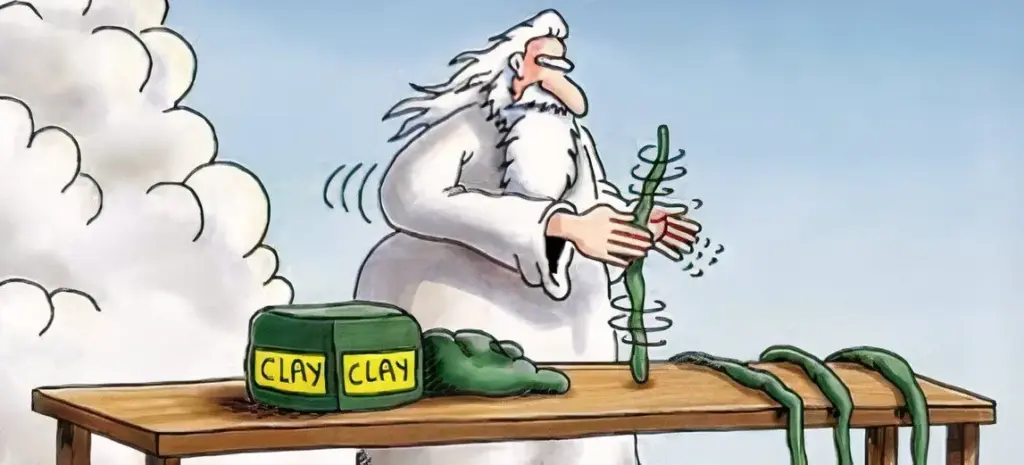
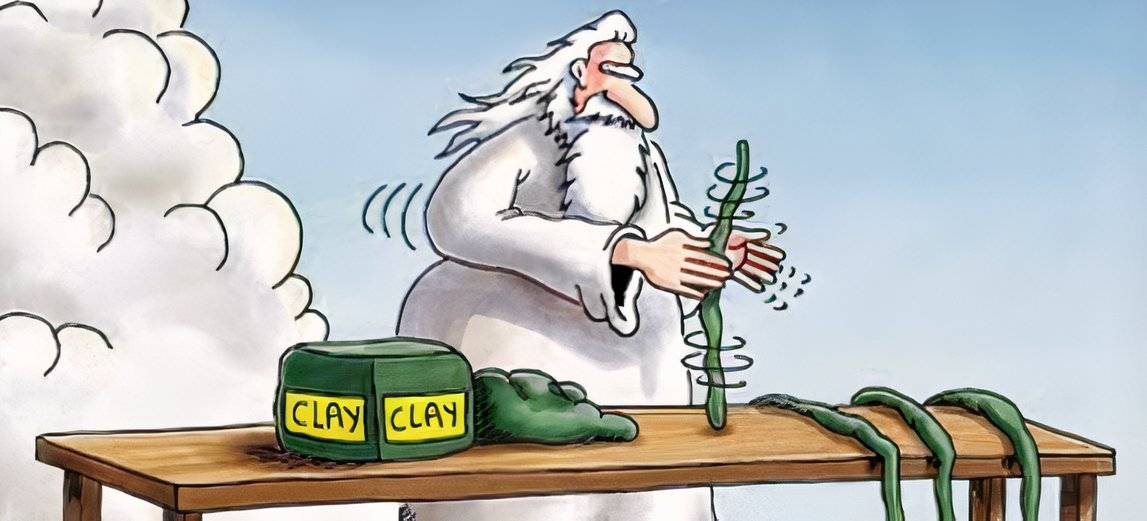
While Larson rarely touched upon the grand meaning of existence, he frequently explored the sheer cosmic silliness of creation. In a brilliant theological cartoon, Larson imagines God crafting snakes out of Play-Doh in a manner reminiscent of an easily distracted child, effectively trivializing the grand design of nature into a haphazard, slapstick art project.
Love Triangle
Much like the classic bowling pin investigation, another masterclass in character absurdity features stranded castaways on a desert island. The brilliant humor of the piece is derived almost entirely from the profound lack of cleverness and spatial awareness exhibited by the characters involved, turning a standard desert island trope on its head.

Smoking Dinosaurs
Among the most famous panels in The Far Side canon is a cartoon that endures not because it changed the trajectory of paleontological history, but because it encapsulates every brilliant trait of Gary Larson’s artistry in a single frame. Larson possessed a lifelong fascination with prehistoric creatures, paired with a distinct penchant for dark, morbidly funny situations. On the surface, the image of giant dinosaurs huddled together smoking cigarettes is delightfully lowbrow, but the implication that the species ultimately drove itself to extinction via a collective tobacco habit is an elite level of comedic writing. It remains a definitive high-water mark for the artist, capturing the pure, concentrated essence of The Far Side in one small, perfect rectangle.