


The stock market has once again found a way to surprise investors. As market valuations climb to unprecedented levels, fueled by a historic frenzy around Artificial Intelligence, a familiar wave of anxiety has washed over retirement savers. Whenever the market reaches soaring heights, a chorus of worriers warns that a catastrophic crash is inevitable, driven this time by the intense speculation surrounding generative AI. Yet, looking back at historical market cycles reveals that this tension between market exuberance and existential financial dread is far from new.
Long-term investors who have tuned out the daily news cycle have largely enjoyed the ride, but the broader financial narrative remains gripped by the AI story. Investors worry that while artificial intelligence is unquestionably a major technological milestone, the financial mania surrounding it is moving too fast and too aggressively. This has triggered widespread fears of a repeat of the early 2000s dot-com crash—an era that notably propelled the early careers of many professionals before the subsequent downturn threatened jobs and financial stability.

To address these growing concerns in the investment community, veteran financial commentators and early-retirement advocates have taken to public speaking circuits, addressing audiences at events like Camp FI Midwest and preparing presentations for upcoming gatherings such as the Bogleheads conference. These discussions consistently circle back to a fundamental question shared by retirees and savers alike: Will the current AI bubble ruin our retirement?
Echoes of the Past: Comparing Modern Worries to 2006
Reflecting on decades of financial independence, commentators often encounter anxious queries from friends and followers asking how anyone can stay retired and sleep peacefully given the state of the world. Today’s news feeds are dominated by a heavy mix of geopolitical tensions, political instability, inflation eroding purchasing power, towering national deficits, active conflicts in Ukraine and the Middle East, and the looming threat of an AI-driven economic crash.

However, a look back at the year 2006 reveals a strikingly similar psychological landscape. Two decades ago, society was consumed by a parallel set of existential worries. The geopolitical stage featured contentious leaders and military conflicts in the Middle East, alongside persistent anxieties over inflation and soaring national debt. Instead of an AI bubble, the stock market’s overvaluation was blamed on a rampant housing bubble. Rather than artificial intelligence replacing human labor, the prevailing fear was that widespread outsourcing to India and China would eviscerate domestic job markets. There was even a fierce global debate over "Peak Oil," with apocalyptic predictions that fossil fuel consumption would inevitably outstrip supply and plunge civilization into crisis.
Despite the intense anxiety of 2006, the subsequent two decades defied the doomsayers. Even the Great Financial Crisis—triggered by irrational exuberance over housing prices and complex financial leverage—ultimately proved to be a temporary, albeit severe, detour in the grand scheme of long-term market growth. Historical market data shows that a diversified $100,000 investment made during that turbulent era still managed to grow substantially over the next twenty years, weathering both the mortgage meltdown and the subsequent pandemic-induced market drop of 2020.

At the same time, global living conditions improved dramatically. Extreme poverty rates plummeted significantly over a twenty-year span, and global infant mortality rates were cut in half. Clean energy technology advanced at a staggering pace, with solar panels becoming exponentially cheaper and supplanting older energy sources, while electric vehicle adoption surged across the globe. History suggests that human societies are remarkably adept at navigating uncertainty and engineering solutions to seemingly insurmountable problems.
Prosperity, Productivity, and the Human Experience
The persistent fear-mongering propagated by financial media often overlooks a fundamental economic truth: true prosperity does not originate from the financial system or the stock market, which are ultimately human-constructed numerical abstractions. Instead, genuine economic prosperity stems directly from productivity.

The underlying engine of capitalism is inherently volatile, prone to sharp cyclical swings and emotional extremes. Beneath the turbulent waves of the financial markets, however, real people continue to perform real work, invent new technologies, and drive efficiency. If a financial system breaks down because market participants lose confidence in arbitrary computer valuations, society possesses the capacity to reset the metrics and return to productive labor—a mechanism successfully deployed during the 2008 financial crisis and numerous historical precedents.
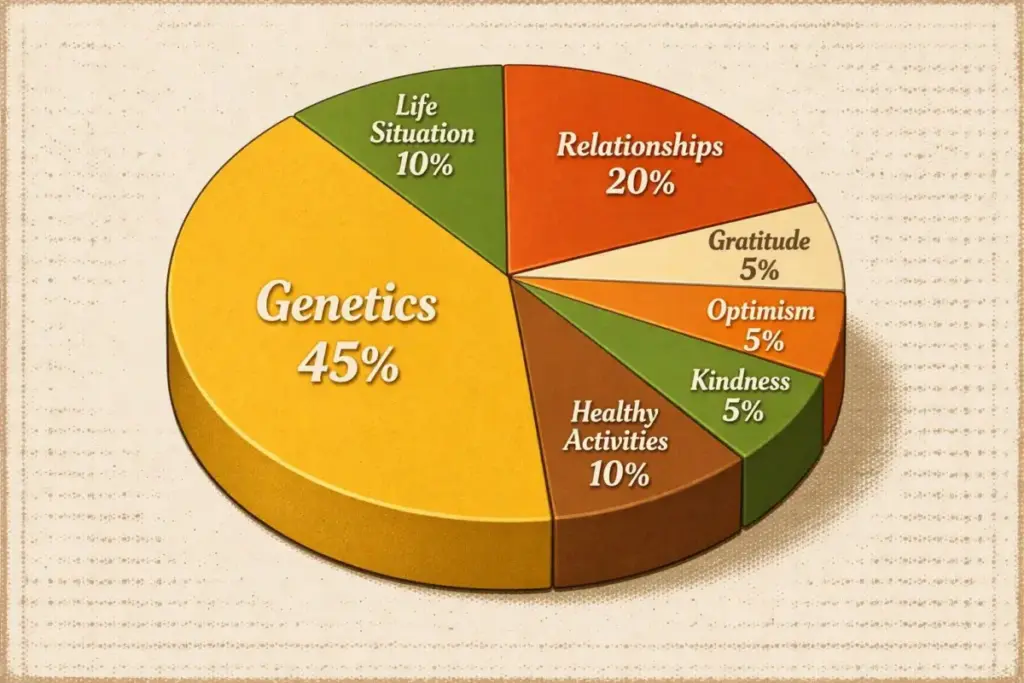
Furthermore, once human societies achieve a certain baseline standard of living, additional wealth yields diminishing returns in terms of core happiness. In developed nations, basic survival and comfort thresholds were surpassed decades ago. True human satisfaction relies far more on controllable factors, such as cultivating meaningful relationships, maintaining a philosophy of optimism, engaging in physical activity, and practicing gratitude.

Psychologically, human beings are essentially sophisticated danger-detection machines. This evolutionary trait is designed to protect us from immediate physical threats, but in modern, stable environments, it often backfires. When actual physical dangers recede, the human brain continues to hunt for new things to worry about, shifting the goalposts from basic survival and food scarcity to social standing, tax strategies, and portfolio longevity. Recognizing this psychological quirk is the first step toward combating irrational financial fear.
Understanding Fear and the Nature of AI
Conquering financial anxiety requires self-awareness, including an examination of one’s personal history and upbringing. Scarcity mindsets are often inherited from previous generations who lived through monumental economic hardships, such as the Great Depression. By identifying the root causes of financial dread—rather than reacting impulsively to daily news headlines—savers can begin to separate objective reality from emotional conditioning.

Taking concrete action remains one of the most effective ways to neutralize fear. Engaging with new situations makes the unfamiliar familiar, building the resilience and adaptability necessary to handle unexpected economic shifts. For most people, this also involves curating a healthier mental diet by tuning out sensationalized media coverage and focusing instead on positive, productive behaviors and supportive communities.
Applying an experimental mindset to major life changes—whether shifting careers, making large purchases, or transitioning into early retirement—helps reframe uncertainty from a threat into an opportunity for discovery. This same experimental perspective applies directly to the current artificial intelligence boom.

Rather than viewing artificial intelligence strictly as an existential threat or succumbing to sensationalized headlines, technologists and economists often frame AI as a highly sophisticated cognitive tool—effectively a digital cognitive nail gun. Like any major technological leap, AI promises to dramatically boost human efficiency, productivity, and, by extension, broader economic prosperity.
At the same time, historical precedent indicates that such innovations inevitably displace certain types of labor, particularly in entry-level administrative, software, and transportation roles. Yet, just as the advent of the internet and mobile computing destroyed old jobs while creating entirely new industries, the AI transition is already reshaping the modern economy. While the financial rewards of these technologies often concentrate among corporate shareholders and business owners, they also offer broader societal benefits through cheaper services and enhanced capabilities.

Ultimately, artificial intelligence represents another major technological evolution, presenting individuals with choices on how to respond. By addressing the root causes of anxiety, filtering out unnecessary noise, and embracing change as an ongoing experiment, investors can navigate market bubbles and future uncertainties with greater confidence, focusing on what truly matters: living a purposeful, productive, and fulfilling life.