
The world of cosplay and Halloween costume design has long been a canvas for extraordinary engineering feats, showcasing everything from moving mechanical masks and articulated giant wings to meticulously lit ambient garments. Makers consistently find innovative ways to merge technical disciplines with artistic expression, bringing complex concepts to life through 3D printing, laser cutting, and microcontrollers. Yet, even within a community accustomed to boundary-pushing creativity, certain concepts stand entirely on their own. For instance, encountering a fully functional, wearable replica of a public transit fare gate is something few observers would ever expect to witness.
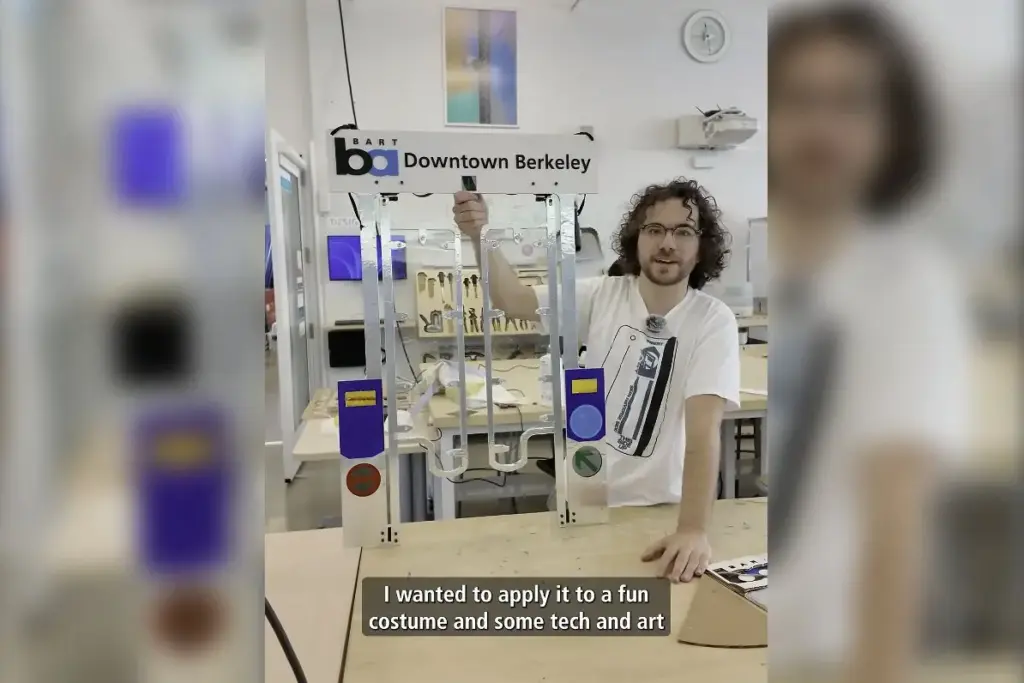
Taylor Waddell, a recognized figure in the maker community known for his work on projects like the OpenCAL layerless 3D printer, looked at a standard Bay Area Rapid Transit fare gate and decided to ask a simple question: why not? The result of that curiosity is a wearable engineering marvel that captures not only the visual aesthetic of modern transit infrastructure but also its mechanical functionality. Constructed primarily using a laser cutter at Jacob’s Makerspace located at UC Berkeley, Waddell’s creation goes far beyond a static cardboard box or foam prop. The costume features actively motorized doors that open and close, alongside a working card reader that completes the authentic experience of passing through a transit terminal.

Interestingly, this ingenious build represents more than just a one-off novelty; it is actually Waddell’s second iteration of a transit fare gate costume. The updated version was specifically built to reflect and incorporate the modern changes in transit design that have occurred since his earlier attempt, demonstrating a continuous cycle of prototyping, iteration, and refinement that is characteristic of the broader maker philosophy. By updating the mechanics and external styling, Waddell managed to capture the precise look and feel of the contemporary gates that thousands of commuters navigate daily across the San Francisco Bay Area.
The San Francisco Bay Area Rapid Transit system has long held a unique place in the cultural fabric of the region, occasionally leaning into playful public engagement through its official mascots. Commuters and local transit enthusiasts are familiar with characters such as Baylee, an online influencer mascot with a documented fondness for boba, or Barty, described creatively as the reincarnated bunny spirit of a legacy rail car that has seen it all over decades of service. With Waddell unveiling his latest wearable tribute, residents of the SF Bay Area who feel a strong sense of pride in their local public transportation system now have another iconic homage to choose from when celebrating the culture of the region.
For makers and cosplayers looking to push the limits of their own projects, creations like the BART gate costume highlight the endless possibilities that open up when different disciplines intersect. Whether builders are exploring advanced fabrication methods or simply trying to recreate everyday urban objects in wearable form, the tools available in modern community makerspaces make ambitious concepts increasingly achievable. As the community continues to share techniques, tips, and insights—ranging from professional cosplay execution to rapid prototyping strategies—innovative projects will undoubtedly continue to emerge from workshops and hacker spaces, bridging the gap between everyday civic infrastructure and imaginative wearable art.