



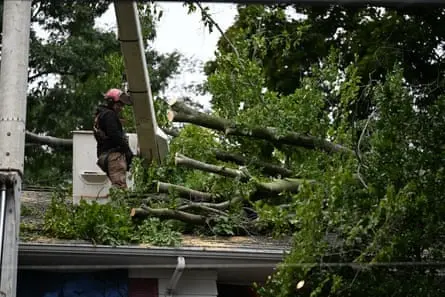
A powerful and destructive nor’easter slammed into the United States eastern seaboard over the weekend, unleashing a dangerous combination of torrential downpours, hurricane-force gusts, severe coastal flooding, and treacherous ocean conditions that disrupted millions of lives from North Carolina up through New England.
The severe weather system crippled regional infrastructure, knocking down countless trees and power lines across multiple states. At least one person was tragically killed in the storm’s wake, while hundreds of thousands of residents were left shivering in the dark without electricity as utility crews struggled to access downed lines amid the hazardous conditions.
The storm’s ferocious impact was felt across a vast expanse of the coastline, hitting major metropolitan hubs and smaller coastal communities alike. Boston, the New York City tri-state area, the Jersey Shore, and parts of the northern Outer Banks in North Carolina all experienced severe battering from rough surf, high winds, and coastal inundation. Dangerous rip currents created perilous conditions along the oceanfront, prompting local authorities to urge residents to stay away from beaches and seawalls as surging waves breached coastal barriers.
By Sunday afternoon, utility companies and local crews were slowly making progress on power restoration efforts, though extensive outages remained. According to data from the tracking website Poweroutage.US, approximately 110,500 households and businesses were still grappling with a lack of electricity across the affected region. In New York, more than 21,000 customers remained in the dark, while neighboring New Jersey reported approximately 11,940 customers without power as repair teams worked around the clock to clear debris and fix damaged transformers.

The destructive weather system triggered immediate legislative and administrative responses at the highest levels of local government. New York Governor Kathy Hochul formally declared a state of emergency to marshal state resources and expedite emergency response efforts. The emergency declaration covered a wide swathe of the metropolitan area and surrounding suburbs, including the Bronx, Kings, Nassau, New York, Queens, Richmond, Suffolk, and Westchester counties. Similarly, eight counties in New Jersey had already been placed under a state of emergency prior to the storm’s arrival, allowing local officials to deploy resources and enact precautionary measures ahead of the anticipated flooding.
Tragedy struck on Saturday in the east New York City borough of Brooklyn, where a 56-year-old employee of the New York City Housing Authority lost his life during the height of the storm. The victim was in a parking lot when a large tree came down, fatally crushing him. Emergency responders rushed him to Brookdale University Hospital, where he was pronounced dead. Police and municipal authorities launched an investigation into the incident, noting that while the storm brought intense winds to the area, it had not yet been definitively determined whether the wind was the direct cause of the tree’s collapse.
The city faced further infrastructural challenges later that afternoon in Queens. High winds and saturated soil caused another large tree to uproot in the Glendale neighborhood at approximately 5:40 p.m., bringing down live power lines and blocking a heavily traveled roadway. Out of an abundance of caution due to the volatile electrical hazards, the New York City Fire Department was forced to evacuate a nearby residential building. Fortunately, swift coordination by emergency personnel ensured that no injuries were reported in connection with the Queens incident.
Along the picturesque and densely populated Jersey Shore, residents spent their Saturday between alternating periods of high tide desperately working to clear debris and pump water out of flooded streets and homes. The relentless ocean surge pushed water past traditional boundaries, inundating coastal neighborhoods and leaving behind thick layers of sand and marine debris that required heavy machinery and community-wide clean-up efforts to clear.
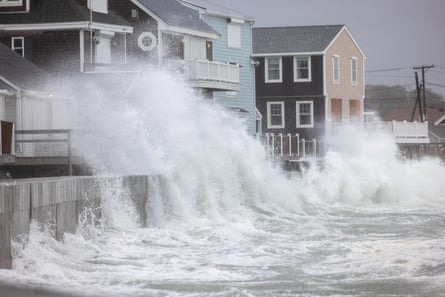
The transportation sector also experienced widespread chaos as the severe weather system interfered with both air and ground travel. The Federal Aviation Administration advised passengers nationwide to check directly with their respective airlines for real-time flight updates and itinerary changes. FlightAware, a prominent flight tracking service, recorded more than 5,000 flight delays across the United States alongside nearly 550 outright cancellations. In Massachusetts, conditions deteriorated to the point where aviation authorities were forced to issue a temporary ground delay at Boston Logan International Airport, grounding departing flights until visibility and wind speeds improved to safe operating levels.
Meteorologists and forecasters at the National Weather Service indicated that while the core of the nor’easter was expected to lose some of its raw intensity late Sunday night, residual heavy rainfall and localized flooding threats would persist into Monday across several areas of the Mid-Atlantic and New England. Despite the lingering rain, coastal flood warnings were officially canceled for multiple regions spanning New York, New Jersey, and Connecticut as peak tidal surges began to subside.
However, the threat posed by the water was far from over. The National Weather Service warned that coastal flooding would continue to fluctuate in the coming days, rising and receding with the twice-daily tidal cycles as the slow-moving system gradually exits the region. Forecasters predicted that significant coastal flooding would continue to impact areas stretching from the Jersey Shore down to the northern Outer Banks of North Carolina, while more moderate, yet still concerning, flooding conditions remained in the forecast for vulnerable sections of the Massachusetts coast. As communities transition from emergency response to long-term recovery, local officials continue to monitor weather updates closely while residents begin the arduous task of repairing storm-damaged properties.