


Social media giant Meta is facing mounting frustration from local government agencies and small nonprofit organizations after its ongoing paid-link experiment mistakenly ensnared accounts that were explicitly supposed to be exempt from the new restrictions.
The policy shift, which has been quietly tested by the company for nearly a year, forms a central pillar of Meta’s broader commercial push to monetize basic platform features through tiered subscription packages. While the tech giant maintains that government entities and registered nonprofits should be completely shielded from these paywalls, affected users report a vastly different reality. Across the country, public servants and community leaders are suddenly finding their ability to direct citizens to essential online resources severely curtailed unless they agree to pay a monthly fee.
Daniel Starks knows this friction firsthand. As the communications manager for Greenville, Texas—a city of approximately 35,000 residents—Starks oversees nearly a dozen official Facebook pages maintained by the municipality. Recently, the digital desk for the city’s public library received an unexpected notification informing administrators that it could no longer share more than two links per calendar month.
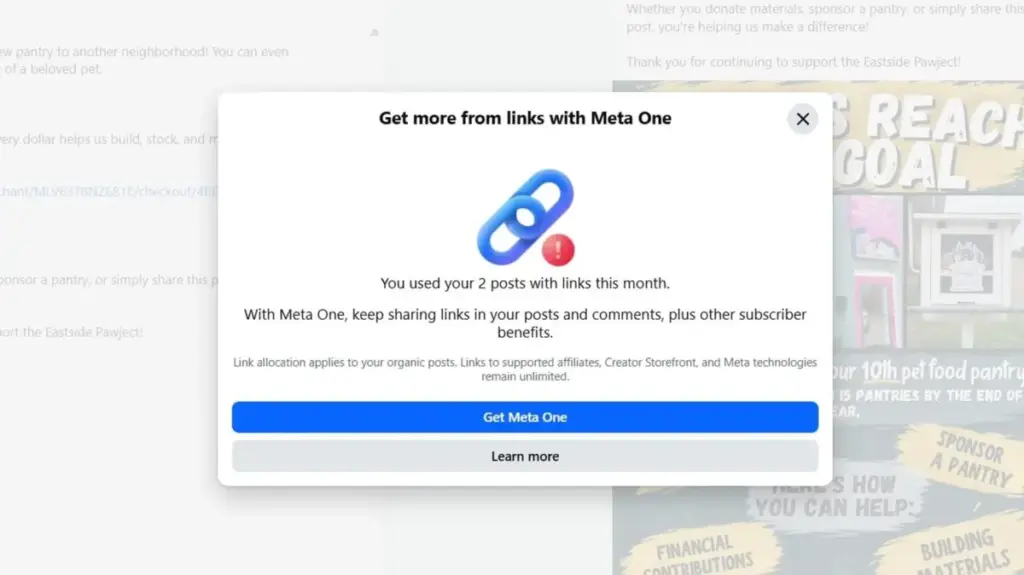
"You can add links to 2 posts per month, and you’ve used them all," the automated platform message read.
According to the interface, sharing any additional URLs would require purchasing a recurring Meta One subscription starting at $50 per month, with higher tiers climbing significantly. The restriction caught city officials entirely off guard. Starks is just one of a growing wave of professionals encountering Meta’s test, which forces creators, businesses, and other page administrators to pay for the fundamental right of sharing hyperlinks.
Although Meta states that the experiment is not supposed to impact pages designated for nonprofits or government entities, nonprofit leaders and public administrators argue that the safeguards are failing in practice. Many of the affected organizations feature pages explicitly identified as nonprofits and have already undergone separate, rigorous verification processes to utilize Meta’s internal fundraising tools. Left with little recourse, these organizations are now forced to rethink their entire digital communication strategy.
"More than half of what we do as a city, is linking back to information on our website," Starks explains. "It’s scary because we don’t know how we’re going to pivot."
Fearing that the municipality’s other informational pages would soon be hit with identical constraints, Starks instructed his communications staff to cease posting direct links in Facebook posts altogether. In response, his team designed custom graphics to inform the city’s followers that relevant URLs would henceforth be relegated to the comments section of each post. He expresses deep frustration over a system that penalizes a public entity trying to disseminate critical information. The library’s page clearly identifies it as a government building, and the account held previous verification from the company.
"When you have an official governmental entity that is trying to get out in some instances very, very important information, and we’re being paywalled by Facebook all because we’re trying to post a link, that’s a problem," Starks notes.
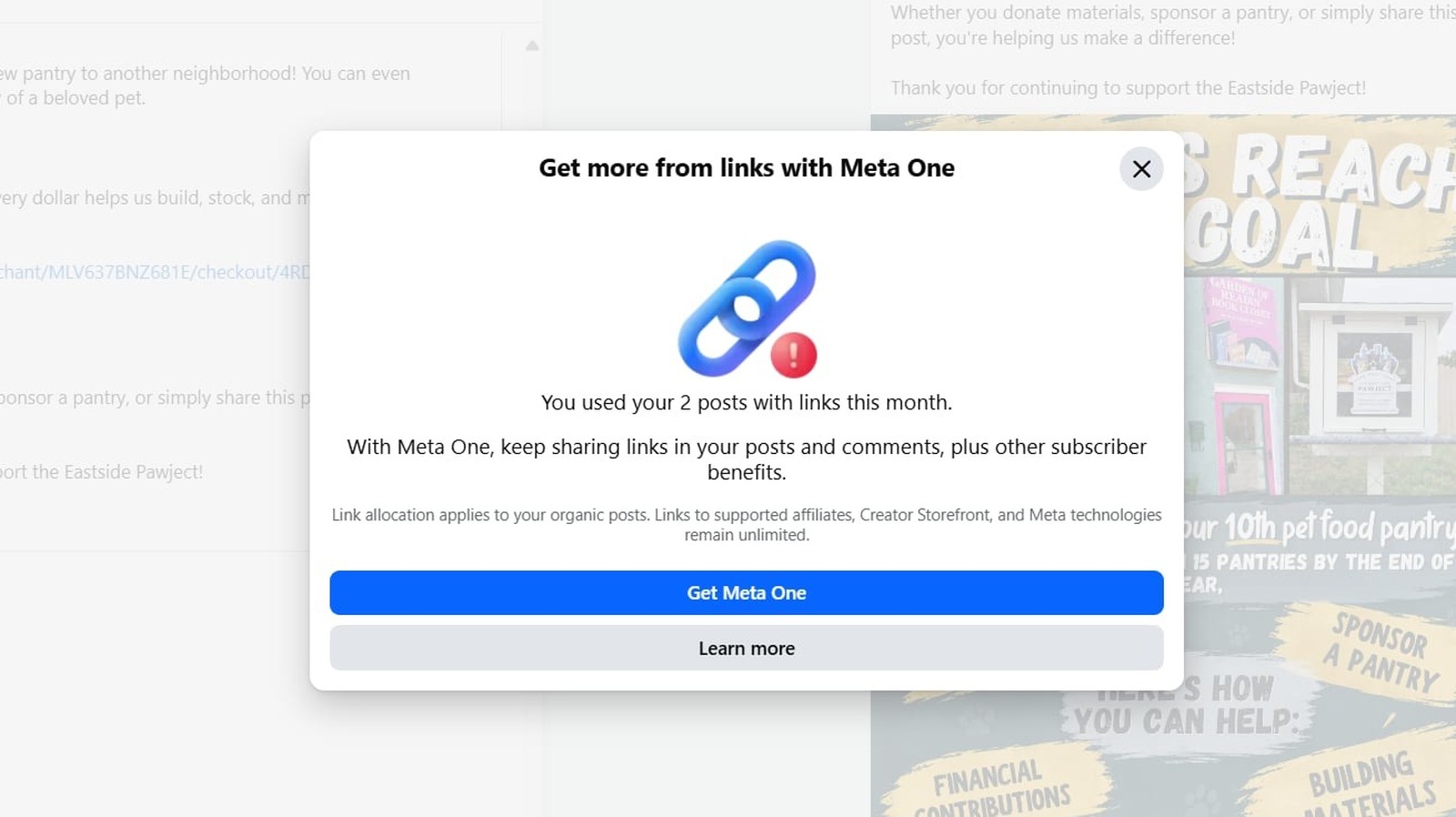
Nonprofit organizations are facing similar turmoil as they scramble to adapt to the sudden enforcement. Bethany English serves as the co-president of a small Indianapolis-based nonprofit that organizes local pet food pantries. Last week, she attempted to publish a routine Facebook update detailing an upcoming community event, only to discover that her account was locked out of link-sharing capabilities because she had already exhausted her monthly allowance of two links.
Much like the situation in Greenville, the platform offered English no workarounds other than signing up for a Meta One subscription. Under the pricing structure presented to her, an "expert" level tier granting up to 20 links per month would carry a price tag of $150 monthly.
English explains that social media has historically been a vital lifeline for her organization, the East Side Pawject, which she co-founded last year. With just under 1,000 followers, the nonprofit’s Facebook page serves as an essential hub helping residents locate pet food pantries and find designated drop-off sites for material donations. Furthermore, standard posts on the platform traditionally directed prospective volunteers and financial contributors directly to the organization’s official website. For a grass-roots operation running on tight margins, justifying a $150 monthly overhead expense simply to share hyperlinks is an impossible financial hurdle.
"We’re a very small nonprofit, and we want to do big things, but that makes it very hard when something just like having social media is going to cost that much," English says.
She has already begun brainstorming potential operational workarounds, such as creating dedicated Facebook events rather than publishing organic text posts. She is also weighing whether board members might post the links from their personal profiles instead, given that personal accounts remain exempt from Meta’s restrictions.
"I don’t know what the fix is," she admits. "I know that the long term implications will be big if we’re not able to use it like we have before."
When contacted for comment, a Meta spokesperson did not directly address why verified nonprofits were experiencing link-sharing restrictions. Instead, the representative pointed to the experimental nature of the rollout.
"We’ve been testing whether sharing links on Facebook should be part of the Meta One subscription," the spokesperson said. "We will continue to evolve the experience based on the feedback we receive and what we learn."
Meta has gradually expanded its testing of paid linking over the span of nearly a year. The company initially integrated the concept into traditional Meta Verified subscriptions before shifting its promotional focus toward its newer, AI-centric Meta One business plans. Under the current pricing model, the entry-level plan costs $14.99 per month and includes no additional link-sharing privileges on Facebook itself, though subscribers gain the ability to add a dedicated link page to their Instagram bios. Mid-tier options charge $49.99 per month for eight monthly Facebook links, while a $149.99 tier increases the cap to 20 links. True unlimited link-sharing on Facebook is restricted exclusively to the highest subscription tier, which costs $499.99 per month.
"Fifty bucks for eight links a month is crazy," says Jeff Bannister, the marketing manager for SparkPoint, a small North Carolina-based nonprofit. "That’d be crazy for a corporation or a small business. The ROI seems almost negative."
SparkPoint, which focuses on advocating for public health and strengthening social connections in Transylvania County, was recently caught in the web of Facebook’s link-sharing limitations. Bannister is currently exploring cooperative strategies with other regional nonprofits to share information collectively, thereby reducing their overall reliance on the platform. Even so, he acknowledges the difficulty of abandoning an ecosystem where a vast majority of the local population remains active.
"So much of the county is on Facebook still, there’s really not an easy solution to migrate us and the audience," he observes.
Widespread confusion surrounds the implementation of Meta’s new rules. While some page administrators report that they retain the ability to drop links inside the comments section of their posts, others find that avenue blocked as well. Compounding the issue, Meta’s public help center documentation and official product descriptions do not explicitly frame the link restriction as a temporary test. The company has framed its Meta One bundles as a way to unlock specialized capabilities and artificial intelligence features, prompting criticism from users who point out that inserting a URL into a social media post is one of the platform’s foundational legacy features and does not rely on AI infrastructure. Consequently, many affected organizations view the policy as an aggressive cash grab.
"Having only two links per month for a nonprofit organization to spread awareness, raise support, ask for volunteers and more is really quite limiting," says David Diskin, president of California Freethought Day, an organization that hosts an annual Sacramento event promoting civic engagement.
Diskin received notice of the link-sharing restrictions earlier in the month, mere days before his organization’s major annual event. The pricing tiers presented to his page were slightly different, quoted at $40 per month for eight links, $119 per month for 20 links, or $399 for an unlimited plan.
Without warning, the restrictions were abruptly lifted later in the week, restoring the page’s standard ability to post links freely. Diskin received no official explanation or context regarding the reversal. While he feels a sense of relief, lingering frustration remains regarding the timing of the glitch and the lack of communication from the platform.
"It wasn’t until after our big fundraiser had passed that they fixed the problem," he says.
Following the initial publication of these accounts, a Meta spokesperson clarified that page administrators must explicitly list "nonprofit" within the designated category section of their Facebook page settings in order for the company’s automated systems to recognize their status. It remains unclear why the platform’s verification algorithms cannot identify organizations that indicate their nonprofit status elsewhere on their profiles or those that actively participate in Meta’s official fundraising programs.