
TAIPEI — Hong Kong icon and star-director Stephen Chow once offered a pointed critique to Japanese filmmakers, advising them to abandon attempts at imitating kung fu and instead root their action cinema in their own rich tapestry of martial arts.
The anecdote was shared by Kii Muneyuki, the founder of K2 Pictures, on Saturday at the Taiwan Creative Content Fest (TCCF) in Taipei. Kii, who noted that he has shared drinks with Chow in Tokyo on several occasions, recalled the director’s exact perspective on the matter.
"He said, ‘You have karate, judo, jujitsu and kendo. That is Japanese culture. Only you can turn it into action films, so you should be the ones doing it. Stop aping kung fu,’" Kii recalled.
Kii expressed his full agreement with Chow’s sentiment, pointing to successful international projects like the Netflix sumo drama "Sanctuary" as prime examples of how storytelling rooted in unique Japanese cultural traditions can captivate global audiences.
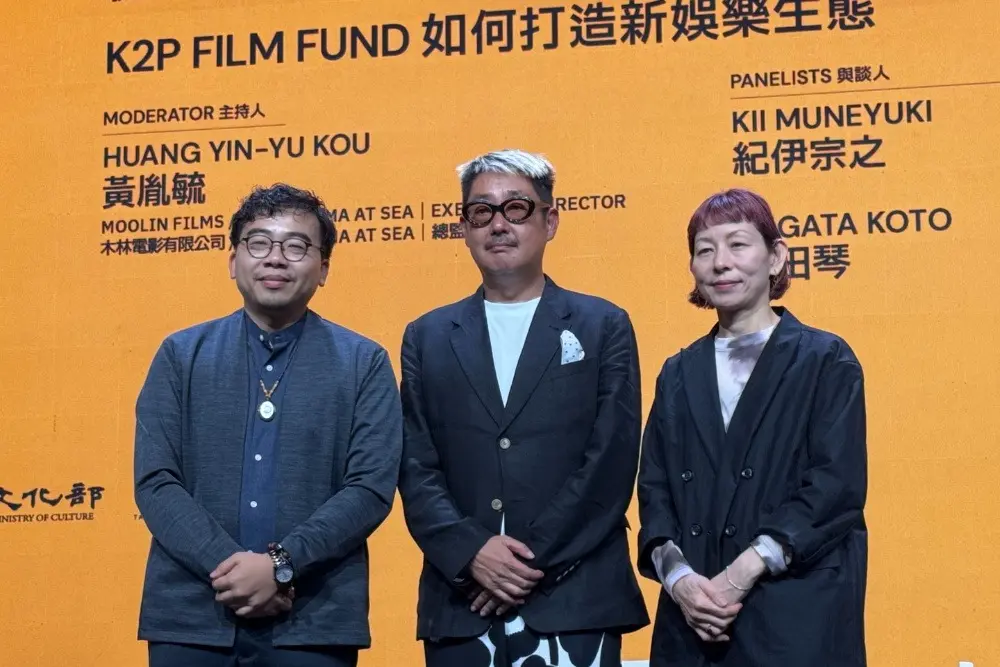
The conversation at TCCF, moderated by filmmaker Huang Yin-yu Kou of Taiwan’s Moolin Films—who is also the founder of the Cinema at Sea – Okinawa Pan-Pacific International Film Festival—highlighted K2 Pictures’ ongoing mission to disrupt traditional Japanese filmmaking models and scale its international footprint.
Kii’s financial backing vehicle, K2P Film Fund I, which previously supported Hirokazu Kore-eda’s animated-style visual adaptation "Look Back," may soon open its doors to new investors. The fund successfully closed its $33 million equity round in February. However, Kii revealed that additional companies have approached K2 about investing since the close, raising the possibility that the round could be reopened if existing backers give their consent, though he has not yet made a final decision.
To date, roughly 30 companies have backed the fund. The investor pool is led by MUFG Bank, Japan’s largest lender, alongside major corporate names such as Bandai, Dentsu, the government-backed Development Bank of Japan, and prominent real estate firms Tokyu Land and Mori Trust, with Kii serving as the fund’s general partner.
This equity is being systematically paired with debt financing and loans that are continuously added to the pool, ultimately targeting a total of $67 million in loans to complement the equity. This will bring K2’s planned capital chest to a staggering $100 million, earmarked to finance a target of 50 films over a seven-year span.
During the TCCF session, Kii shared the stage with director Nagata Koto. K2 previously unveiled Nagata’s Fukushima-set noir project, "The Nuke Crab," at the Cannes Film Festival in May. Discussing the ambitious project, Kii and Nagata revealed they are aiming for a dual-market hit in Japan and Eastern Europe—specifically targeting countries like Poland and Ukraine, where audiences who lived through the real-world devastation of the Chernobyl nuclear accident might deeply connect with the narrative. The project is currently in development, with principal photography targeted to begin next year.
The film explores the lives of those who profited from the massive financial flows directed from across Japan into the government’s radiation clean-up efforts in the Tohoku region. Nagata, whose previous feature "Baka’s Identity" competed at the Busan International Film Festival last year, noted that the subject matter remains heavily socially taboo in Japan, representing precisely the kind of gritty, critical material that major domestic TV networks and traditional studios would routinely avoid.
"When I took it to Kii-san, he immediately said, ‘That sounds interesting, let’s do it,’ and got it started," Nagata recounted.
This project embodies K2’s targeted international distribution strategy, which the company refers to as "Japan plus one." Rather than adopting a broad, one-size-fits-all global approach, K2 carefully identifies specific secondary territories where a film’s themes might resonate on a personal level.
"What Americans like about Japan, what the French like about Japan, what Taiwanese audiences like about Japan and what Koreans like about Japan are completely different," Kii explained. "The Japan that Japanese people like is different again."
Nagata emphasized that while the global public is largely aware of the Chernobyl disaster itself, far less is understood about how the daily lives of local people transformed in the aftermath. Her goal is to lock in international sales early enough so that overseas releases can roll out concurrently with the Japanese theatrical run. She believes universal human emotions will bridge any cultural gaps for foreign viewers.
"I think jealousy and love are the same anywhere in the world, as long as we are human," Nagata said.
K2 Pictures was specifically established as a direct challenge and alternative to Japan’s entrenched production committee system. Under the traditional committee model, domestic films are financed and produced with a strict focus on the local market alone. Kii, whose career in the industry began in his youth tearing cinema tickets and popping popcorn before he eventually rose to become a producer at Toei, argued that the historically closed nature of the Japanese studio system has effectively locked out foreign and outside investment. In turn, this structural limitation has made it exceptionally difficult to return meaningful profits to the actual creators.
Under K2’s alternative model, profits are calculated on a strict title-by-title basis. The financial split allocates 70% of the returns to investors, while reserving 30% directly for the creative side.
"Producers and the people involved in making the film aren’t putting up money, but the film exists because of their creativity," Kii noted.
The studio has maintained a rigorous production pace, completing six films over the past year. This slate includes Kore-eda’s live-action adaptation of Fujimoto Tatsuki’s manga "Look Back"—which competed at the Venice Film Festival—and Son Myung-ah’s debut feature "Trophy," which is slated to open in South Korea. Kii stated that the company’s long-term goal is to maintain an output of six or seven releases annually, though he freely admitted that after just one year in operation, sustaining that frantic pace has proven to be "pretty tough."
As part of its strategy to bypass traditional bottlenecks, K2 has established physical outposts in Taiwan and South Korea with the explicit objective of distributing its films directly in both markets. Kii pointed out that roughly 99.9% of Japan’s overseas film business historically relies on passive licensing deals, a practice he contends fails to build long-term international equity or raise the global value of Japanese cinematic titles.
"Japanese people taking Japanese films to that place and promoting them hard there – I think that’s what raises their value," he said.
Greenlighting decisions at K2 are decentralized among its roster of six or seven producers, including Kii himself. He emphasized that he operates on a principle of trust, refusing to block any project that a producer is passionately committed to, provided it passes a fundamental fiscal test of balancing costs against realistic revenue projections.
"Nobody can tell whether a film will be a hit," Kii said.
According to Kii, this pragmatic philosophy applies equally to high-minded arthouse cinema and broad commercial ventures. "If it’s only going to bring in JPY50 million ($330,000), make it for JPY20 million ($130,000)," he remarked during the session.
This risk-mitigation strategy is also extended to first-time directors. Kii explained that producers work proactively to secure pre-sales, streaming rights agreements, and corporate sponsorships ahead of time. The objective is to structure debut features so they cannot suffer catastrophic financial losses, noting that a massive commercial failure early on often makes it nearly impossible for a young director to secure funding for a second film.
"I want to keep launching new directors from K2 Pictures," Kii said. "And I want them to be grateful for the rest of their lives. Don’t forget us when you make it big."
Beyond reforming production and distribution models, Kii has set his sights on systemic legal reform within Japan’s financial sector. He shared that discussions with a British entertainment lawyer and an American completion bond executive highlighted how the international film business fundamentally functions like real estate: producers create valuable intellectual property assets and subsequently monetize them. While Japan successfully passed an investment trust law around the year 2000 that allowed real estate assets to be effectively securitized, current legislation does not extend the same framework to creative content. Kii confirmed he has been actively consulting with legal experts to advocate for a change in the law.