
When fitness enthusiasts discuss building strength, mobility, and stability, the conversation almost invariably focuses on the major muscle groups that dominate our attention in the mirror. We track our biceps, quads, abdominals, and glutes, obsessing over their development and building entire training blocks around their growth. We ice our hamstrings, foam roll our IT bands, and dedicate hours to shoulder mobility. Yet, beneath our weightlifting shoes and cushioned daily sneakers lies an intricate, hardworking system that is almost entirely ignored: the feet.
Comprising 29 small muscles, 26 bones, and thousands of mechanoreceptors, the human foot is a marvel of biological engineering. Muscles like the flexor digitorum brevis, quadratus plantae, and plantar interossei work constantly underneath us with every step we take. Despite their vital role in our daily movement, these muscles remain a complete afterthought for most people. We meticulously care for the rest of our musculoskeletal system while sliding our feet into narrow-toed sneakers and calling it a day, creating a glaring blind spot in modern fitness and wellness routines.
Your Feet Are Running the Show
To understand why this oversight matters, one must look at how the body interacts with the physical world. The feet serve as the absolute first point of contact between the human body and the ground. Every single step taken is a continuous neurological and muscular feedback loop. The brain is in constant communication with the thousands of mechanoreceptors embedded in the soles of the feet, processing spatial orientation, calculating how to distribute mechanical load, and making microscopic adjustments to keep the body upright.
This process occurs automatically, all day long, making it easy to take for granted. What is far less easy to ignore, however, is what happens when that complex system begins to break down.
Biomechanics experts emphasize that dysfunction in the foot rarely stays localized. Instead, it travels upward through the ankle joint, radiates into the knee, influences the hip structure, and eventually manifests in the spine. What begins as a tight, underused arch can gradually contribute to compensatory movement patterns. Over time, these compensations show up as stubborn knee pain, hip instability, or chronic lower back tightness that confounds patients and practitioners alike if they fail to look down at the foundation.

The Longevity Connection
This cascading effect on the skeletal system has profound implications for long-term health and aging. Courtney Conley, M.D., a chiropractic physician and prominent expert in foot and gait mechanics, points out that declining foot strength directly correlates with reduced gait speed, an increased risk of falls, and a gradual loss of physical independence as individuals age. These are not merely isolated orthopedic concerns; they represent real, measurable health outcomes that begin accumulating long before most people ever think to pay attention to their foot health.
Both contemporary research and longevity specialists have made it increasingly clear that foot function serves as a primary predictor of how well a person will move through life over time. Recognizing this connection prompts a crucial realization: waiting until a painful pathology or injury develops is a reactive approach to health that can easily be avoided through proactive awareness.
Making Foot Health a Priority
Motivated by these insights, one fitness writer and researcher recently decided to run a personal experiment. Rather than undertaking an extreme or overly regimented training protocol, the goal was simply to spend a month deliberately integrating foot awareness into daily life and observing the physiological and sensory changes that followed.
The intervention began with small, manageable habits, such as incorporating toe spacers during evening relaxation time on the couch. Initially, the sensation was quite unfamiliar and even uncomfortable—though not painful—particularly for someone with a background in sports and long-distance running. This discomfort was underscored by a growing visual awareness of how modern footwear alters human anatomy. Observing the compressed, crowded toes of elite athletes in high-impact sports highlighted the toll that narrow shoes and rigorous training take over time. Determined to avoid long-term structural changes, the toe spacers became a regular post-workout ritual, particularly after high-lateral-movement activities like pickleball, which heavily compress the foot.
Alongside passive stretching and alignment tools, the experiment incorporated targeted foot-specific strength work. This required surprisingly little equipment, focusing instead on slow calf raises with an explicit eccentric focus—emphasizing the lowering phase where the true muscular work occurs—alongside short-foot exercises, barefoot balance drills, and humbling attempts at independent toe isolation. Because these exercises could easily be performed while working at a standing desk, the barrier to entry was minimal, though the difficulty of isolating forgotten muscles served as a humbling reminder of their previous neglect.
Another major adjustment involved eliminating house slippers. Although giving up cushioned footwear around the home was a reluctant sacrifice, the objective was to allow the feet more time to engage directly with the ground, thereby activating intrinsic muscles that otherwise sit idle inside cushioned footwear. In a dense urban environment where true barefoot time outdoors is rare, increasing barefoot exposure indoors—and transitioning to training in socks during gym sessions, particularly for single-leg work and squats—proved to be an accessible and effective intervention.
Evaluating the Footwear Landscape
The final and perhaps most impactful phase of the experiment was a comprehensive audit of everyday footwear. By examining the shoes worn for hours at a time—walking shoes, training shoes, and daily footwear—the researcher evaluated toe box shapes, cushioning levels, and overall structural design. The evaluation revealed a striking paradox: modern footwear prioritizes a specific kind of immediate comfort that can inadvertently diminish long-term mechanical function.
As Dr. Conley explains, highly cushioned running shoes tend to dampen the sensory input originating from the mechanoreceptors in the soles of the feet. This reduction in proprioception deprives the brain of vital information regarding the body’s position in space, yielding a less stable platform for movement. Under heavy loads—such as during a barbell squat, a lunge, or a rapid lateral cut on a sports court—that lack of sensory clarity creates micro-instabilities. These minute disruptions travel upward through the ankle, knee, hip, and spine, accumulating wear and tear over decades of movement.
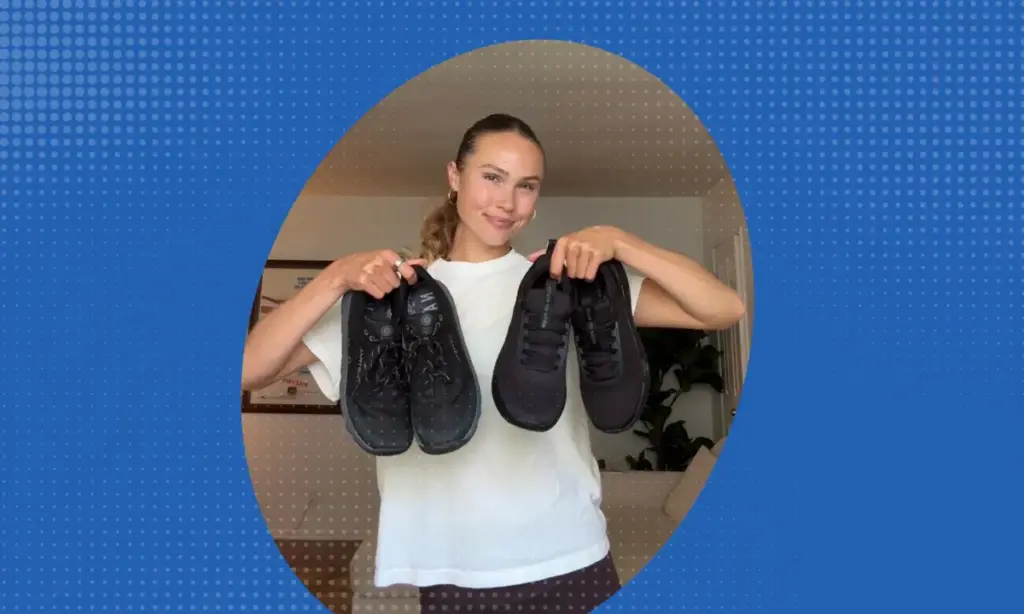
To address this, the experiment integrated alternative footwear options designed to restore natural biomechanics. The first pair tested was the Astral TR1 Sensi HT. Characterized by a wide toe box, a zero-drop platform, and construction utilizing natural fibers, these shoes were designed to maximize ground feel without stripping away necessary support. Transitioning to zero-drop footwear required a gradual approach to allow the foot structures time to adapt after years spent in heavily cushioned alternatives, but the difference in toe splay and ground connection was immediate.
The second footwear choice was the while on earth move trainer, selected for more active days. Featuring a wide toe box and a modest 6-millimeter heel-to-toe drop, this option provided slightly more cushion for higher-impact activities while still maintaining a minimalist profile. Together, these shoes successfully covered diverse daily needs, making a subsequent return to traditional, narrow footwear feel like a distinct downgrade in sensory feedback and physical freedom.

Observed Changes and Practical Takeaways
After a month of heightened foot awareness, the resulting changes were subtle yet distinct. The participant reported improved stability during single-leg exercises such as split squats and Romanian deadlifts, where balance dictates performance. Furthermore, there was a noticeable reduction in foot fatigue following long walks, runs, and athletic matches, alongside a greater sense of connection and control during heavy resistance training.
More than the physical adaptations, however, the primary transformation was cognitive. A heightened consciousness regarding posture, weight distribution, and shoe selection fostered a deeper connection to everyday movement and quicker adjustments when physical alignment felt compromised.
Ultimately, the experiment highlights a fundamental oversight in modern health and fitness culture. While society invests immense energy into chasing visible aesthetics and measurable external metrics, the true foundation of human movement rests upon 29 small muscles, 26 bones, and a sensory feedback system that has spent decades in the dark. Whether the objective is athletic achievement, long-term longevity, or simply remaining active and independent well into later life, the journey begins at the ground level, where the foundation is quite literally underfoot.