

Unusual weather patterns and a shallow, developing snowpack have triggered a rash of early-season avalanches across the Mountain West, sweeping multiple backcountry skiers into jagged, exposed terrain. Safety officials are issuing urgent warnings to outdoor enthusiasts, cautioning that the slopes boasting the deepest snow cover often carry the most severe hazards during the nascent months of winter.
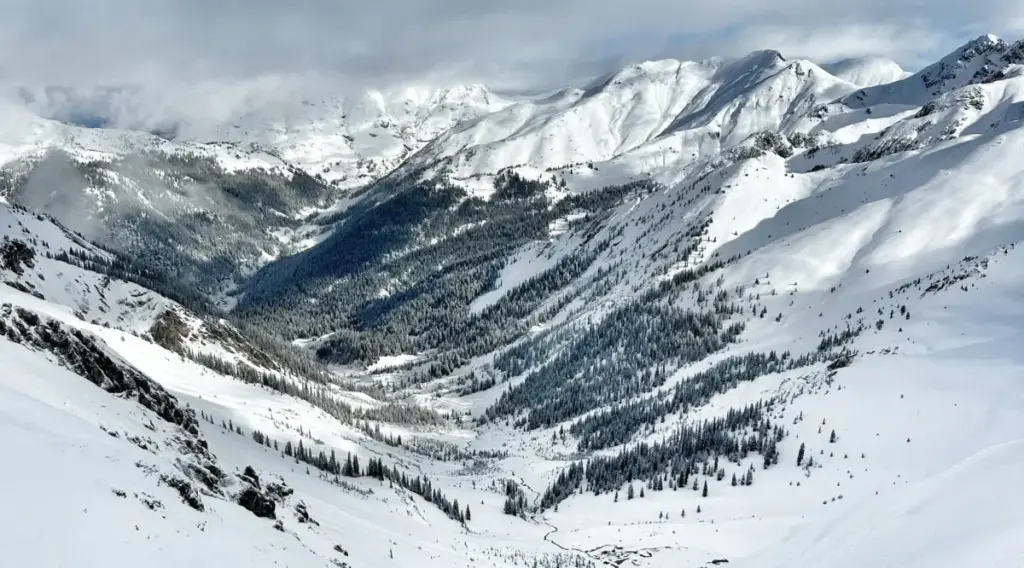
The risks were starkly highlighted on November 3 near Silverton, Colorado, when an avalanche swept an unidentified skier an estimated 500 feet down a steep mountainside. The slide partially buried the skier before his touring partner managed to dig him out. Remarkably, the skier emerged unharmed from the harrowing ordeal. The entire incident was captured on video by professional skier and filmmaker Colter Hinchliffe, whose footage quickly circulated within the outdoor community as a chilling reminder of early-season mountain volatility.
This close call is far from an isolated event. It is one of several alarming avalanche incidents recorded across the Mountain West early in the 2026 season, collectively illustrating that a thin overall snowpack does not equate to safety in the backcountry.
On October 25, another skier triggered a wind-slab avalanche on Colorado’s Mount Bross. That slide buried the victim face-down in the snow before quick-thinking companions rushed to unearth them. Days later, on November 1, backcountry travelers near Alta, Utah, triggered multiple wet-snow slides. According to an official observation submitted to the Utah Avalanche Center, those slides ran violently over a cliff band and eventually reached a service road below.
As of November 6, the Colorado Avalanche Information Center (CAIC) has recorded nearly 100 avalanches statewide. Among those, 15 were explicitly triggered by human activity, primarily skiers testing the nascent snowpack.
Brian Lazar, the deputy director of the CAIC, noted that while the sheer volume of slides is not entirely unprecedented for this time of year, the underlying snow conditions demand extreme vigilance.
"That amount of avalanches at this time of year is not that unusual," Lazar said in an interview. "We’re in avalanche season, even though the snowpack is still developing, and it’s important to acknowledge that, even when there’s a lot of dry ground showing."
Early-Season Avalanches Are Already Catching Skiers
The temptation to chase early-season powder has driven high volumes of eager recreationists into the backcountry, particularly in regions like southwestern Colorado’s San Juan Mountains, where early storms have dumped heavy snow above 11,000 feet.
Colter Hinchliffe observed that this surge in early-season enthusiasm directly correlates with an increased probability of accidents. With numerous skiers eager to make their first turns of the year, the margin for error narrows significantly.
"A lot of people in the mountains means a lot of decisions are being made, and some of them can go wrong," Hinchliffe said. "That’s kind of what we saw."
Beyond human factors, erratic weather has played a critical role in destabilizing the snowpack. Lazar explained that two recent, unusually warm and wet storms brought heavy rain to elevations exceeding 12,000 feet in parts of southwestern Colorado. This liquid precipitation saturated the developing snow layers, triggering immediate wet avalanches. Furthermore, the intermittent dry periods between these storms allowed weak, fragile layers of faceted snow to form on the surface, which subsequent snowfalls then buried, creating classic, highly unstable slab conditions.
Why Early-Season Snow Can Be Dangerous
The dangers inherent to early-season avalanches extend far beyond the sheer volume of moving snow. Even relatively small slides, which might lack the mass to cause a deep burial or a fatal asphyxiation, present severe physical threats due to the surrounding landscape.
"Even if you get knocked off your feet and take a short ride in a small avalanche, it might not be big enough to bury or kill you, but it can drag you across rocks, logs, stumps, and things like that," Lazar warned. "Early-season conditions can produce some really nasty rides, even in small avalanches."
Compounding this physical hazard is the deceptive nature of the terrain itself. Because early-season snowfall is rarely uniform, exposed rocks, fallen timber, and gaping chasms remain partially uncovered. Skiers venturing out in search of continuous riding surfaces are naturally funcled into specific corridors where snow has drifted or accumulated to sufficient depths.
"If you’re going out looking to ride on snow, you are naturally drawn to the places with the best coverage, and those are the same places that often have the most dangerous avalanche conditions," Lazar noted.
To mitigate these risks, avalanche safety organizations and experienced backcountry travelers emphasize the necessity of rigorous preparation. Before stepping into the backcountry, experts urge skiers to consult local avalanche forecasts, ensure they are carrying essential rescue gear—including a avalanche transceiver, a sturdy shovel, and a probe—and travel exclusively with knowledgeable partners who are well-versed in rescue protocols. Regular practice and formal avalanche education are continually cited as cornerstones of safe winter recreation.
For seasoned professionals like Hinchliffe, these early-season hazards serve as a powerful psychological cue to scale back ambitions and practice profound restraint. Reflecting on the morning of the Silverton slide, Hinchliffe noted that he and his touring partner had explicitly agreed to maintain a conservative mindset, intentionally avoiding steeper, more committing lines in favor of mellower terrain.
"At this point, I’ve got the whole season laid out in front of me," Hinchliffe said. "So when I ski in the early season, I try to be very cautious with my choices."