

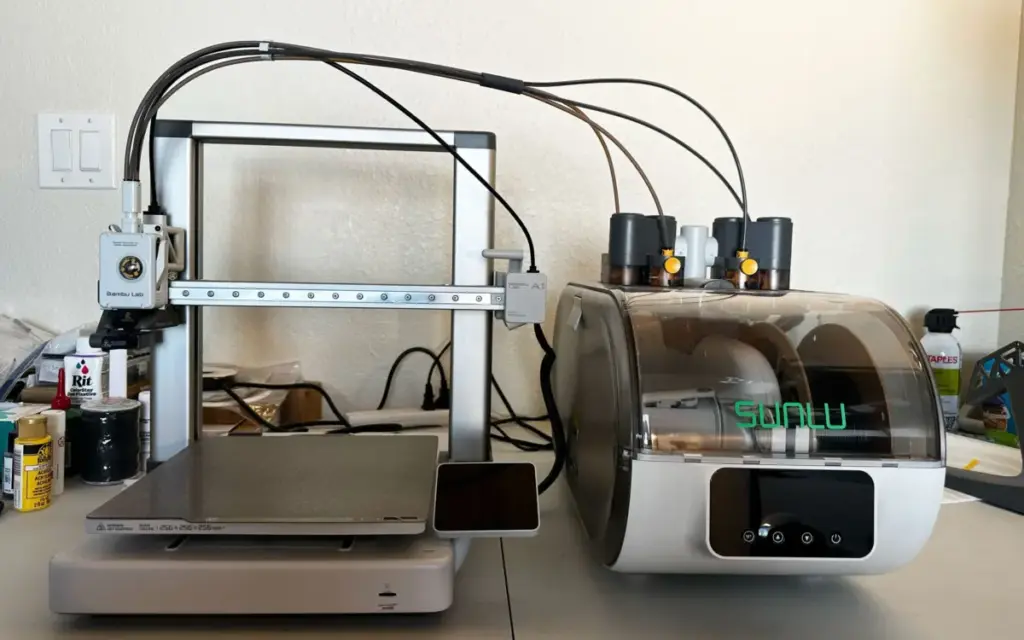
For many 3D printing enthusiasts, moisture in filament is an invisible enemy that quietly ruins prints with popping sounds, stringing, and weakened layer adhesion. While standalone drying cabinets and separate spool boxes have long been staples for hobbyists battling humid climates, keeping filament dry during active multi-color printing presents an ongoing logistical challenge. Enter Sunlu’s latest hardware offering: the AMS Lite Filament Heater, priced at $130 and designed specifically to integrate directly with Bambu Lab’s popular A1 printer series and its corresponding AMS Lite multi-material system.
The device, manufactured by Sunlu, bridges the gap between active filament drying and automated multi-material feeding. Unlike traditional standalone drying boxes that require users to feed dry filament out of a separate enclosure into the printer, Sunlu’s iteration integrates directly into the hardware architecture of the Bambu Lab AMS Lite. This design philosophy creates a fully enclosed system capable of conditioning filament both before and during active printing jobs.

Approaching the assembly process requires a shift in perspective. What initially appears to be a straightforward accessory attachment turns out to be a more involved integration. Installing the heater involves splitting the core structure of the AMS Lite apart and inserting the Sunlu heating unit directly into the middle of the assembly. Despite the slightly daunting prospect of dismantling factory hardware, the practical installation process is surprisingly manageable. It primarily requires swapping out a handful of screws and plugging in two internal wires.
The engineered integration retains key functionalities of the original ecosystem. The modified AMS Lite continues to draw its main power directly from the Bambu Lab printer. This setup allows users to run print jobs without activating the heating elements, or alternatively, to run the drying heater independently while the printer itself remains powered off. Aside from minor alignment quirks—such as a couple of screw holes that required patience to match up and a somewhat fussy replacement plastic cover—the final hardware assembly achieves a remarkably clean, factory-style integration.
Operationally, the Sunlu AMS Lite Heater provides a robust suite of controls tailored to modern engineering and aesthetic printing materials. The unit comes equipped with six preset temperature and humidity configurations optimized for standard and advanced polymers, including PLA, PETG, TPU, ABS, PA (Nylon), and PC (Polycarbonate). For operators who prefer manual control, the system allows custom temperature adjustments ranging from 35 degrees Celsius to 70 degrees Celsius, alongside humidity target ranges between 25 percent and 50 percent.

The integrated timer defaults to a standard six-hour heating cycle. Once the initial timer elapses, the system transitions into an intelligent maintenance mode, automatically engaging whenever ambient humidity crosses a 50 percent threshold to bring the internal environment back down to the user-defined target value. Throughout extended operational cycles, the enclosure remains comfortably warm to the touch without posing any risk of burns. Furthermore, the unit manages thermal containment effectively, preventing heat from leaking into the surrounding workspace, and operates at a low, unobtrusive noise level.
Evaluating the tangible benefits of the heater depends heavily on regional climate conditions. Testing conducted in the relatively stable and moderate climate of the San Francisco Bay Area showed that while the system functioned exactly as advertised, it did not yield a dramatic, night-and-day improvement in surface finish or structural integrity for standard prints. Because the environment lacked extreme baseline humidity, the baseline quality of the printed parts was already high. However, makers operating out of significantly more humid regions can expect to derive much more substantial performance benefits, particularly given that the unit maintains its drying cycle concurrently with ongoing printing tasks.
Practical considerations also come into play regarding spatial arrangement and desktop footprint. Because the Sunlu heater encloses the entire AMS Lite assembly, users must account for physical clearance around the sides of the machine. The access doors on the heater require dedicated space to fold downward. Due to the relatively short length of the stock Bambu PTFE tubing connecting the system to the printer, accessing the side facing the printer can sometimes require rotating the entire combined unit to comfortably load or unload filament spools.

Another vital operational factor involves material compatibility during concurrent multi-spool setups. Because the filament spools are housed and heated within a shared, enclosed environment, operators must exercise caution when loading mixed material types. Different polymers demand vastly different thermal thresholds. For instance, setting a high drying temperature tailored to a spool of PETG could easily exceed the glass transition temperature of an adjacent spool of PLA loaded in the same system, leading to softened filament strands that risk melting and fusing together.
Despite these workflow considerations for mixed-material printing, the Sunlu AMS Lite Heater offers a clever, purpose-built engineering solution. It delivers reliable drying performance, intuitive digital controls, and seamless hardware integration while preserving the compact desktop footprint that makes the Bambu Lab A1 and AMS Lite combination popular among makers.