



For comic book enthusiasts, the digital age has transformed the pursuit of obscure international art into a global treasure hunt. Across the internet, niche preservationists and dedicated fan communities keep long-forgotten works alive, scanning and translating bandes dessinées, science-fiction serials, and serialized stories buried deep within old magazine anthologies. While major European hits like Valerian or Yoko Tsuno eventually crossed oceans to find official translations and widespread release, dozens of other stellar titles remain perpetually out of print. Discovering a well-crafted, overlooked narrative from another country often feels akin to striking gold.
This dynamic is doubly true for newspaper comics, a medium historically treated as inherently disposable in ways traditional graphic novels never are. Consequently, very few newspaper strips have ever managed to build a lasting international audience. Notable exceptions include Andy Capp and Fred Basset, two British creations that successfully outlived their original creators. Yet, these cultural exports do not encompass every British classic—such as the United Kingdom’s Dennis the Menace, which debuted in the British comic anthology Beano in 1951, arriving a mere five days before Hank Ketcham launched his unrelated American comic strip of the same name.
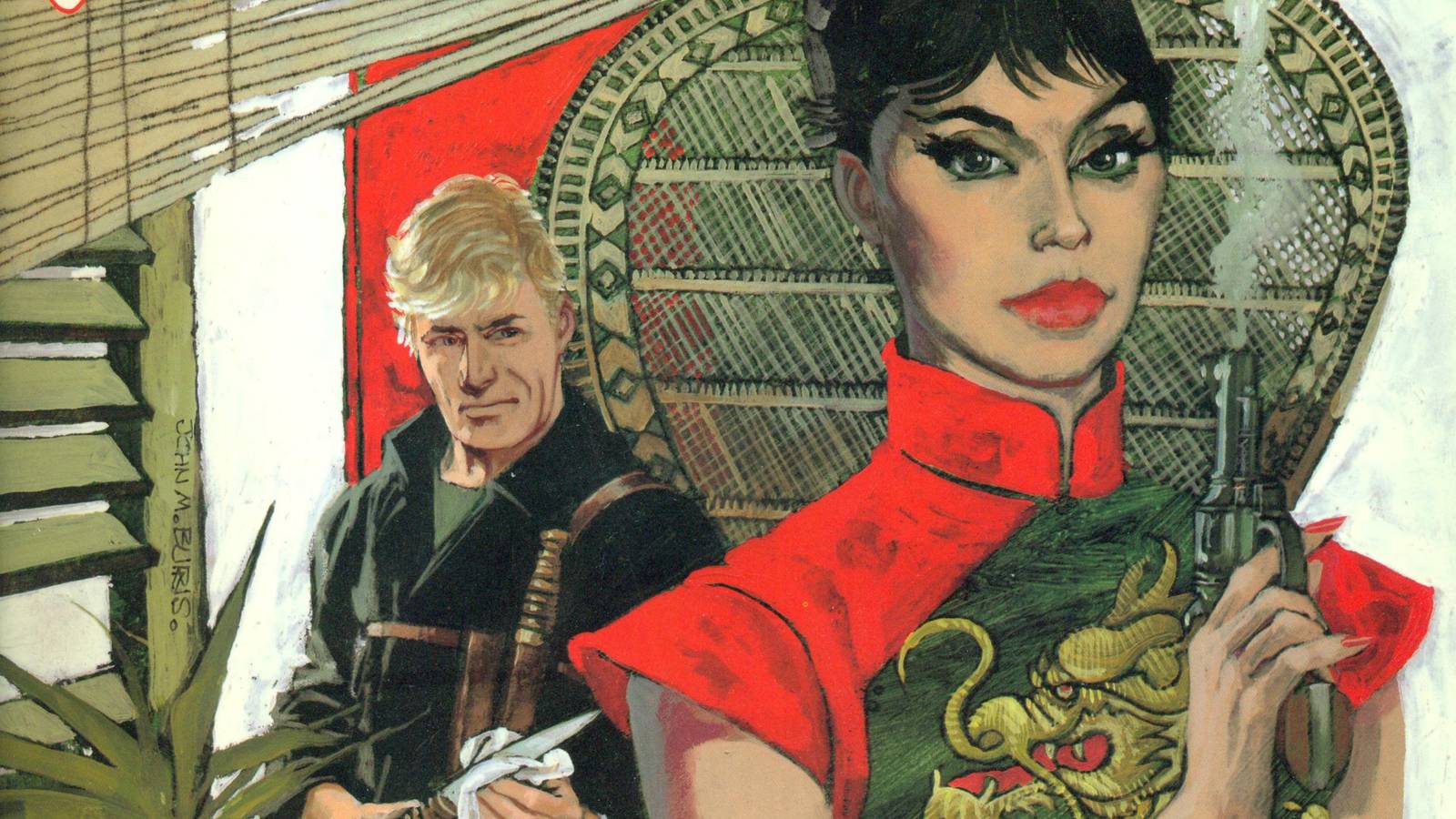
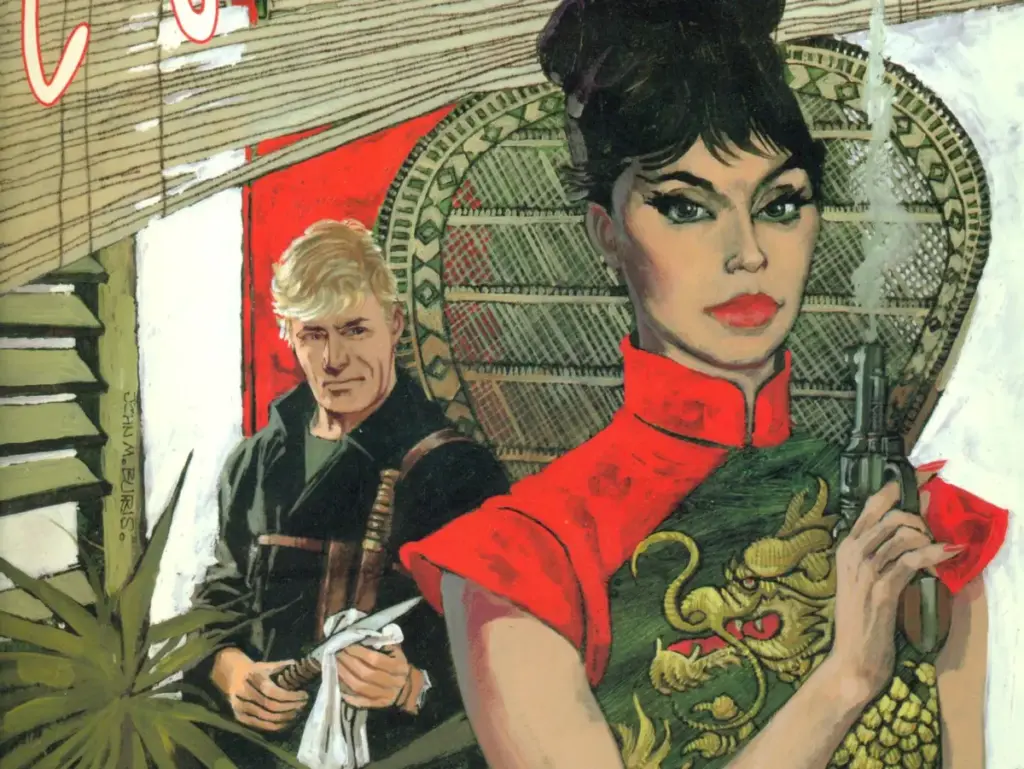
Among the most glaring omissions from the American comics canon is the celebrated British adventure strip Modesty Blaise. Created by the late writer Peter O’Donnell, the comic ran in British newspapers from May 1963 through February 2001, remaining virtually unknown across the United States throughout its nearly four-decade run. While the character enjoys a passionate, enduring following globally more than 25 years after publication ceased, Modesty Blaise was only ever carried intermittently by a handful of American newspapers. Industry historians largely attribute this absence to the strip’s frequent and casual depictions of nudity, which kept it far too risqué for mainstream American newspaper syndicates of the era. The irony of the protagonist’s name—Modesty—was matched only by her willingness to dispense with garments when the plot demanded it. For years, the Detroit Free Press stood as a solitary American exception for carrying the strip, and even then, editors occasionally resorted to censoring individual panels.
For the rare American fan who did encounter the character, the introduction usually came via O’Donnell’s companion line of original novels or through one of the property’s two cinematic adaptations. The 1966 feature film Modesty Blaise, a campy box-office misfire starring Monica Vitti and Terence Stamp, managed to cultivate a dedicated cult following over the decades. That enduring legacy eventually inspired Quentin Tarantino to serve as executive producer on the loosely adapted prequel My Name is Modesty in 2004.
For younger readers or American audiences who missed its original newspaper run, the Modesty Blaise strips represent absolute classics of the adventure format. While certain storylines and cultural attitudes have naturally weathered poorly over the decades, the series remains an undisputed pillar of 20th-century adventure comics. Modern readers looking to experience the source material can find the complete original run collected across 27 paperback volumes published by Titan Books between 2004 and 2017. Though acquiring the entire shelf requires some determination, every volume remains in print at the time of writing, complete with behind-the-scenes commentary and historical context provided by O’Donnell himself. For fans of classic spy movies, gritty crime dramas, or heist television shows like Leverage, the adventures of Modesty Blaise offer a rewarding literary journey.

Magnets for Trouble
The character’s origins trace back to the aftermath of World War II, where she was "born walking" as an orphaned refugee in the Middle East, entirely stripped of any knowledge regarding her birth parents or nationality. She eventually wandered into Tangier, a crucible of international intrigue, where she swiftly seized control of a local street gang. Under her visionary guidance, the operation rapidly expanded into an international organization of anti-heroic criminals known simply as "The Network." While Modesty and her syndicate never flinched from grand larceny or high-stakes corporate espionage, they frequently turned their considerable resources toward crushing the drug traffickers and human traffickers operating within their territories.
Having successfully amassed a personal fortune, Modesty ultimately secured British citizenship and retired to a comfortable life in London alongside her inseparable right-hand man and platonic partner, Willie Garvin. Highly traveled and immensely wealthy, both characters possess years of elite training as thieves, spies, and martial artists. Modesty is a dead shot with firearms, while Willie operates as a master of throwing knives. These formidable skills naturally make them irresistible targets for British intelligence, which frequently enlists the pair as freelance troubleshooters for impossible missions.
Furthermore, Modesty’s colorful criminal background, unique skillset, and innate gravitational pull toward danger consistently thrust her and Willie back into peril, whether through voluntary intervention or sheer misfortune. Both characters embody a classic pulp-fiction archetype—a literary superpower shared by modern action heroes like Jack Reacher—whereby they can effortlessly stumble upon an old friend or a deeply imperiled stranger no matter where they happen to be on the planet. One notable example occurs in the storyline "The Stone Age Caper," wherein Willie becomes hopelessly lost in the Australian outback and randomly crosses paths with the exact Aboriginal Australian he happens to personally know.
In its earliest incarnations, Modesty Blaise functioned as a quintessential Cold War-era pulp action strip. The narrative is neatly divided into roughly 95 individual storylines that frequently pit Modesty and Willie against ruthless communist organizations such as "La Machine," "Top Traitor," and "The Wicked Gnomes." Other sweeping arcs involve small-time con artists in adventures like "The Girl From the Future" and "The Moon Man," or organized crime syndicates in "Death in Slow Motion" and "The Maori Contract," alongside recurring vendettas against old rivals like "The Girl in the Iron Mask." The overarching stakes in Modesty Blaise are routinely kept refreshingly small-scale—focusing primarily on personal vengeance, immediate justice, or basic survival rather than the hollow threat of universal annihilation. This deliberate constraint consistently serves the narrative’s overall benefit.
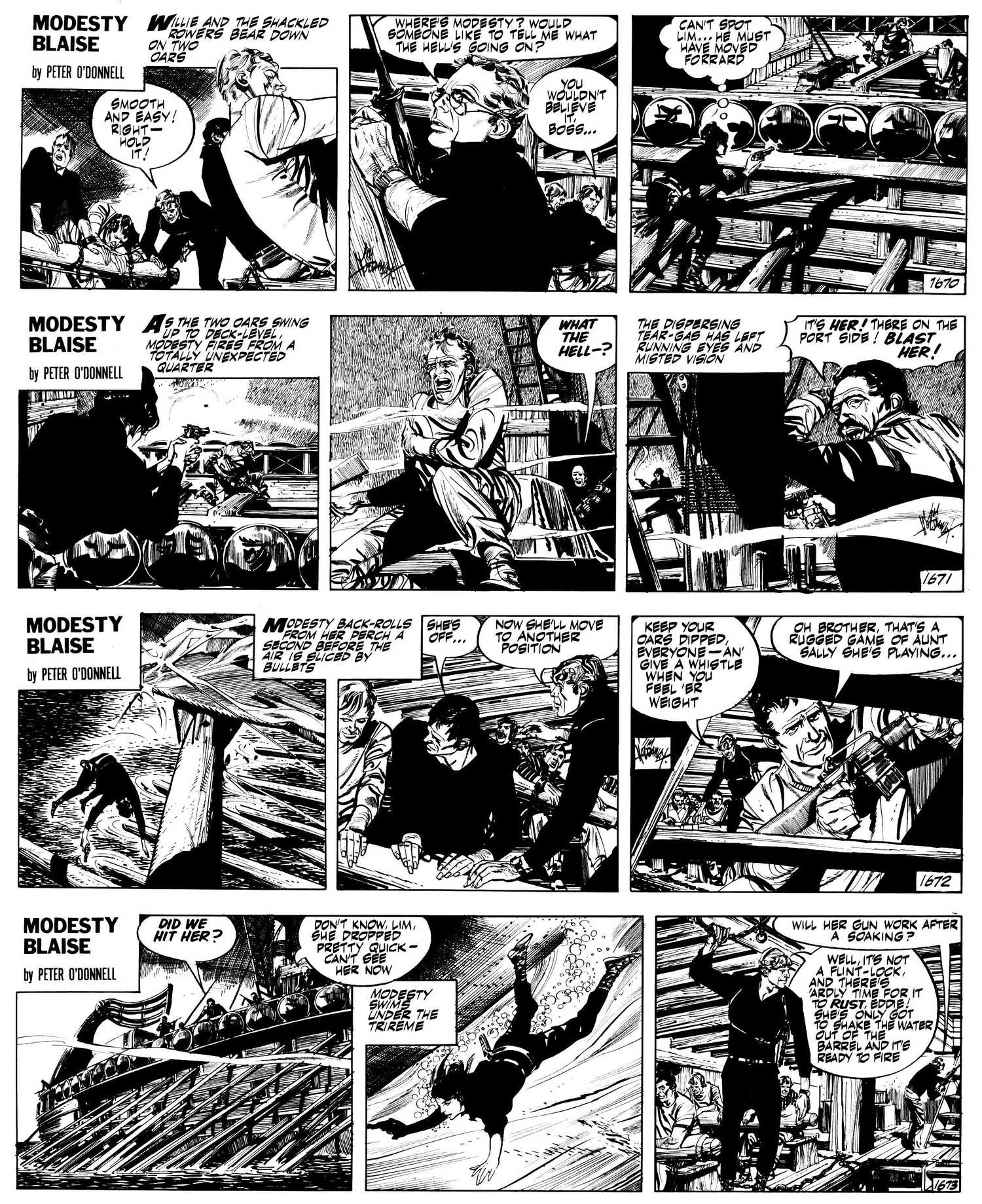
The artistic integrity of the strip shifted following the sudden death of original artist Jim Holdaway in 1970. The vast majority of the subsequent run was brought to life by acclaimed Spanish illustrator Enrique Badia Romero, known for his work on Axa and Judge Dredd. Additional artistic contributions came from notable talents including John Burns of 2000 AD and Heavy Metal fame, newspaper cartoonist Neville Colvin—who illustrated fan-favorite arcs like "The Balloonatic"—and, for a brief stint spanning a single and a half storylines in 1979, Pat Wright of Private Eye.
Holdaway and Romero, celebrated as the definitive Modesty Blaise artists, possessed an astonishing talent for economic visual storytelling. Both masters frequently achieved more narrative impact within the span of three panels than many contemporary pencilers manage across an entire page. This exceptional efficiency transformed Modesty Blaise into a genuinely thrilling read, capably squeezing remarkably elaborate action sequences within the tight spatial constraints of a traditional black-and-white newspaper strip. Combined with O’Donnell’s sharp plotting and crisp dialogue, the collaboration established Modesty Blaise as one of the finest adventure serials of the late 20th century. For aspiring creators studying sequential art, the panel compositions of Holdaway and Romero remain essential academic studies.
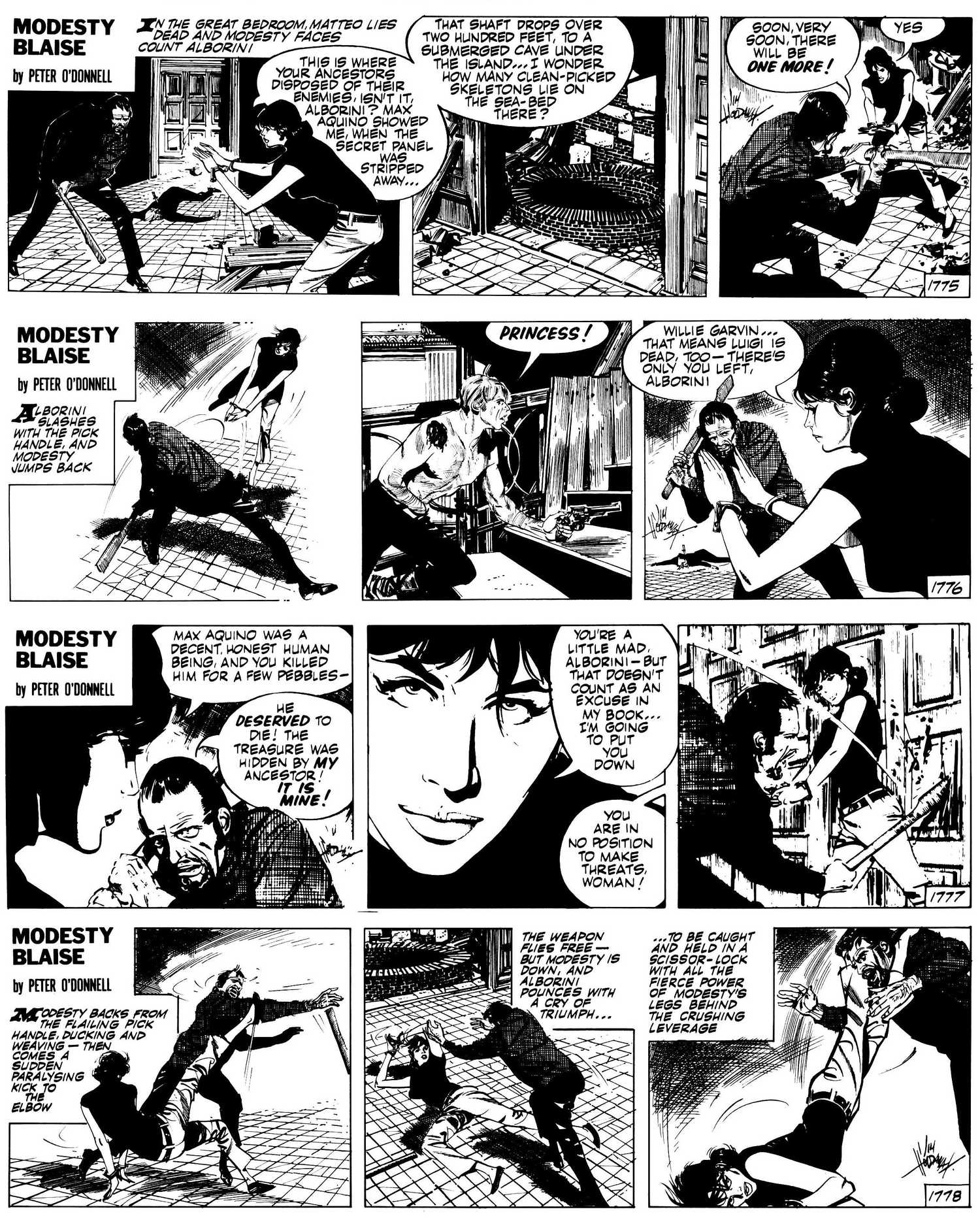
Naturally, not every element of Modesty Blaise has aged gracefully. At times, these anachronisms supply a distinct charm for modern readers, such as when characters pull out now-obsolete technology and treat it like a revolutionary trump card. In the 1972 storyline "The Bluebeard Affair," for instance, Willie successfully outwits a pair of armed thugs by utilizing a portable cassette player—a cutting-edge consumer electronics device at the time of publication. Other narratives similarly highlight period-specific innovations like ham radios, early VCRs, Mace spray, or heavy-duty thermic lances.
On other occasions, the strip stands firmly as a product of its historical era. While Modesty Blaise was frequently ahead of its time regarding progressive cultural issues like race—with both Modesty and Willie routinely standing shoulder-to-shoulder with marginalized communities against bigoted antagonists—the material has occasionally faced controversy among contemporary audiences due to outdated vernacular. As recently as 2020, explicit racial prejudice displayed by a villain toward indigenous Australians within the 1971 storyline "The Stone Age Caper" resulted in Modesty Blaise reprint collections being temporarily pulled from distribution by a major newspaper in Australia.
Despite these necessary historical caveats, Modesty Blaise unquestionably deserves a prominent place on the bookshelf of anyone who appreciates a masterfully crafted serial adventure. For readers raised in the United States, it remains one of the greatest comics they likely never knew existed, and Titan Books’ comprehensive modern reissues provide a high-quality avenue to experience the timeless escapades of the fabulous, feminine answer to James Bond.