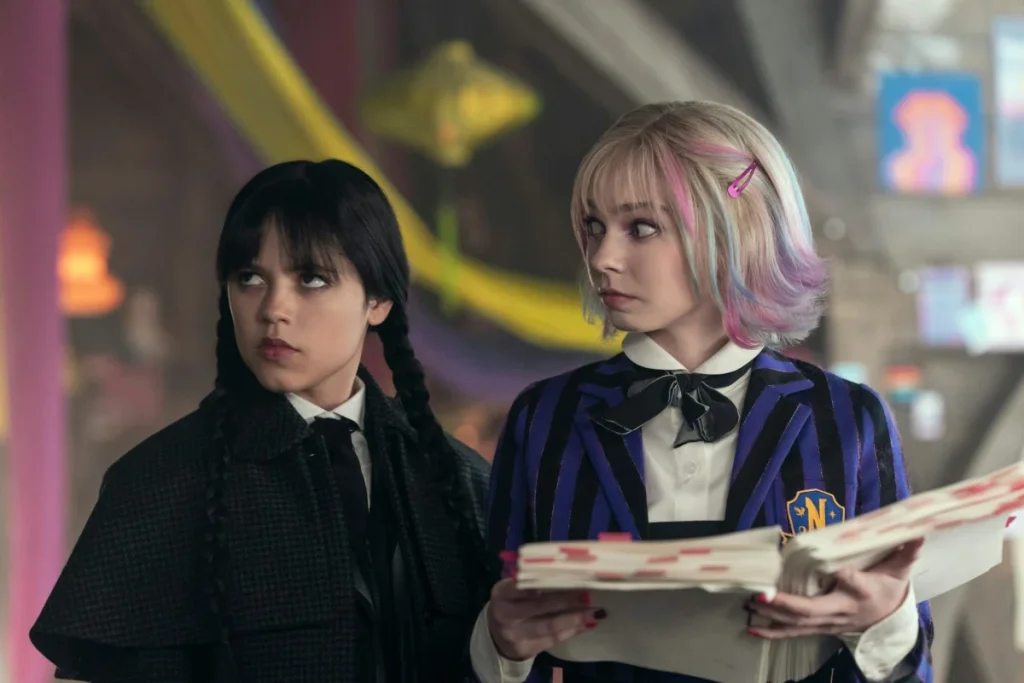
The polar-opposite personalities of roommates Enid and Wednesday in the hit Netflix revival show The Addams Family spin-off Wednesday have captured the imaginations of viewers worldwide. While Wednesday Addams remains a beacon of doom, gloom, and strict monochrome fashion, Enid stands out as a vibrant, colorful explosion of unbridled extroversion. For many parents, watching these characters brings to mind their own children, who often embody a hybrid of the two archetypes—perhaps a talkative, rainbow-loving youngster who suddenly develops a morbid curiosity about the darker side of life.
This duality frequently leads to unexpected and darkly humorous conversations in households everywhere. A trip to a natural history museum to look at prehistoric exhibits, for instance, can quickly pivot from innocent wonder to complex inquiries about how the bones actually exited the dinosaurs’ bodies. Parents often find themselves casually discussing topics like decomposition, caskets, and embalming over everyday snacks like a handful of crackers. Yet, when children begin musing about chopping off limbs or crafting elaborate, miniature coffins for their stuffed animals, it is entirely natural for parents to pause and wonder whether this behavior crosses the line into concerning territory.
If your child leans heavily toward the Wednesday Addams side of the spectrum rather than the sunny disposition of an Enid, you are certainly not alone in questioning where normal childhood curiosity ends and potential behavioral issues begin. However, mental health experts suggest that parents can generally breathe a sigh of relief. While an emerging fascination with death, horror movies, or general violence might give caregivers the creeps, it is rarely a definitive cause for alarm and frequently represents a normal stage of development.
According to Dr. Monika Roots, a child and adolescent psychiatrist and co-founder of the pediatric mental healthcare provider Bend Health, kids frequently use imagination and play as a mechanism to explore big, confusing, or emotionally charged ideas. This psychological processing often manifests in the form of dramatic stories, dark humor, or pretend scenarios that can sound genuinely alarming to adults. Furthermore, an affinity for gothic characters, spooky imagery, and dark humor can simply be a part of identity exploration, particularly as children transition into later childhood and adolescence.
Dr. Roots encourages parents to remember that asking probing questions about morbid topics or engaging in interests that involve the macabre does not equate to harmful intent. When a child talks about death or dark ideas, they are usually trying to make sense of abstract concepts they have recently encountered in stories, media, or casual conversations, rather than expressing an internal desire to cause actual harm to anyone.
This sentiment is echoed by Jillian Amodio, a licensed clinical social worker who frequently works with adolescents. Amodio notes that curiosity surrounding these heavy topics is fundamentally natural, as human beings at various points in their lives inevitably ponder questions related to mortality, the dying process, and the darker aspects of human behavior. For teenagers in particular, this developmental stage is marked by the emergence of advanced abstract thinking. A heightened focus on subjects like true crime, death, danger, and suspense serves as an enticing and effective method to explore complex emotions and process the intricate realities of human existence. It provides a safe psychological boundary to test ideas and explore heavy themes that would otherwise be entirely unsafe or socially unacceptable to enact in the real world.
When parents maintain an open posture toward conversations regarding difficult topics like death, it fosters a safe domestic environment where children feel secure enough to process their concerns and voice their questions. Dr. Roots recommends that adults answer inquiries simply and calmly, maintain a healthy curiosity regarding dark-themed play, and reinforce the notion that natural life processes like dying are a normal part of existence rather than something to be feared.
If a child references something provocative they have witnessed in the media—such as a dark slogan or a violent-sounding phrase—it is typically far more constructive to ask what the expression means to them personally before automatically assuming it reflects their true feelings or mental state. Keeping these lines of communication open reinforces the idea that difficult or uncomfortable topics can be discussed safely at home without fear of immediate reprimand or harsh judgment.
Conversely, shutting down these conversations or responding with intense negativity can inadvertently make dark subjects feel terrifying and overly mysterious to a developing mind. This reactionary stance can ultimately backfire, making it much more likely that older children and teens will seek out answers from their peers, unregulated social media algorithms, or unverified corners of the internet, potentially exposing them to inaccurate information or genuinely disturbing material.
Proactive parental questioning can also help clear up misunderstandings and alleviate unnecessary worries. Amodio recalls a case where a client’s parents expressed deep concern because their young child insisted on carrying around a doll while repeatedly declaring that it was dead. Upon closer inquiry, it was revealed that the child had recently been watching cartoons featuring vampires, understood that vampires were technically considered "dead," and had simply decided that his toy shared the same supernatural status. The child had no genuine preoccupation with mortality or dying; he was merely connecting his toy to a popular cartoon trope.
Despite the fact that an interest in the macabre is usually benign, experts emphasize that there are distinct boundaries where normal childhood curiosity can tip into territory requiring professional attention. With younger children, Dr. Roots advises parents to pay close attention to the overall tone and quality of their play. There is a distinct psychological difference between exploring dark themes purely as a form of fantasy or humor and engaging in play that feels rigid, distressing, or rooted in genuine real-world intent. A child who tells a spooky story while smiling, laughing, or easily transitioning between different play themes presents a completely different picture than a child who appears tense, genuinely fearful, or psychologically stuck on a single distressing idea.
For adolescents, Amodio points out that the concern lies less in the actual genre of the content and more in how the teen engages with it. If an interest in true crime or the afterlife transitions from casual curiosity into a rigid obsession or an unhealthy fixation, that shift serves as an important red flag that parents should address.
Ultimately, experts stress that a dark aesthetic, a temporary spooky phase, or the use of provocative language does not automatically signal impending danger. What matters most is how the child feels and functions underneath those outward expressions. If a child or teenager begins exhibiting concerning shifts in behavior, persistent distress, or other warning signs alongside their dark interests, consulting with a qualified mental health professional such as a child psychiatrist or a licensed therapist is recommended to ensure they receive appropriate support.