




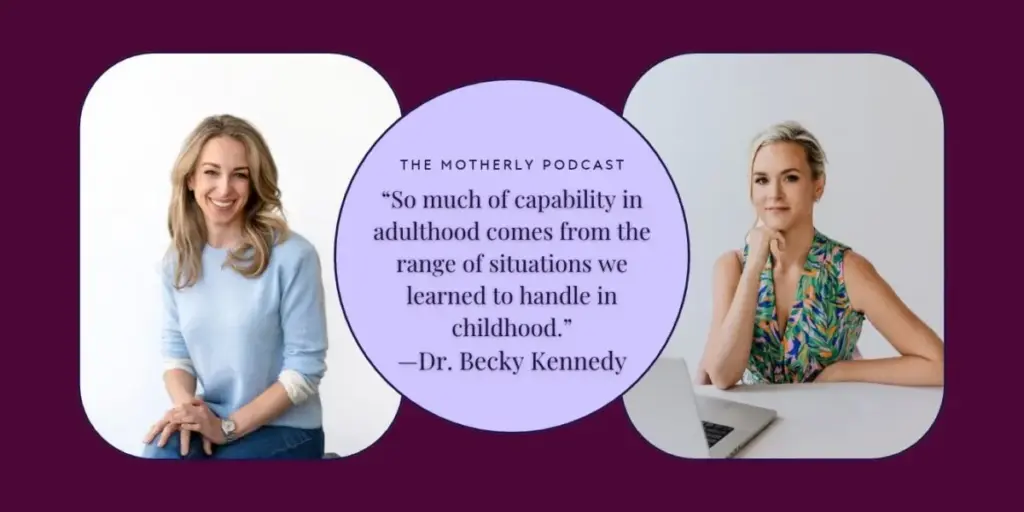
In an era where parents can solve almost any minor inconvenience with a simple tap on a smartphone screen, renowned clinical psychologist Dr. Becky Kennedy argues that we are inadvertently doing our children a profound disservice. The founder of the parenting platform Good Inside and a three-time New York Times bestselling author recently sat down with Liz Tenety on The Motherly Podcast to discuss what true confidence means, how parental authority has shifted, and why letting children experience discomfort is the cornerstone of lifelong resilience.

The conversation touches on core philosophies that have made Dr. Kennedy a trusted voice for millions of caregivers worldwide. Known simply as Dr. Becky to her vast community, her approach centers on two fundamental parental responsibilities: holding firm boundaries and validating children’s emotions. Yet, she suggests that contemporary culture has swung too far toward comfort, leading to a generation of kids who struggle when facing the inevitable hurdles of life.

To illustrate this modern trap, Dr. Kennedy shared a personal anecdote about her daughter attending summer camp. In a handwritten letter sent home early in the season, the young camper requested more bikinis, specifically noting a pricey, trendy brand that her peers were wearing. However, by the time she and her mother spoke on the phone a few days later, the request had vanished from her mind entirely.

"She hadn’t brought up bikinis," Dr. Kennedy recalled during the podcast. When prompted, her daughter casually brushed it off, saying she didn’t need them after all. For the psychologist, this brief window of time allowed the initial panic and peak urge to subside, proving that giving children space to process their desires—rather than immediately satisfying every passing whim—teaches them emotional regulation. Because modern conveniences make it effortless to remove discomfort immediately, Kennedy points out that it has never been harder to raise genuinely capable and resilient individuals.

Defining Parental Confidence and the Core Job Description

When discussing what brings her personal confidence as a mother, Dr. Kennedy rejected the notion that parents need to have all the answers. Instead, she emphasized the importance of having a reliable internal framework to process difficult situations.

"I don’t ever assume I have the right answer. This might sound weird. I’m not that attached to the right answer. I’m very attached to having a way to think through problems," she explained. She contrasted the panic-driven question of "What am I going to say?" with the more grounded inquiry of "What’s really going on here? What’s my job?" According to Kennedy, parental burnout and lost confidence often stem from the exhausting feeling that every single conflict requires starting from scratch.

When Tenety asked for a formal job description for modern caregivers, Kennedy outlined two distinct pillars. The first is setting boundaries, an element she believes has been largely missing or distorted in contemporary parenting due to over-correction. True boundaries, she explains, are decisions made by adults that children might not like today, but which foster healthy development for tomorrow. Crucially, boundaries involve what the parent will do, requiring zero compliance from the child in the moment. She contrasted this with mere requests disguised as boundaries, such as asking a child to stop jumping on furniture or hitting a sibling.

The second primary duty is maintaining connection and validating children’s feelings. Kennedy clarified that validation does not equate to agreement or allowing a child’s emotional state to dictate household rules; rather, it means acknowledging that their feelings are real. Together, these two jobs address the deepest, often unconscious questions every child is asking: "Am I safe, and am I real?"

Challenging the Pursuit of Happiness

Generations of parents have uttered the classic phrase, "I just want my kid to be happy." While well-intentioned, Dr. Kennedy challenges this cultural baseline, arguing that operating under the assumption that a parent’s primary goal is to maintain a child’s perpetual happiness actually breeds anxiety and fragility.

Capability in adulthood, she argues, stems directly from the wide array of difficult situations children learn to navigate during their formative years. Using a personal example from her own childhood—being left out of a second-grade class grouping that included her three best friends—Kennedy noted that while the specific classroom setup won’t matter decades later, the emotional circuit it builds is invaluable.

"You know what’s gonna happen when I’m 40? I’m gonna see a group of moms at lunch without me. I’m gonna see a group of people at work get promoted before me. We have to be able to handle jealousy and sadness and being left out for there to be room for happy," she said.

This philosophy extends to academic stumbles as well. When discussing a scenario where a middle schooler discovers a zero in their grade book, Kennedy addressed the parental urge to immediately sweep in with reassurances like, "Don’t worry, we’ll go through it together." While acknowledging that parents should not take an overly harsh, hands-off approach, she advocates for a balanced stance she calls "one foot in and one foot out."

The "one foot in" phase involves acknowledging the reality of the situation and the child’s frustration without minimizing it. The "one foot out" phase—usually delivered after allowing time for initial emotions to settle—serves as a reminder that a single grade does not define their worth or capability, and that the mistake is entirely recoverable.

From Tummy Time to Teenagers

Confidence, according to Kennedy, is not about feeling like the best or maintaining persistent positive reinforcement; rather, it is about self-trust. It is the quiet reassurance that it is safe to be oneself, especially when things are difficult. She reflected on her own upbringing as a perfectionistic child who relied heavily on external validation like good grades and athletic achievements—a pathway she warns ultimately leads to a shrinking life rather than true resilience.

Even in infancy, these confidence-building moments begin. During tummy time, for instance, a baby may fuss and signal displeasure. Kennedy points out that a caregiver’s role is to provide comfort, not to eliminate all uncomfortable experiences. By staying close, offering a reassuring presence, and helping the infant push through a brief, tricky moment, parents lay the neurological groundwork for future problem-solving.

Addressing the reliance on parenting scripts, Kennedy noted that while predefined phrases help translate psychological theory into actionable steps, they should not become rigid dogma. Whether parents use formulas or internalize a broader method of thinking through distress, the ultimate goal is internal trust—both for the child navigating the world and for the parent guiding them through it.