



When pet owners stroll down the pet food aisle or browse online retailers, product names like "Beef Dog Food," "Chicken Dinner," or "Dog Food with Lamb" might seem like interchangeable marketing phrases. However, in the highly regulated world of animal feed, the precise phrasing printed on the front of a package is governed by strict, legally recognized standards.
At the center of these standards is the "95% rule," a key regulation established by the Association of American Feed Control Officials (AAFCO). This rule dictates that when a product is named directly for an ingredient—such as "Beef Dog Food"—that specific ingredient must make up at least 95 percent of the total product weight, excluding added water. Once added water is factored in, the ingredient must still account for at least 70 percent of the final total weight.
The 95% rule is just one component of a broader family of product naming regulations. Minor adjustments in terminology—adding simple words like "dinner," "with," or "flavor"—dramatically change the mandatory minimum content of the named ingredient, lowering the threshold from 95 percent down to 25 percent, 3 percent, or even no minimum percentage at all. Understanding how these rules operate, how added water alters the mathematical calculations, and how state and federal agencies enforce these guidelines enables dog owners to evaluate pet food labels with confidence.
What Is the 95% Rule in Dog Food?
The 95% rule applies to product titles built entirely around an ingredient without qualifying descriptors, such as "Beef Dog Food" or "Chicken and Rice Dog Food." According to official AAFCO label reading guidance, named ingredients in these products must account for at least 70 percent of the total finished product weight, and at least 95 percent of the formula weight when added water is removed from the calculation. The remaining 5 percent typically consists of essential vitamins, minerals, and minor formulation ingredients required to make the food nutritionally complete.
AAFCO standards also ensure that the product name reflects actual meat ingredients rather than substitutes. A product labeled "Beef Dog Food" must be composed predominantly of beef meat, rather than beef meal or beef byproducts. Furthermore, creative or shortened spellings do not allow manufacturers to bypass the requirement; AAFCO regulations state that stylized spellings like "Chik’n" are held to the exact same 95 percent standard as traditional spellings.
This rule is particularly significant for canned, wet, and fresh dog foods, where water is routinely introduced during processing. While dry kibble formulas also utilize water during the initial mixing process, most of that moisture is driven off during the drying phase. Because high-moisture foods retain significant water content, the regulatory framework specifies two separate percentages: one that ignores added water and one that factors it into the final weight.
To help consumers navigate these distinctions, AAFCO establishes clear percentage thresholds based on specific trigger words in the product
- The 95% Rule (Ingredient Name Alone): Applies to names like "Beef Dog Food." Requires at least 95 percent of the ingredient weight excluding added water, and at least 70 percent of the total product weight including water.
- The 25% Rule (Descriptor Words): Applies to names containing words like "Dinner," "Entrée," "Platter," or "Formula." Requires at least 25 percent of the ingredient weight excluding added water, and at least 10 percent of the total product weight including water.
- The 3% "With" Rule (The Word "With"): Applies to names like "Dog Food with Beef." Requires at least 3 percent of the total finished product weight for each named ingredient.
- The Flavor Rule (The Word "Flavor"): Applies to names like "Beef Flavor Dog Food." Requires no minimum percentage, provided a listed ingredient imparts a detectable flavor.
When evaluating pet food options, reading the exact wording on the front display panel provides immediate insight into the formula’s composition. A subtle shift in phrasing from "Beef Dog Food" to "Dog Food with Beef" represents a drop in required beef content from 95 percent (excluding water) down to just 3 percent of the total package.
The 25% Rule: Descriptors Like Dinner, Entrée, and Platter
When an ingredient name is paired with a qualifying descriptor on the packaging, the 25 percent "dinner" rule takes effect. Under AAFCO Model Regulations for Pet Food (specifically regulation PF3 governing product names), descriptor terms include words such as "Dinner," "Entrée," "Platter," "Nuggets," "Formula," and similar terms.
For products using these descriptors—such as "Chicken Dinner" or "Lamb and Rice Platter"—the named ingredient must constitute at least 25 percent of the weight excluding added water, and at least 10 percent of the total product weight when added water is included.
This represents a major reduction from the strict requirements of the 95% rule. A product labeled "Beef Dinner for Dogs" legally requires significantly less beef than one titled "Beef Dog Food." AAFCO compares this distinction to ordering a meal at a restaurant: a "sirloin dinner" is served alongside side dishes like potatoes, vegetables, and salad, rather than consisting entirely of steak. The descriptor signals to the buyer that while the named protein is a key element of the recipe, the overall formula is built around a broader blend of secondary proteins, grains, or vegetables.
When a descriptor product name includes multiple ingredients—such as "Chicken and Rice Entrée"—additional regulatory conditions apply. The named ingredients combined must meet the minimum 25 percent threshold (excluding added water), and no single named ingredient can account for less than 3 percent of the total product weight. Additionally, the ingredients must be listed in the product name in order of their predominance by weight. Consequently, a product named "Lamb and Rice Platter" must contain more lamb than rice by weight.
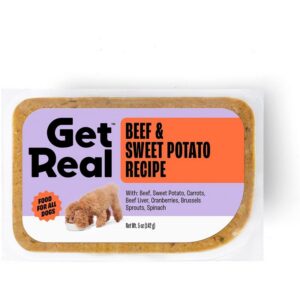
The 25% rule does not indicate a lower quality food. Many complete and balanced canine diets intentionally blend high-quality protein sources with healthy grains and produce. For pet owners seeking variety across primary protein sources, comparative testing can help identify individual preferences. Products such as the Get Real Sampler Pack—which features gently cooked beef, chicken, and turkey recipes—allow owners to evaluate different named protein sources within the same feeding format.
The 3% "With" Rule
The 3 percent "with" rule represents one of the most flexible percentage-based naming standards in pet food labeling. Under AAFCO guidance, inserting the word "with" allows a manufacturer to highlight a specific ingredient on the front of the package as long as that ingredient makes up at least 3 percent of the total product weight.
For instance, a dog food labeled "With Chicken" must contain a minimum of 3 percent chicken, while a cat food labeled "With Tuna and Rice" must contain at least 3 percent tuna and 3 percent rice.
This rule is a common source of consumer confusion because a title like "Dog Food with Beef" uses the exact same core words as "Beef Dog Food." On commercial packaging, the word "with" is frequently printed in smaller or lighter typography, causing shoppers to visually focus on the prominent protein word and assume it makes up the bulk of the food.
While a "with" designation is a legal and transparent way for manufacturers to highlight featured additions, it provides minimal information about the primary protein base of the diet. To identify the primary components of such foods, consumers must inspect the ingredient list on the back of the package, where items are required to be listed in descending order of predominance by weight.
The Flavor Rule: No Minimum Percentage Required
The flavor rule establishes the lowest quantitative threshold among all pet food naming regulations, setting no fixed minimum percentage requirement. AAFCO standards permit a flavor designation—such as "Beef Flavor Dog Food"—to be used on a label provided that a specific ingredient in the formula supplies the designated flavor and the word "flavor" appears in the same type size and visual prominence as the named flavor itself.
Under this rule, a bag of "Beef Flavor Dog Food" is not required to contain a specified amount of actual beef meat. Instead, the flavor profile may be derived from ingredients such as beef fat, beef broth, or digested animal proteins that impart a clear beef taste. Similarly, for a chicken-flavored product, AAFCO guidelines require that an ingredient providing authentic chicken flavor—such as chicken fat—be declared in the ingredient statement, printed in equal font size on the front panel.
Flavor names are widely used in commercial dog treats and budget-friendly kibbles, allowing manufacturers to offer distinct sensory varieties without altering the core underlying recipe. While these labels are fully compliant with regulations, they do not serve as an indicator of actual meat content.
How Added Water and Combination Recipes Change the Math
The dual-threshold math built into the 95% and 25% rules accounts for moisture introduced during processing. Because canned and fresh pet foods depend on water for processing and texture, the regulations require products to meet both an un-watered percentage floor and a total-weight percentage floor.
To illustrate how water alters label compliance, consider a theoretical 100-pound production batch for a canned product intended to be named "Beef Dog Food":
- Batch Composition: 72 pounds of beef, 25 pounds of added water, and 3 pounds of vitamin and mineral supplements.
- Calculation Excluding Added Water: Removing the 25 pounds of water leaves 75 pounds of dry and non-water components. The 72 pounds of beef accounts for 96 percent of this non-water total (72 divided by 75), successfully exceeding the 95 percent requirement.
- Calculation Including Added Water: Across the total 100-pound wet batch, beef represents 72 percent of the overall weight, comfortably clearing the 70 percent total product weight floor.
Because this formula clears both calculations, it can legally be sold under the single-ingredient title "Beef Dog Food."
However, if the recipe is modified to include 65 pounds of beef, 30 pounds of added water, and 5 pounds of supplemental ingredients, the math shifts:
- Calculation Excluding Added Water: Removing the 30 pounds of water leaves 70 pounds of non-water components. The 65 pounds of beef now represents approximately 92.8 percent of the non-water total (65 divided by 70).
- Regulatory Result: Because 92.8 percent falls below the 95 percent threshold, the product can no longer be called "Beef Dog Food." It could, however, be labeled as "Beef Dinner for Dogs," which requires only 25 percent excluding water and 10 percent of total weight.
Moisture content also explains why fresh, gently cooked foods display significantly different guaranteed analysis numbers on their packaging compared to dry kibble. Fresh recipes frequently contain around 75 percent moisture. As a result, their crude protein and crude fat percentages appear lower on the package label until they are mathematically converted to a dry matter basis.
Regulatory Framework: AAFCO Model Regulations vs. FDA Authority
Pet food labeling oversight in the United States operates through a coordinated framework involving model guidelines, state law, and federal enforcement.
AAFCO itself is not a government regulatory body, nor does it have independent enforcement authority. Rather, it is a voluntary association of state and federal feed control officials. AAFCO publishes annually updated Model Pet Food Regulations and nutritional profiles for dogs and cats. Individual state agricultural departments then formally adopt these model regulations into their state legal codes, empowering state inspectors to enforce label compliance.
At the federal level, authority resides with the U.S. Food and Drug Administration (FDA) through its Center for Veterinary Medicine (CVM). The FDA enforces federal standards applying to all animal foods sold in interstate commerce, ensuring that products are properly identified, list net contents, disclose manufacturer information, display ingredients in descending order of weight, and remain safe, sanitary, and truthfully labeled.
Roles in Pet Food Oversight
- AAFCO: Drafts model pet food regulations, establishes naming rules, and defines canine and feline nutritional profiles.
- FDA (Center for Veterinary Medicine): Enforces federal regulations regarding food safety, sanitary manufacturing, and truthful ingredient declarations.
- State Feed Control Officials: Formally adopt AAFCO model rules into state law and inspect products sold within their state jurisdictions.
A common consumer misconception is that products can be "AAFCO approved." In reality, AAFCO does not inspect, test, certify, or approve pet food products. When a label mentions AAFCO, it indicates that the manufacturer formulated the food to meet AAFCO Nutrient Profiles or passed standardized AAFCO feeding trials for a specified life stage.
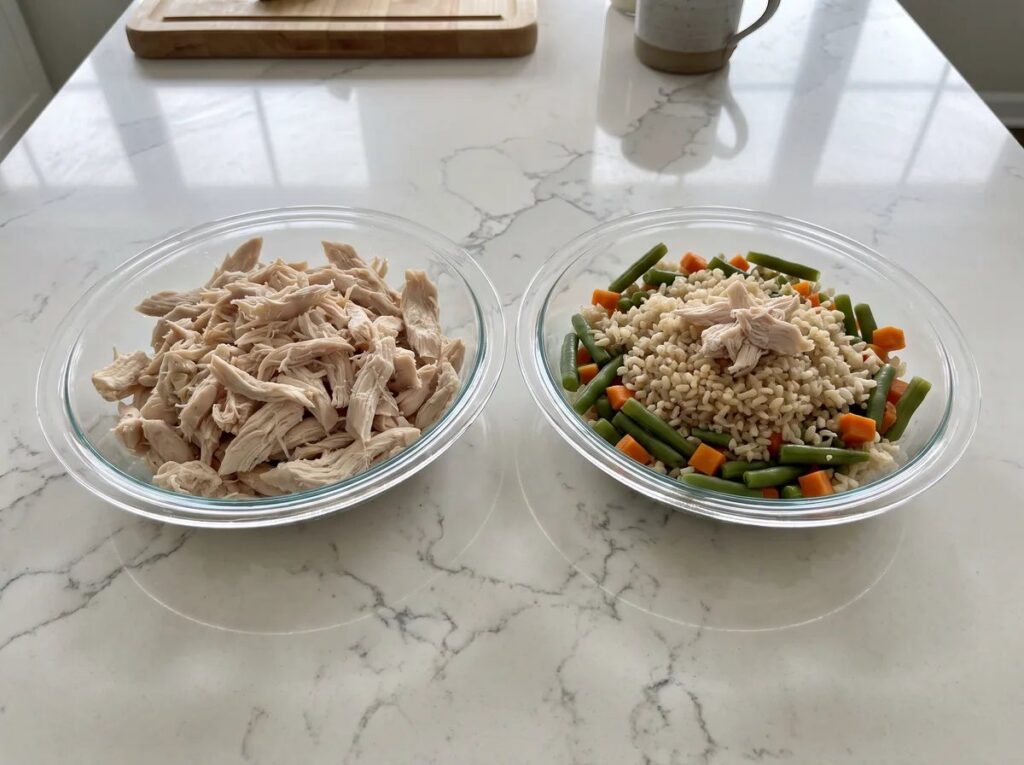
Because these rules apply uniformly across manufacturing formats, pet owners can evaluate kibble, canned food, and fresh gently cooked diets using the same structured approach: review the product name, inspect the ordered ingredient list, and verify the nutritional adequacy statement. For instance, recipes such as Get Real Chicken & Brussels Sprouts Recipe state compliance with AAFCO nutrient profiles for all life stages, including the growth of large-size dogs, making them readable under standard label guidelines.
Beyond the Product Name: What Label Rules Do Not Reveal
While naming rules clarify the proportion of named ingredients, they do not provide a complete assessment of a food’s overall dietary value. A product title does not measure raw ingredient quality, overall nutrient balance, caloric density, or suitability for an individual dog’s health condition.
To fully evaluate a dog food, owners should review three key sections on the back or side of the package:
- The Nutritional Adequacy Statement: Confirms whether the diet provides complete and balanced nutrition. This statement verifies that the food either meets established AAFCO Nutrient Profiles or has successfully completed standardized feeding trials for a designated life stage (e.g., adult maintenance or all life stages).
- The Guaranteed Analysis: Provides mandatory minimum guarantees for crude protein and crude fat, alongside maximum limits for crude fiber and moisture. The term "crude" refers to the specific chemical testing method used to analyze the nutrients, not the physical quality of the ingredients.
- Calorie Statement: Discloses the metabolizable energy (ME) content, typically expressed as kilocalories per kilogram and kilocalories per cup or package, helping owners feed appropriate portions.
Third-party certifications, such as testing by the Clean Label Project, represent a separate evaluative tier focused on environmental contaminants and heavy metals. These voluntary testing programs operate independently of AAFCO naming rules; a clean label seal does not indicate compliance with naming rules, just as a 95% name does not reflect contaminant testing.
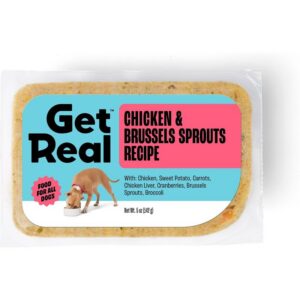
When evaluating protein selections within a complete diet line, alternative recipes—such as Get Real Turkey & Cranberry Recipe—offer different protein sources in the same gently cooked, frozen format while adhering to identical labeling standards.
Reading a Fresh Dog Food Label: A Worked Example
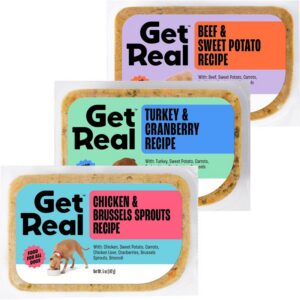
To understand how naming rules and label standards apply to commercial packaging, consider a practical analysis of Get Real Beef & Sweet Potato Recipe, a gently cooked fresh dog food distributed by Chewy.
Starting with the front display panel, the title "Beef & Sweet Potato Recipe" pairs two primary ingredients with the descriptor word "Recipe." Under AAFCO standards, the use of a descriptor means the product falls under the 25% naming framework rather than the 95% rule.
Turning to the ingredient statement on the back panel, ingredients are listed in descending order of predominance by weight:
- Beef: The primary protein, matching the first named ingredient on the front panel.
- Sweet Potato: The secondary carbohydrate and produce source, matching the second named term.
- Water: Required for cooking and texture consistency.
- Beef Liver: A nutrient-dense organ meat serving as an additional beef protein source.
- Spinach: A whole vegetable addition.
- Supplements and Minerals: Dicalcium phosphate, canola oil, potassium chloride, calcium carbonate, salt, fish oil, choline chloride, magnesium sulfate, mineral complexes, mixed tocopherols, and vitamins.
This list confirms a simple base formula of 10 primary ingredients plus added essential vitamins and minerals.
Next, examining the Guaranteed Analysis panel reveals the following required values:
- Crude Protein: Minimum 9.0%
- Crude Fat: Minimum 7.0%
- Crude Fiber: Maximum 1.5%
- Moisture: Maximum 75.0%
The package lists a caloric density of 451 kilocalories per 12-ounce container. The nutritional adequacy statement confirms the recipe is formulated to meet AAFCO Dog Food Nutrient Profiles for all life stages, including growth of large-size dogs expected to weigh 70 pounds or more as adults.
By analyzing the title, ingredient order, guaranteed analysis, and adequacy statement together, pet owners can easily determine what a product offers regardless of whether it comes in a bag, can, or frozen pouch.
Frequently Asked Questions
How do you calculate the fat percentage in dog food on a dry matter basis?
To convert a fat percentage to a dry matter basis, subtract the moisture percentage listed on the guaranteed analysis from 100 to determine the dry matter total. Then, divide the listed fat percentage by the dry matter total and multiply by 100.
For example, a fresh dog food guaranteeing a minimum of 7 percent fat and a maximum of 75 percent moisture has 25 percent dry matter (100 minus 75). Dividing 7 by 25 yields 0.28, or 28 percent fat on a dry matter basis. By contrast, a dry kibble listing 15 percent fat and 10 percent moisture contains 90 percent dry matter, yielding approximately 16.6 percent fat on a dry matter basis. Because guaranteed analyses reflect minimums and maximums rather than exact values, this calculation serves as a comparative estimate.
What is the 80/20 rule for dog food?
The 80/20 rule is an informal ratio used in raw feeding models, typically advocating for diets made of 80 percent muscle meat, 10 percent bone, and 10 percent organ meats. It is not an AAFCO regulation and carries no official standing in pet food labeling laws. An 80/20 raw diet is not automatically complete and balanced, and pet owners considering raw feeding should consult a veterinarian or board-certified veterinary nutritionist.
Is there such a thing as AAFCO-approved dog food?
No. AAFCO does not test, certify, approve, or sanction pet food products or manufacturers. When a pet food package mentions AAFCO, it refers to the product being formulated to meet AAFCO Nutrient Profiles or passing feeding trials conducted under AAFCO protocols.
What are the AAFCO dog food guidelines?
The AAFCO guidelines consist of two main components: Model Pet Food Regulations and AAFCO Dog Food Nutrient Profiles. The model regulations define standards for product names, ingredient declarations, guaranteed analyses, and health claims. The nutrient profiles establish minimum (and sometimes maximum) nutritional levels required for dog foods categorized under adult maintenance or growth and reproduction life stages.
What is the Clean Label Project for dog food?
The Clean Label Project is an independent non-profit organization that tests consumer products for industrial contaminants, heavy metals, pesticide residues, and plasticizers. Their pet food certifications are voluntary and entirely separate from federal labeling laws or AAFCO regulations.
Who regulates pet food labels in the United States?
Pet food labeling is enforced through a dual system. The FDA Center for Veterinary Medicine regulates safety, sanitary processing, and truthful labeling under federal law. Simultaneously, state feed control officials enforce specific labeling rules adopted from AAFCO model regulations within their respective state jurisdictions.
What does the term "flavor" mean on a dog food label?
Under AAFCO’s flavor rule, a product labeled with a flavor designation (such as "Beef Flavor") is not required to contain a specific minimum percentage of that meat. However, the manufacturer must include an ingredient in the recipe that provides a detectable flavor source, and the word "flavor" must be displayed with the same visual prominence and font size as the flavor name on the packaging.