



The stock market has once again found a way to surprise investors. As valuations climb to historic heights, a familiar anxiety ripples through the financial community. When markets crash, retirement portfolios shrink, sparking immediate panic. Yet, even when equities surge to record-breaking valuations, a different kind of worry takes hold: the creeping suspicion that an unprecedented boom must inevitably precede a catastrophic crash. Today, that prevailing market anxiety is largely fueled by the frenzied momentum of the artificial intelligence boom.

For observers who have tuned out financial media drama, the modern AI story can be distilled into a few broad trends. Investors worry that while artificial intelligence is unquestionably a major technological leap, the financial mania surrounding it is moving too fast and reaching unsustainable valuations. Many fear that the current environment is setting the stage for a magnified version of the early 2000s dot-com crash. For veterans of that era, the parallels are striking. The late-90s internet boom launched early careers and paved the way for early retirement, only for the ensuing crash to nearly upend employment security and financial stability.
As financial commentators field mounting questions about this current investment cycle, public discourse has turned toward examining historical market booms and busts. Discussions at recent gatherings, such as Camp FI Midwest and upcoming appearances at financial literacy conferences, highlight a recurring theme: the persistent friction between market anxiety and long-term economic reality.

Reflecting on decades of early retirement, financial writers often encounter a common question from friends and observers: how can anyone remain retired, comfortable, and able to sleep at night given the state of the world? To the chronically worried news-watcher, the list of existential threats feels endless. Modern anxieties include political instability, surging inflation, the looming AI bubble, mounting national debt, and various international conflicts threatening global stability.
Interestingly, these exact categories of fear are not new. Similar questions posed during past economic eras—such as the mid-2000s—revealed a nearly identical catalog of worries. Two decades ago, anxieties centered on different political leaders, wars in the Middle East, national debt, inflation, and a housing market bubble that many feared was dangerously overvalued. At the time, economists and workers also worried that globalization and outsourcing to countries like India and China would permanently erode domestic employment. There was even widespread debate over "peak oil," a theory suggesting that rising fossil fuel consumption would inevitably outstrip supply and doom global civilization.

What followed those anxieties in 2006 was indeed the Great Financial Crisis, driven by irrational exuberance in housing prices and excessive leverage in mortgage-backed financial instruments. It marked the most severe economic downturn since the Great Depression. Yet, when viewed through the lens of a multi-decade horizon, even that historic crisis appears as a temporary dip in a broader upward trajectory. Over a twenty-year span, diversified stock investments continued to compound significantly, weathering both the 2008 financial collapse and the subsequent market shocks of the 2020 pandemic.
Concurrently, global living standards improved dramatically. Over a twenty-year period, the share of the global population living in extreme poverty dropped substantially, and infant mortality rates were cut in half. Clean energy adoption surged, with solar panels becoming dramatically cheaper and emerging as the primary source of new electrical generation capacity worldwide. Meanwhile, electric vehicle adoption transitioned from a marginal concept to a major market share across global automotive sectors.

These historical shifts raise a fundamental question about whether human energy is better spent worrying about an uncertain future or maintaining long-term optimism. Skeptics frequently ask whether current conditions are genuinely different. Concerns persist that the ballooning U.S. national debt could finally trigger systemic instability, that the AI bubble far exceeds the housing market mania, or that advanced artificial intelligence could eventually destabilize employment markets entirely. Financial media outlets routinely amplify these narratives. However, these cautionary tales often overlook a foundational economic principle: true prosperity does not originate from financial systems or stock market indices, which ultimately represent numerical tracking systems. Prosperity stems directly from productivity.
The core lesson of long-term economic growth is that capitalism is inherently volatile and prone to cyclical swings. Beneath the surface turbulence, however, real people perform tangible work and develop genuine innovations. The concept of an economy is a human construct; if financial accounting systems face severe disruption, societies historically adapt by restructuring monetary metrics and returning to productive labor. The essential tools for boosting productivity, raising standards of living, and enabling financial independence remain intact regardless of market cycles.

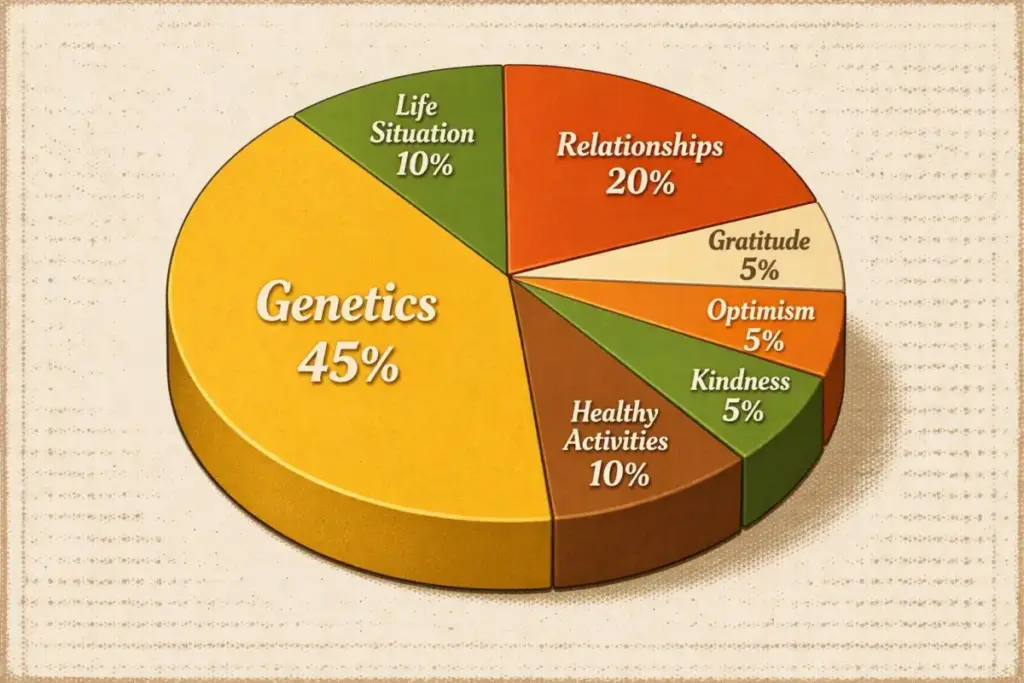
Furthermore, economic productivity and prosperity represent only one dimension of human well-being. Beyond a certain threshold of material comfort in developed nations, incremental wealth yields diminishing returns in personal happiness. Studies on the factors influencing human satisfaction suggest that individual temperament, close personal relationships, community engagement, and healthy lifestyle choices play a dominant role in determining overall life satisfaction. Wealth primarily serves as a supporting component within a broader framework of personal well-being.
Despite these historical realities, background anxiety remains remarkably persistent among investors and retirees. Psychologically, human beings function largely as danger detection machines. Evolutionarily, hyper-vigilance protected early humans from immediate physical threats. However, in modern environments where physical predators and acute scarcity have been largely mitigated, the human brain continues to scan for new targets of concern. Once basic survival needs are met, worry shifts toward social status, relative wealth comparisons, tax strategies, and portfolio management.

Combating this pervasive anxiety requires self-awareness and rational evaluation. Understanding personal history—such as growing up in households influenced by post-Depression scarcity mentalities or past trauma—can clarify why certain financial fears persist despite objective security. Identifying specific worst-case scenarios often reveals that feared outcomes are far less catastrophic than anticipated. Taking concrete action remains one of the most effective remedies for fear, transforming the unfamiliar into the manageable and building personal resilience.
Additionally, managing media consumption can significantly alter personal outlooks. Daily news cycles frequently prioritize sensationalized and alarming stories designed to capture attention rather than inform objectively. Shifting focus toward active problem-solving, physical health, outdoor activity, and associations with optimistic, forward-thinking peers helps realign daily life with human evolutionary needs.

Viewing major technological shifts through the lens of experimentation rather than existential dread offers a constructive path forward. Rather than succumbing to doom-scrolling, analyzing the underlying mechanics of new technologies provides clarity. Artificial intelligence, viewed objectively, functions essentially as a sophisticated cognitive tool designed to enhance efficiency and productivity.
Much like previous technological revolutions—including the advent of the internet, personal computing, and mobile smartphones—AI will inevitably boost productivity while disrupting specific job categories, particularly in routine administrative and entry-level analytical fields. Historically, such technological leaps simultaneously reduce costs and catalyze the formation of entire new industries. While the economic rewards of these transitions often concentrate among enterprise owners and shareholders, the broader macroeconomic result is increased societal efficiency.

Ultimately, artificial intelligence represents another transitional phase requiring adaptation and strategic choices. By recognizing fear as an internal psychological mechanism rather than an objective reflection of reality, individuals can navigate market volatility and technological shifts with greater resilience, focusing productive energy on personal well-being, continuous learning, and constructive engagement with the modern world.