


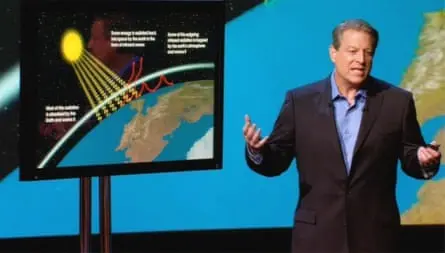
Marking the 20th anniversary of his groundbreaking climate change documentary An Inconvenient Truth, former United States Vice-President Al Gore has reflected on two decades of climate advocacy, admitting he was surprised by the ferocious and ongoing backlash from the fossil fuel industry and its political allies. Speaking at a high-profile New York event coinciding with Climate Week, the 78-year-old leader maintained an underlying optimism that the global community will ultimately rise to confront the climate crisis, even as he issued stark warnings about the pace of environmental destruction and institutional capture by oil and gas interests.
Reflecting on the progress made since the film’s release in 2006—which documented a comprehensive slideshow presentation Gore delivered worldwide after the 2000 US presidential election—Gore offered a characteristic touch of dark humor. When asked about the state of global climate action over the past twenty years, he joked to television weather forecaster Al Roker, “I always say if it hadn’t been for me, we might have a big problem right now.”
Yet, beneath the levity lay a sobering assessment of the modern political and scientific landscape. “The scientists unfortunately have been proven to be absolutely correct,” Gore told the audience on Wednesday. “In some important ways, they may have even understated what the damage is doing. The resistance has been more durable and sustained than I expected it to be.”
Gore pointed directly to the pervasive influence of the fossil fuel industry, asserting that it has “captured control of too many governments” and even managed to infiltrate the United Nations’ top climate science apparatus “to a shocking degree.” He highlighted recent investigative reporting by the Guardian, which revealed that Saudi oil operatives had been involved in shaping high-profile UN climate reports.
In the wake of the landmark 2006 documentary, Gore’s climate advocacy extended far beyond the silver screen. He pioneered a grassroots movement aimed at cultivating a new generation of climate activists through the Climate Reality Project. Over the past two decades, that organization has expanded into a formidable global network encompassing approximately 4.5 million individuals across 196 countries, mobilizing communities to demand local and international policy shifts.
However, the tangible impacts of global heating over the same twenty-year period have outpaced many early expectations, manifesting with increasing frequency and severity. Gore drew attention to the devastating consequences of barely restrained global temperature increases, citing the record-shattering heatwaves that affected numerous countries across Europe and beyond over the summer, as well as recent climate-induced disasters, such as the catastrophic flooding on the Nepal-Tibet border triggered by a collapsing glacier.
Warning of the trajectory the planet is currently on, Gore noted that the ongoing rate of temperature rise is set to breach internationally agreed thresholds, threatening to unleash utter devastation. He underscored the peril of looming “tipping points,” such as the rampant melting of polar ice sheets and the potential transformation of the Amazon rainforest into a dry savanna, both of which could push the global climate system toward irreversible catastrophe.
Drawing parallels between his decades-long crusade and other historical struggles for social justice, Gore compared the fight against climate change to the American civil rights movement and the historical campaign for women’s rights. He acknowledged that those who fought for progress in past eras frequently wrestled with profound doubt.

“And in all those previous cases, some of the advocates felt despair, and the biographies and diaries are filled with those kinds of expressions,” he said. “But they kept going anyway because, as others have said, courage is not the absence of fear or despair. It’s the decision to go forward in spite of it. And I really strongly believe that we are very close to that positive tipping point where the mass of public opinion is going to be unstoppable.”
Despite the bleak indicators, Gore emphasized that collective human action has already managed to avert the most catastrophic scenarios predicted at the dawn of the century. While the world remains on a dangerous trajectory toward global temperatures exceeding 2C above pre-industrial averages, the rapid deployment and falling costs of clean energy technologies have rendered earlier, apocalyptic projections of a 4C or greater temperature rise by the end of the century largely unlikely.
Gore acknowledged persistent economic hurdles, noting that many developing countries continue to struggle with securing adequate financing for crucial renewable energy and battery infrastructure projects. Nevertheless, he expressed firm confidence that the mass adoption of clean energy will inevitably prevail, pointing out that renewable sources like wind and solar are now routinely cheaper than traditional fossil fuels such as coal and gas.
“The day is coming when our momentum will overtake the resistance. We’re getting very close now,” Gore said. “I think we are going to win this. The remaining question is whether we will win it in time to avoid those negative tipping points I talked about.”
Gore’s remarks served as a precursor to a major UN climate event hosted by António Guterres, the outgoing UN secretary-general and an outspoken champion of aggressive climate policies. Guterres used his platform to lament the continued expansion of the fossil fuel industry, describing its persistence as an action that is “defying science, economics and common sense.”
The outgoing UN chief highlighted the widespread economic and geopolitical fallout stemming from continued reliance on oil and gas. “We have seen how fossil fuel dependence wreaks havoc — driving up costs, draining budgets, squeezing households and leaving countries at the mercy of conflicts and decisions far beyond their borders,” Guterres said.
At the same time, Guterres echoed Gore’s notes of cautious optimism, emphasizing that nations now possess the technological and economic tools to chart a fundamentally different course through aggressive investments in clean energy, large-scale reforestation, and the electrification of global economies.
“Renewables are the cheapest, fastest and most secure source of new electricity almost everywhere,” Guterres concluded, framing the transition away from fossil fuels not merely as an environmental necessity, but as an economic inevitability. “Clean energy has gone from alternative to unstoppable.”