



For millions of households around the world, the autumn season is incomplete without a viewing of the 1966 CBS television special, It’s the Great Pumpkin, Charlie Brown. Created by legendary cartoonist Charles Schulz, the animated classic captures the standard hallmarks of Halloween through the eyes of the Peanuts gang. While characters like Charlie Brown and Lucy engage in time-honored traditions such as trick-or-treating and carving jack-o’-lanterns, Linus van Pelt charts a drastically different course. Instead of chasing candy, Linus dedicates his Halloween to preparing for the arrival of the mythical "Great Pumpkin."
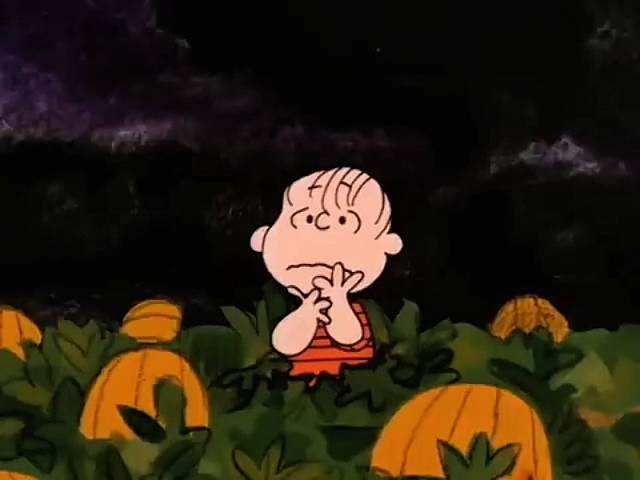
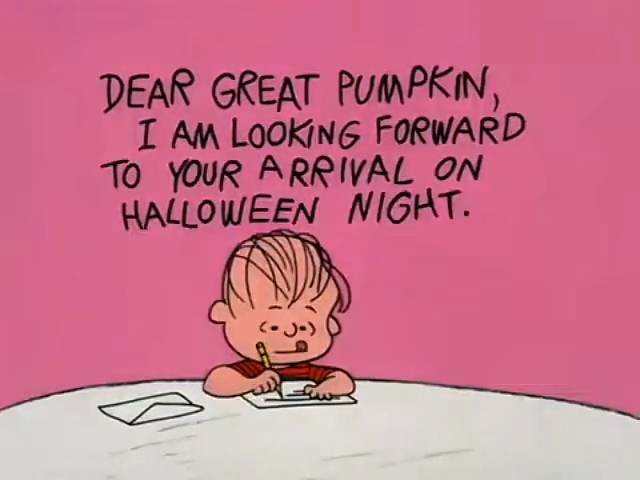
As Linus explains to anyone willing—or unwilling—to listen, the Great Pumpkin emerges each year from the pumpkin patch that he deems the most sincere. Once he surfaces, he bestows toys upon the children patiently waiting in the cold night air. Throughout the television special, Linus meticulously pens letters, attempts to convert his skeptical peers, and ultimately spends the entirety of Halloween night shivering in a desolate pumpkin patch, awaiting a visitation that never comes. Despite the inevitable disappointment, Linus vows every year to return and wait again.
To the casual viewer or general pop culture consumer, this single television broadcast might define the entire extent of the Great Pumpkin mythology. However, dedicated readers of the Peanuts comic strip know that the cinematic adaptation only scratches the surface of a much deeper, more complex, and frequently hilarious multi-year narrative arc crafted by Charles Schulz in the daily newspaper strips.
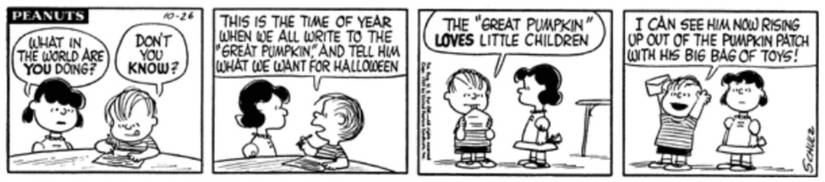
The origins of this surreal holiday obsession stretch back long before the CBS special aired. The Great Pumpkin was first introduced to readers in a Peanuts comic strip published on October 26, 1959. In the strip, Linus is seen hunched over a piece of paper, diligently writing a letter, when Lucy approaches him and demands to know what he is doing. Linus replies with absolute sincerity, explaining that this is the time of year when children write to the Great Pumpkin to request their Halloween wishes, completely confident that the mythical entity loves little ones and will soon rise from the earth with a massive bag of toys. Lucy responds with a blank, dumbfounded stare, establishing a dynamic that would repeat for years.
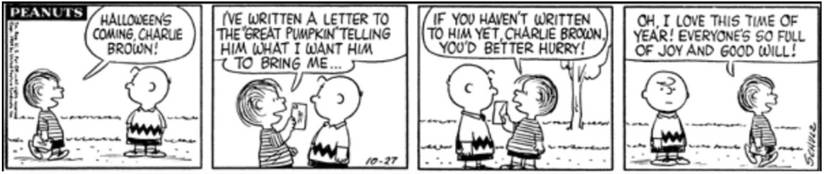
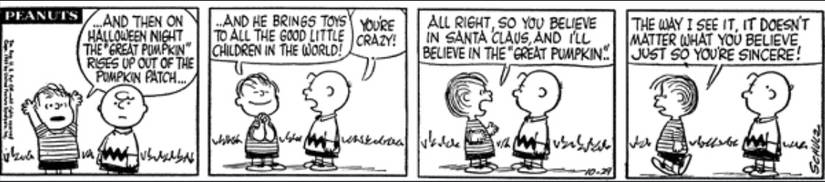
The very next day, Schulz published a follow-up strip featuring Linus continuing his breathless monologue about the Great Pumpkin while Charlie Brown stares at him with equal bewilderment. Over the next several days, various characters react with outright disbelief, culminating in Charlie Brown bluntly telling his blanket-toting friend, "You’re crazy."
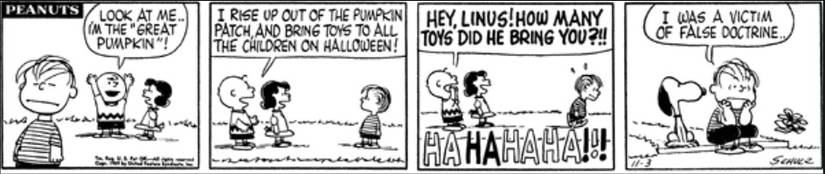
True to form, the Great Pumpkin never materializes in the comics, nor do any letters receive a response. Charlie Brown and Lucy routinely tease Linus once November arrives, but Schulz was far from finished with the gag. For the next several years, the cartoonist established a dependable seasonal rhythm, using the final week of October to feature Linus writing more letters and preaching about the Great Pumpkin’s imminent arrival.
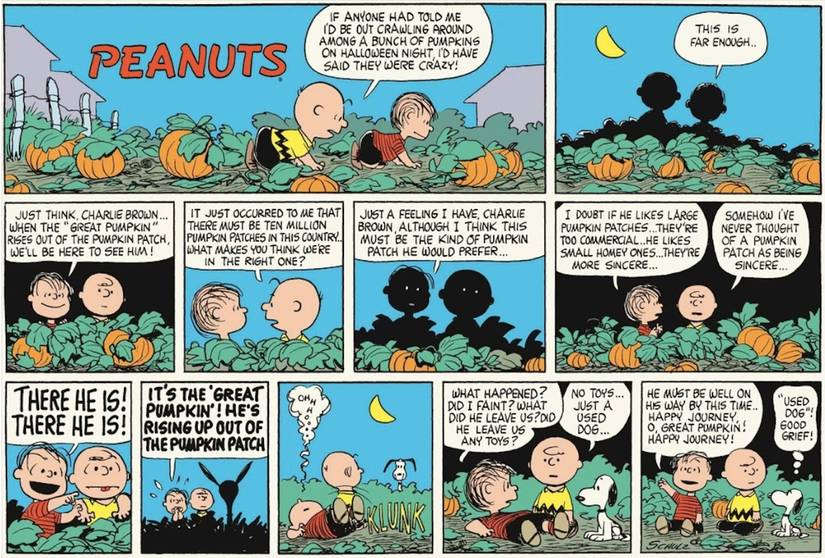
In 1960, Linus manages to rope Charlie Brown into joining him in the pumpkin patch, prompting Charlie Brown to pose a remarkably logical question that exposes the logistical flaw in Linus’s faith: "It just occurred to me that there must be ten million pumpkin patches in this country… What makes you think we’re in the right one?"
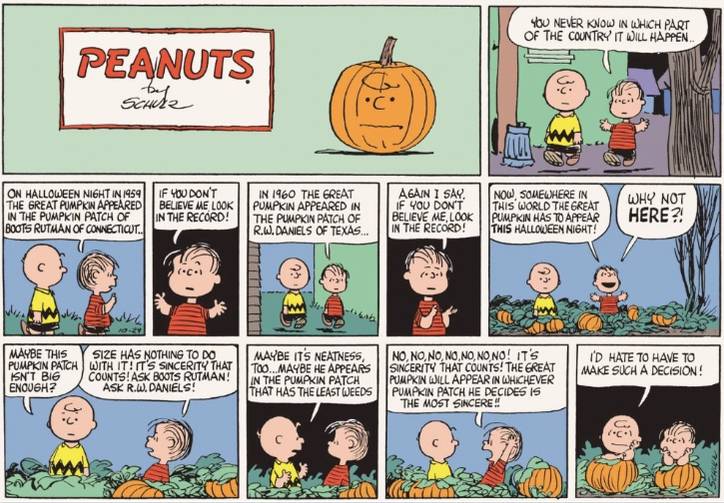
The humor evolved further in 1961, when Schulz gave Linus an increasingly specific, almost bureaucratic command of the Great Pumpkin’s supposed historical record. In one memorable strip, Linus cites past appearances, telling his friends that on Halloween night in 1959, the Great Pumpkin appeared in the pumpkin patch of Boots Rutman in Connecticut, and in 1960, he surfaced in the patch of R.W. Daniels of Texas. The meticulous specificity of these fictional sightings added a layer of absurd world-building that many fans feel was a notable omission from the eventual television special, despite the fact that many other comic strip elements successfully made the leap to the screen.
Another striking 1961 strip featured Linus justifying his unwavering faith through sheer economic pragmatism. Explaining to Lucy that he has already sent out 57 pumpkin cards, Linus declares with dramatic flair, "It would be economically disastrous for me not to believe it!"—a sentiment that resonates like an early comic-strip equivalent of a modern viral meme.
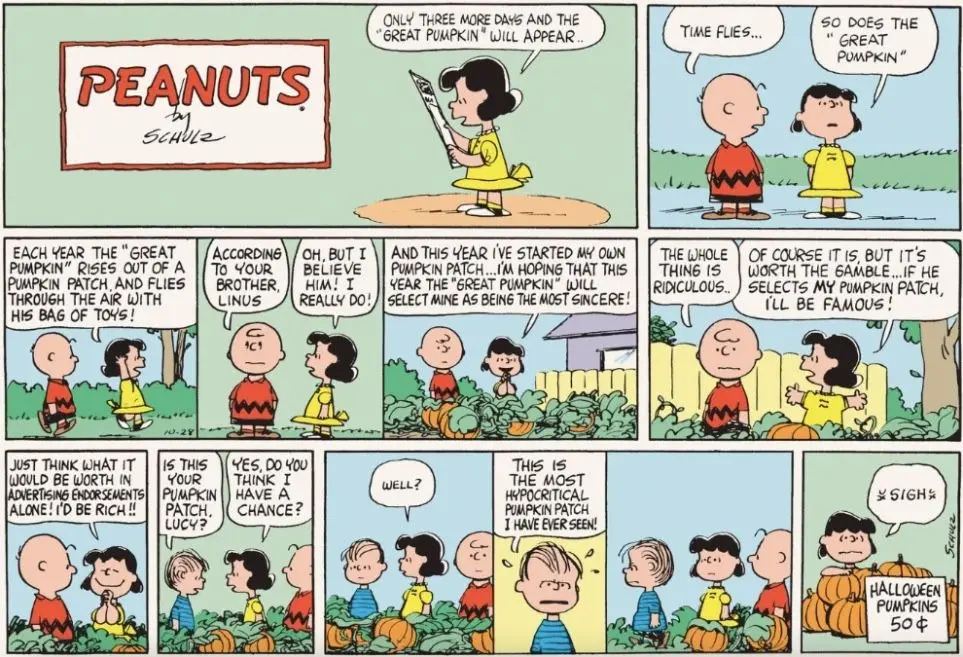
Perhaps most surprisingly for readers looking back at the archives, Linus actually succeeds in converting Lucy to Great Pumpkinism in 1962. Seized by the prospect of acquiring a mountain of free toys, Lucy plants her own pumpkin patch to lure the entity. However, Linus abruptly turns on her, declaring that her patch is utterly hypocritical due to her transparent greed. Offended and defeated, Lucy abandons her spiritual crusade and decides to simply sell her pumpkins for a profit instead.
Bouncing back and forth through the October Peanuts archives yields a fascinating dual effect for modern readers. For audiences intimately familiar with the 1966 television special who have never explored the source strips, reading these archival panels feels akin to discovering long-lost deleted scenes. It showcases the breadth of Linus’s evangelism and the varied, increasingly exhausted ways his friends react to his unyielding dogma.
Simultaneously, consuming a high volume of these strips back-to-back reframes Linus’s characterization. While the television special portrays him as a whimsical boy with an innocent, albeit eccentric, belief, the daily comic strips often paint Linus as an obsessive, single-minded zealot. This heightened intensity makes the ongoing running joke vastly funnier, particularly when looking at how Schulz manipulated the calendar to build tension.
Typically, Schulz restricted his Great Pumpkin material to the final week of October, occasionally extending the gag into the first couple of days of November to show Linus lamenting his failure. However, in 1964, the cartoonist executed a brilliant narrative pivot that stands as one of the finest comedic long-cons in comic strip history.
On October 5, 1964, Schulz launched a multi-week storyline centered around Linus running for class president. Capitalizing on the political climate of an actual presidential election year in the United States, the storyline dominated the daily strips for two straight weeks. Linus emerges as an exceptionally talented, charismatic candidate, delivering stirring and revolutionary speeches that electrify his schoolmates and send him soaring to the top of the polls. Victory seemed entirely assured.
Then, on October 21, Schulz delivered a narrative twist that caught readers completely off guard. While standing at the podium delivering his rousing, climactic final campaign speech, Linus abruptly pivots from standard student politics to preach about the Great Pumpkin, instantly shattering his political aspirations and tanking his campaign in a single moment.
When viewed in isolation, the strip functions as a sharp satire on how a single extremist viewpoint or catastrophic political gaffe can ruin a candidate’s viability. But when contextualized within the broader framework of the month, the payoff is extraordinary. By spending two weeks entirely divorced from the Great Pumpkin only to let the obsession utterly derail a successful political campaign at the eleventh hour, Schulz demonstrated an elite mastery of comedic timing and long-form storytelling. The patience and structural brilliance required to execute that gag cement it as one of the absolute greatest Great Pumpkin sequences ever committed to print.