


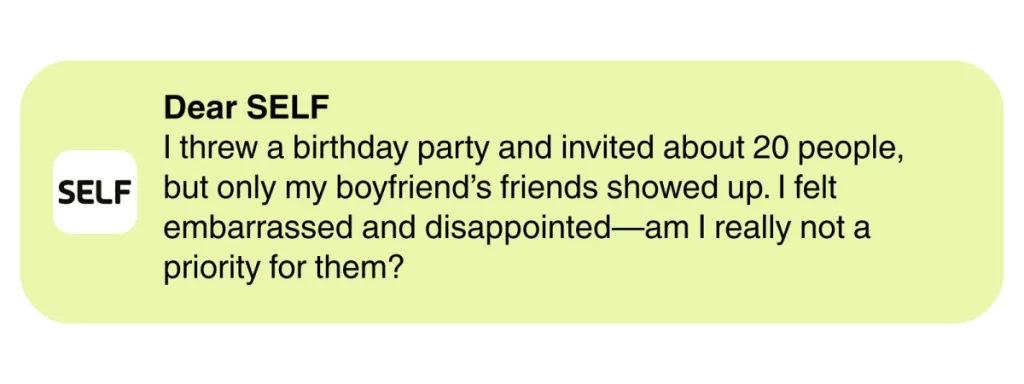
Welcome to Asking for a Friend, a weekly series dedicated to solving the messy, awkward, and confusing parts of modern friendship. Because the truth is, our platonic relationships are often the most complicated.
Technically, you are part of a friend group—well, loosely speaking. You are in the chat threads. You receive the invites, but usually ones that sound like, "Oh, but you can come if you want…" which, the more you think of it, lands less like inclusion and more like a pity afterthought.
You are there for big, public-facing plans—birthday parties, group trips, anything that benefits from a larger headcount—yet absent from spontaneous happy hours and nights out where real bonding happens and the inside jokes are born.
If any of this hits close to home, you might be what some people call the backup or "fringe friend."
We cannot all be everyone’s number one. But what makes this situation so hard is that there is no obvious villain and no dramatic fallout (which, in some ways, would almost be easier to deal with). Instead, you are left with a low-grade, hard-to-prove insecurity: Am I just—no one’s first choice? I’m their friend—but are they mine?
For this week’s column, experts and mental health professionals are breaking down the psychological dynamics at play, examining the clear signs that indicate someone might be trapped in a second-tier, backup friendship role.
You Are Always Invited Last Minute
The pattern often begins with the timing of invitations. It is not occasionally, but consistently.

As in, you hear about each plan the day of. You are added to existing dinner reservations only after somebody else has cancelled. Of course, this might be a matter of logistics or innocent forgetfulness, which is why experts note that every now and then, it is not an immediate cause for concern. People who are disorganized across the board exist in every social circle.
If this is how they are with all of their friends, that might reflect more about their poor planning—annoying in its own way, but ultimately a separate issue. The point is to pay attention to the pattern if you can recall more than a few instances where your invitation felt like an afterthought rather than a primary consideration.
You Are Missing From the Main Chats Where Plans Actually Happen
A few of these tells are subtle yet revealing. Somehow, get-togethers conveniently skip the messy, in-between stage of coordination, such as deciding whether a certain time works or where the group should go, arriving at you fully formed. Or, when you are together in person, everyone references memes, messages, or memories that clearly happened—just not in any chat you are a part of.
It is totally normal for people to have multiple friendships and separate interactions. This is not about being included in every single aspect of everyone’s lives. Still, paying attention to how often this occurs makes it easier to understand why you feel like you are constantly stepping into something already established rather than being part of it from the beginning.
You Only Ever Talk or Meet If You Initiate
Life, of course, can get busy, and a temporary imbalance in social energy is completely normal. But when you are truly an integrated part of the crew, your absence will be missed or, at the very least, acknowledged. Someone will notice and ask where you have been, noting that they haven’t seen you in forever or that let’s-catch-up conversations need to be scheduled.
There is usually a small moment of recognition—an indication that you exist in their shared awareness when you are not physically present, which is why when you do not get any of those little check-ins, it is disorienting. It feels as if you are not important enough to be missed.
Navigating the Emotional Fallout of the Fringe Friend Dynamic
Bring it up, and you risk sounding insecure. Say nothing, and you will continue to overanalyze every delayed invite, every inside joke, and every social media story you weren’t tagged in.

None of the options above sounds appealing. Though if you do want to say something, experts recommend a low-pressure check-in like expressing that you always have a great time when everyone hangs out and noting that you would love to be looped in next time. It is warm, subtle, and assumes good intent—the kind of communication that makes your intentions clear without putting anyone on the defensive.
However, in ambiguous situations like these, where your gut is whispering that something is off, yet no one is technically doing you wrong, even the most carefully crafted messages cannot give you the reassurance or confidence you are seeking.
That is why the solution is not necessarily figuring out how to force your way into becoming a core member of a reluctant group, but rather asking whether you are spending your energy where you actually feel like you matter.
Nobody deserves to feel disposable with people they care about most. And it is worth remembering that not being fully included in one circle doesn’t mean you are inherently less than. A different solution involves expanding your social network instead of over-investing in your current one.
In other words, going out of your comfort zone to start weekly lunches with a favorite coworker, finally saying yes to that old companion you have been meaning to reach out to, or agreeing to a weekend trip with friends-of-friends instead of defaulting to your usual group or staying home can make a significant difference.
Sometimes, all it takes is noticing the spaces where you are truly welcome to ease the ache of feeling like the unimportant one.