WASHINGTON — President Donald Trump has escalated his ongoing public feud with Ukrainian President Volodymyr Zelenskyy, declaring that it is “time for somebody else to negotiate on behalf of Ukraine” while robustly defending his administration’s recent decision to waive a sweeping package of economic sanctions against Moscow.
Speaking to reporters, Trump pushed back heavily against suggestions that his move to lift sanctions last week amounted to a strategic victory for the Kremlin. Instead, the US president insisted that his sole focus remains on bringing a rapid halt to the devastating conflict, while pointedly aiming his frustration at Kyiv’s wartime leadership.
“I’m supporting stopping the war between Russia and Ukraine,” Trump told reporters. “Frankly, Zelenskyy is not helping matters much. I think he doesn’t want to stop it, but I want to see people not die.”
The remarks mark the latest flashpoint in an increasingly tense relationship between Washington and Kyiv, which has grown strained over recent disagreements regarding military aid, intelligence sharing, and diplomatic strategy. The friction intensified further after Zelenskyy publicly stated that the US president was putting himself on the “wrong side of history.”
Reacting sharply to that characterization, Trump doubled down on his long-standing assertion that the war could have been avoided or settled far earlier on terms much more favorable to Ukraine.
“If he would have listened to me, he would have made a much better deal a long time ago, and he’d have a million people living from his side,” Trump said. “I think it’s time for somebody else to negotiate on behalf of Ukraine. Very little land has moved, but a million people, a tremendous number of people, are dead.”
Independent observers and international human rights organizations have repeatedly pointed out that Trump’s repeated assertions regarding a "million" dead Ukrainians are vastly inflated. While official casualty numbers remain difficult to verify comprehensively amid the ongoing hostilities, a study published in July by the Center for Strategic and International Studies (CSIS) in Washington estimated that Ukrainian forces have suffered between 525,000 and 625,000 total casualties—including killed, wounded, and missing—with fatalities estimated between 125,000 and 150,000 since the full-scale Russian invasion began in February 2022. By comparison, the same study estimated that the Russian military has sustained roughly 1.4 million total battlefield casualties and as many as 450,000 deaths.

Despite mounting empirical evidence, Trump has continuously inflated the death toll in public remarks over the past two years, citing the catastrophic human cost of the grinding war of attrition to justify his urgency for a negotiated settlement. Meanwhile, United Nations human rights monitors continue to document the heavy toll on civilians, reporting that July saw the highest monthly number of civilian casualties in Ukraine since March 2022, bringing the verified UN death toll among non-combatants past 16,800.
The intensifying diplomatic standoff between Washington and Kyiv has unfolded against a turbulent domestic backdrop in the United States, where the Trump administration faces a grueling political climate with midterm elections just weeks away. Recent nationwide polling, including a survey published by Reuters and separate data from the Washington Post and ABC News, indicates that President Trump’s approval rating has slipped to a record low of 31%, with general voter sentiment reflecting widespread economic pessimism and anxiety over congressional control.
As the political landscape tightens, the administration has maintained a busy schedule of domestic campaigning to support vulnerable Republican incumbents across traditional party strongholds. President Trump kicked off a seven-state campaign blitz in Kansas, where incumbent Republican Senator Roger Marshall is facing an unexpectedly fierce challenge from Democratic opponent Adam Hamilton. Analysts note that once-safe Republican seats are seeing increased competitive pressure, prompting national party organizations to heavily reallocate resources to defend margins in the Senate and House of Representatives.
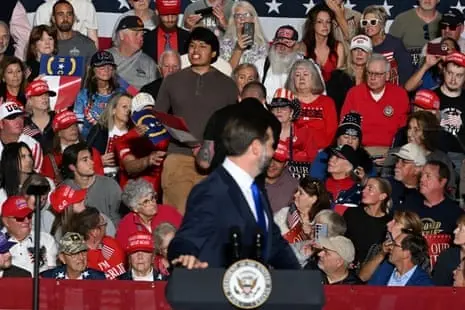
Parallel to the foreign policy and electoral battles, administrative and legal controversies have continued to occupy the national conversation. Vice-President JD Vance faced a disruptive moment during a campaign rally in Hendersonville, North Carolina, when a member of the audience stood up from directly behind the podium to shout demands regarding government transparency before being escorted out by security. Amid booing and chants from the crowd, Vance attempted to deflect the interruption with a remark directed at the demographic identity of the protester, drawing immediate public scrutiny and media attention.
Concurrently, the Department of Justice announced the arrests of 28 legal permanent residents in California on federal charges related to alleged fraudulent voter registrations, an announcement that followed days of heightened legal sparring between the federal government and California election officials regarding the processing of mail-in ballots ahead of the midterms. Voting rights experts and federal data continue to emphasize that non-citizen voting remains exceedingly rare, casting the recent legal actions within the broader, highly polarized debate over election integrity and immigration policy.
Back on the international stage, the friction over intelligence sharing and military logistics remains palpable. While Secretary of State Marco Rubio publicly denied during a diplomatic visit to Uzbekistan that the United States had ever paused intelligence sharing with Ukraine, President Zelenskyy maintained in recent interviews that crucial early-warning data regarding Russian ballistic missile launches was temporarily restricted. Zelenskyy also reported that access to SpaceX’s Starlink and Starshield satellite internet infrastructure had experienced operational degradations, creating tactical hurdles for Ukrainian defense forces along the frontlines as winter approaches and Russian strikes on critical energy infrastructure persist.
As diplomatic channels remain strained and domestic political pressures mount ahead of the November elections, the path forward for US-Ukraine relations and the broader international strategy toward the conflict remains uncertain, leaving international partners closely watching Washington’s next moves.