


For decades, the stock market has maintained a remarkable knack for surprising investors, defying expectations, and continuing its upward trajectory despite periodic corrections. Yet, whether markets are tumbling and retirement portfolios are shrinking, or scaling record-breaking valuations, anxiety remains a constant companion for many investors. Today, that prevailing market anxiety is heavily tied to the frenzied boom surrounding Artificial Intelligence, prompting widespread fears that the current technological wave is building toward a historic market crash that will eclipse the dot-com bubble of the early 2000s.
For those who have managed to tune out the daily market drama and focus on everyday life, the sentiment is often one of quiet contentment. However, for investors looking at the broader economic landscape, the parallels between today’s AI-driven valuations and past financial manias are hard to ignore. This modern financial anxiety has become a central topic of discussion across the early retirement and personal finance communities, inspiring specialized presentations and broader public commentary.

Will the AI Bubble Ruin Our Retirement?
Reflecting on decades of financial independence, long-term retirees often encounter a recurring question from concerned friends and acquaintances: How is it possible to remain retired, comfortable, and sleep peacefully at night given everything happening in the world?
A look back at historical worries reveals that the specific flavor of anxiety changes with every decade, while the underlying emotional response remains remarkably consistent. Twenty years ago, in 2006, investors and the general public were grappling with a different set of formidable concerns. Back then, headlines were dominated by geopolitical conflicts in the Middle East, escalating national debt, stubborn inflation, and an overvalued housing market driven by irrational exuberance and complex financial leverage. There were parallel fears about globalization and the outsourcing of domestic jobs to emerging markets like India and China, alongside intense debates over peak oil and the impending scarcity of fossil fuels.

Despite those widespread anxieties, the subsequent twenty years saw the onset of the Great Financial Crisis—the deepest market downturn since the Great Depression—followed years later by the pandemic-induced market shock of 2020. Yet, viewed through the lens of long-term economic history, even the most severe crises appear as temporary disruptions within a broader arc of growth. A substantial capital investment made during those peak worry years of 2006 would have still grown exponentially over the next two decades, weathering both major economic collapses alongside historic global improvements in living standards.
Over that same twenty-year span, extreme poverty rates plummeted globally, infant mortality was cut in half, and clean energy technologies transformed the global power grid. Solar power generation surged as manufacturing costs dropped dramatically, while electric vehicle adoption expanded from a negligible market share to a substantial portion of global automobile sales. These macro-level developments underscore a fundamental economic truth: long-term prosperity is ultimately driven by productivity rather than the day-to-day fluctuations of financial markets or computerized valuations.

The Core Driver of Prosperity and the Trap of Fear
Financial media outlets frequently generate compelling narratives centered around systemic risks, debt levels, and technological bubbles. However, these pessimistic outlooks often overlook the reality that financial systems and stock market indices are essentially human-made structures. If a financial system experiences a severe correction or reset, economic frameworks can adapt, new metrics are established, and human productivity continues unabated.
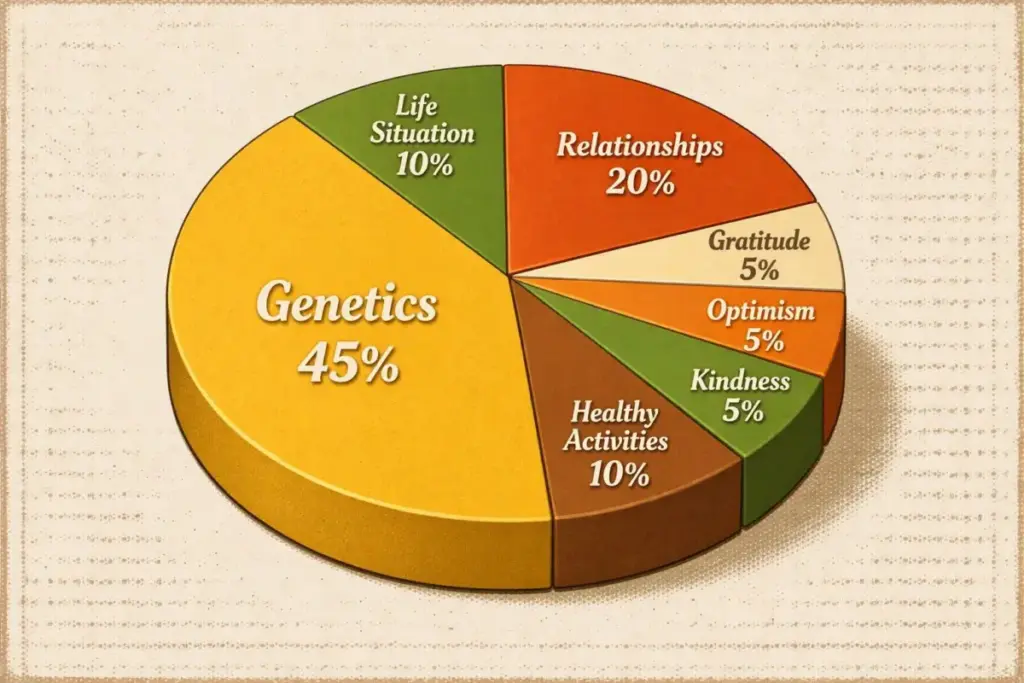
The underlying engine of economic growth, standard of living, and early retirement viability is real human work, ingenuity, and technological innovation. Furthermore, once basic material standards of living are secured, human happiness is largely determined by non-monetary factors. Psychological and social research consistently highlights that long-term well-being is anchored by personal relationships, a lifelong philosophy of gratitude and optimism, physical health, and active engagement with the outdoors, far outweighing the psychological impact of portfolio swings.

Yet, despite these historical precedents and foundational truths, many individuals remain consumed by anxiety about an uncertain future. This pervasive background fear is deeply rooted in human evolution. Humans evolved primarily as danger-detection machines, utilizing anxiety and hyper-vigilance as adaptive traits to protect against physical threats, predators, and food scarcity.
When immediate physical survival threats are successfully mitigated, the human brain tends to move the goalposts, redirecting those innate defense mechanisms toward social standing, community integration, macroeconomic trends, tax strategies, or even minor neighborhood disputes. This psychological anchoring bias and contrast effect mean that simply achieving financial security is often insufficient to quell the underlying instinctual urge to worry.

Fortunately, individuals can actively counter this persistent cycle of fear through self-awareness and rational evaluation. Understanding the personal and historical origins of financial anxiety—whether rooted in childhood scarcity, family history, or broader cultural conditioning—allows people to recognize that their fears often reflect past trauma rather than an objective assessment of present reality. By identifying specific worst-case scenarios, individuals frequently discover that even extreme hypothetical outcomes are manageable.
Action remains one of the most effective antidotes to fear. Engaging directly with unfamiliar situations builds confidence, adaptability, and resilience—traits that transform the unknown from something intimidating into a manageable reality. Additionally, curating one’s mental diet by minimizing exposure to sensationalized daily news and surrounding oneself with optimistic, productive peers can fundamentally shift one’s outlook.

Everything is an Experiment: Navigating the AI Era
Approaching major life transitions and economic shifts through the conceptual framework of experimentation can fundamentally alter how individuals perceive uncertainty. Whether applied to minor decisions, career changes, or early retirement, viewing life choices as iterative experiments removes much of the emotional weight and fear of failure.
This experimental mindset is particularly relevant when examining the current wave of Artificial Intelligence development. Rather than succumbing to doom-scrolling and pessimistic media narratives about technological displacement, examining the underlying mechanics of AI reveals a powerful tool for cognitive efficiency. AI functions essentially as a cognitive productivity multiplier, lowering the cost of complex intellectual tasks and boosting overall economic efficiency.

While technological revolutions historically displace certain categories of workers—particularly in entry-level administrative, financial, and routine operational roles—they simultaneously drive down the cost of essential services and catalyze entirely new industries. This dynamic mirrors the macroeconomic transformation unleashed by the internet and the subsequent mobile application boom. While the economic rewards of such transitions frequently concentrate among capital owners and shareholders, the broader societal impact is a net increase in productivity and innovation.
Ultimately, technological advancements like Artificial Intelligence serve as a mirror for individual choice. They can be viewed either as an existential threat to be feared or as a catalyst for continuous learning, adaptation, and purposeful living. Recognizing that the greatest obstacles and aspirations in life typically lie on the opposite side of fear provides a clear path forward for navigating both personal finances and an ever-changing technological landscape.