


For investors watching their portfolios climb to unprecedented heights over the past several years, a persistent question lingers: Is this massive market rally a reflection of genuine economic strength, or is it an artificial bubble waiting to pop?
The numbers driving this debate are staggering. The S&P 500 index, which serves as the primary repository for retirement savings across the country, has surged by approximately 57 percent in the past two years alone. Looking back over a five-year horizon, the index has more than doubled. For many everyday savers, this means that net worth targets once thought to be a decade away were suddenly surpassed during or immediately following the COVID-19 era. Meanwhile, long-term retirees find themselves eyeing luxury properties or navigating the psychological urge to spend as paper wealth hits record highs.

This rapid ascent has understandably triggered anxiety among market participants. As one concerned reader recently asked in an email: "The market seems to be in a huge bubble right now due to all sorts of hype around Artificial Intelligence. Does this make it more vulnerable to a huge crash in the future, and will it affect my retirement?"
To untangle these concerns, financial analysts often suggest returning to the foundational mechanics of what a stock actually represents. At its core, a stock is simply a more liquid, formalized version of a rental house. When an individual owns a rental property, the primary financial entitlement is the collection of rent. After covering maintenance and operational expenses, the remaining cash flow constitutes the landlord’s profit.

If regional property values double while tenants continue paying the exact same monthly rent, the owner looks wealthier on paper, but cash flow remains entirely unchanged. A higher sale price only benefits the current owner if they decide to liquidate—at which point purchasing a replacement property requires absorbing the same inflated market prices. To genuinely increase earnings, a landlord must actively improve the business: renovating units, carving out a basement apartment, or streamlining expenses. When that property is eventually sold to a new investor, the purchase price should theoretically reflect that future stream of income.
Translating this dynamic to the stock market reveals a widening gap between prices and underlying corporate earnings. If an investor deployed $100,000 into the broader market in 2019 and continuously reinvested dividends, that position would have grown to roughly $256,960—representing a 157 percent gain on the original capital. However, over that exact same timeframe, the actual share of corporate earnings generated by that basket of stocks grew from $5,290 to $7,540, a much more modest 42 percent increase.

Consequently, the price-to-earnings ratio—commonly known as the P/E ratio—has climbed from approximately 20 in 2019 to roughly 30 today. Modern stock investors find themselves in the exact position of landlords whose property values have doubled while rental income lagged far behind. While owning these assets remains profitable, basic mathematics dictates that future returns purchased at today’s elevated valuations will yield lower income percentages relative to portfolio size than assets bought during market downturns.
The Role of Corporate Earnings and the Magnificent Seven
Of course, valuations can remain elevated if future earnings are projected to skyrocket. Consider a prospective rental property priced above historical norms based on current rent, but located directly adjacent to a newly announced corporate campus. In that scenario, surging tenant demand justifies paying a premium for anticipated future cash flows.
This mechanism explains why individual company stocks rally on positive news. During the pandemic era, surging demand for home fitness equipment drove Peloton sales through the roof, leading investors to project permanent lifestyle changes. When consumer habits eventually normalized, the stock price retreated to reality.
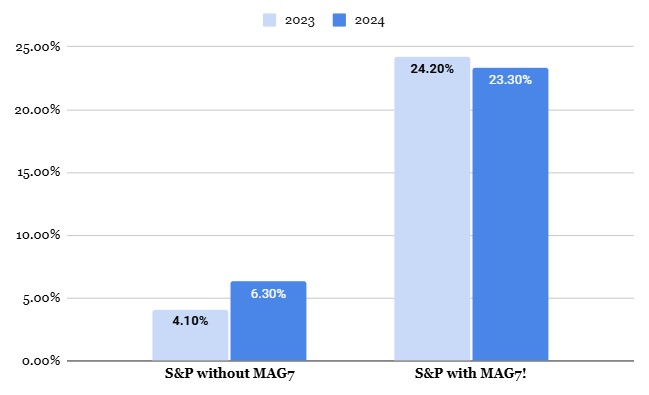
Yet, when the entire market elevates to historic highs, economists examine whether broader macroeconomic growth justifies the enthusiasm. In the context of the current market rally, the answer is nuanced. Dissecting the S&P 500 reveals that approximately three-quarters of recent index growth has been driven by just seven mega-cap technology companies: Apple, Nvidia, Microsoft, Amazon, Alphabet, Meta, and Tesla.
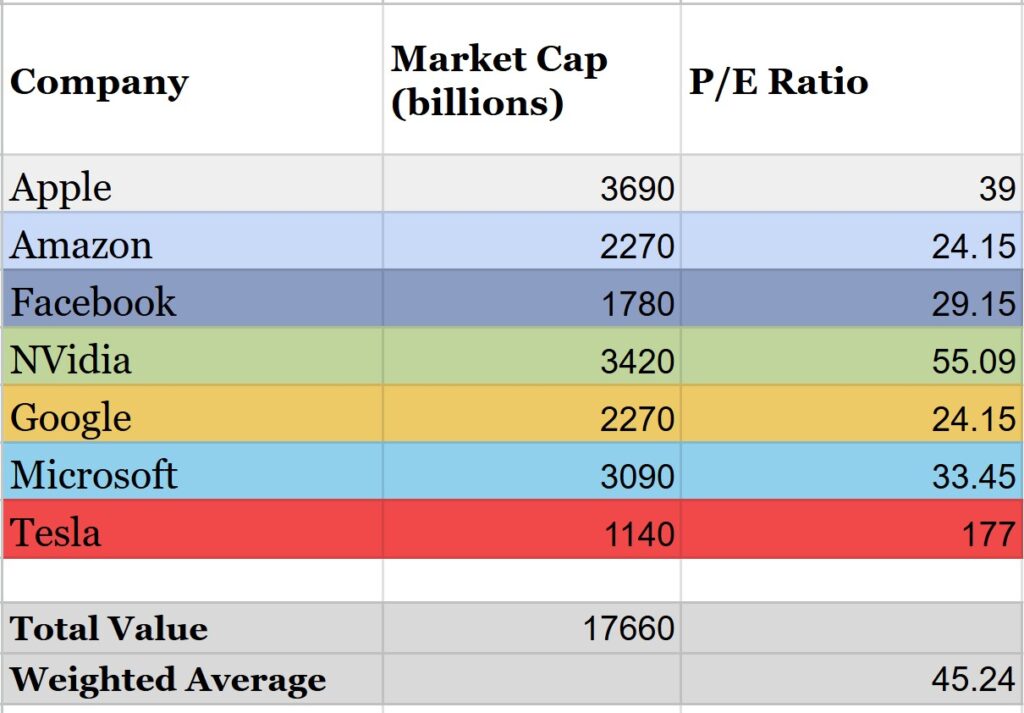
Collectively known as the "Magnificent Seven," these tech giants represent over 25 percent of the entire U.S. stock market value—amounting to roughly $17.66 trillion—while carrying an average P/E ratio of roughly 45. Stripping away these seven dominant corporations leaves the remaining 493 companies trading at a more grounded P/E ratio of 20, which, while historically elevated, is far less extreme. This disparity indicates that while the broader U.S. economy is expected to remain steadily healthy, market participants are heavily betting that mega-cap technology firms will capture extraordinary future growth.
The Artificial Intelligence Catalyst
The common thread binding these seven technology leaders is the sudden, explosive breakthrough in Artificial Intelligence. Recent software advancements capable of human-like reasoning across complex domains have sparked a frenzy throughout the global business ecosystem.

Six of the Magnificent Seven are currently committing hundreds of billions of dollars to construct massive infrastructure hubs packed with advanced supercomputers. Meanwhile, Nvidia sits at the center of this capital expenditure wave as the primary manufacturer of those specialized chips, commanding massive profit margins and shipping hardware at unprecedented volumes.
This infrastructure buildout represents just the foundational layer of the AI boom. Across the broader economy, industries anticipate an era of radically accelerated productivity. Modern AI applications can already process entire legal documents, audit software code for security flaws, assist in medical diagnostics, and accelerate pharmaceutical research by orders of magnitude.
The underlying thesis driving the market is that humanity stands on the threshold of an infinite labor force composed of intelligent digital systems capable of operating around the clock, thereby removing the historical constraints of finite human labor and cognitive bandwidth. While many industry observers believe this technological transition will materialize, the precise timeline and ultimate profitability remain open questions. The central debate centers on whether corporate earnings will scale to meet current valuations or whether unexpected obstacles—such as regulatory hurdles, intense price competition, infrastructure costs, or broader societal displacement—will intervene.
Historical Growth and Alternative Perspectives
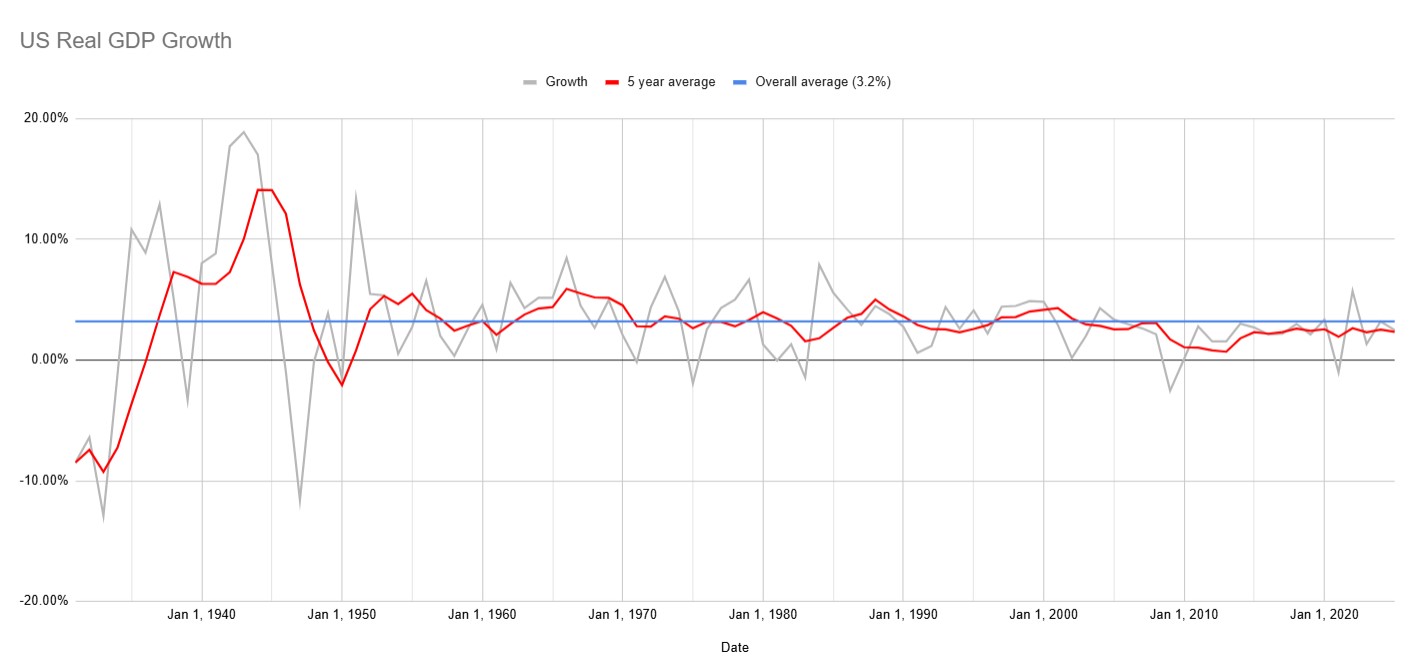
Despite technological shifts, the macroeconomic history of the United States reveals a remarkably stable baseline of long-term economic growth, averaging roughly three percent annually after inflation across successive decades. Interestingly, historical data shows that recent decades have actually experienced slightly slower-than-average economic growth, providing further context to current market valuations.
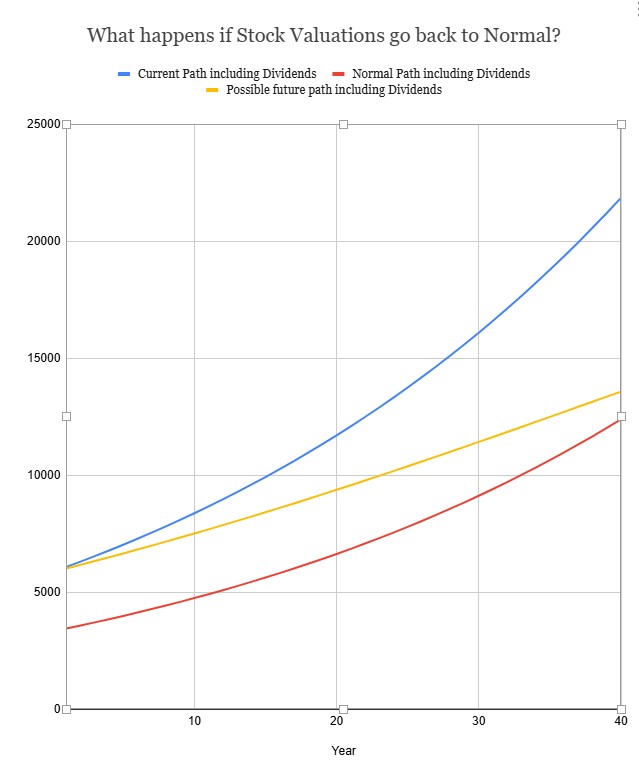
While stock ownership remains viable for long-term wealth accumulation, future returns are projected to moderate compared to historical bargain periods. Attempting to time market crashes or cyclical panics by liquidating positions typically proves detrimental to long-term investors. Even if valuations eventually compress toward historical norms, continuous economic expansion and rising corporate earnings suggest a sustainable long-term trajectory, albeit with lower initial multiples.
Beyond the domestic equity market, institutional forecasters continue to evaluate alternative asset classes. Vanguard’s ten-year annualized return projections suggest that international equities and fixed-income bonds may outperform U.S. stocks over the coming decade. International indexes, such as Vanguard’s VXUS fund, carry significantly lower P/E ratios near 15.9, trading at a steep discount relative to U.S. markets. However, proponents of U.S. equities note that foreign markets have historically lagged during prolonged American technology outperformance.

Similar caution is echoed by veteran investors like Warren Buffett. Berkshire Hathaway’s recent shareholder communications signal a scarcity of undervalued equities, prompting the conglomerate to hold over $300 billion in uninvested cash while pausing share repurchases amid elevated market valuations.
For individual savers navigating these conditions, financial philosophies often converge on established principles: maintaining consistent investment habits, tuning out daily media noise, and focusing on long-term personal well-being.