





Over the past two years, the value of the S&P 500 index has climbed by roughly 57 percent, more than doubling over the past five years. For everyday investors who have diligently stashed their retirement savings into broad-market index funds, this unprecedented surge has fundamentally altered net worth calculations. Individuals who felt they were only halfway to their retirement goals during the pandemic era may suddenly find themselves blowing right past the finish line. Meanwhile, those who achieved financial independence and retired long before the COVID-19 era might find themselves eyeing expensive properties or engaging in other luxury expenditures.
This dramatic financial ascent has naturally sparked a central question across the investing community: Is this meteoric rise real, or is it merely an artificial bubble and a financial illusion?

Addressing anxious inquiries from readers, financial commentators note that the market is currently experiencing a massive wave of hype driven primarily by advancements in Artificial Intelligence. This raises critical concerns regarding whether the market is uniquely vulnerable to a severe future crash and how everyday retirement portfolios might be affected. To evaluate the current state of the global financial world and the stock market properly, financial analysts suggest returning to the foundational mechanics of what a stock actually represents.
At its core, owning a stock is a business arrangement that functions essentially as a more liquid and convenient version of a rental house. When an investor owns a rental property, they are entitled to collect regular rent from a tenant. After covering all associated operational expenses, the remaining balance constitutes the landlord’s profit. If the average sale price of rental houses within a specific region increases while the tenant continues to pay the exact same monthly rent, the higher valuation looks impressive on paper, but it yields no additional cash flow unless the property is sold. Even then, the seller would simply have to turn around and deploy that higher capital into purchasing another expensive rental property.
A property owner’s regular income remains unchanged unless they actively find ways to make their rental business more profitable. This can be achieved by constructing a basement apartment, performing strategic renovations, streamlining expenses, or implementing measures to increase net earnings. When the property is eventually sold to another investor, the purchase price should theoretically be anchored to that future stream of income.

For instance, if a rental house generates $2,000 per month—totaling $24,000 annually—and commands a sale price of $240,000, the incoming investor is purchasing an asset with a price-to-earnings ratio of 10. However, if the seller manages to convince a buyer to pay $480,000 for that exact same property, the transaction occurs at a P/E ratio of 20. While this creates a lucrative exit for the seller, it establishes a considerably less promising financial outlook for the incoming investor.
Translating this economic reality to the broader stock market reveals a striking parallel. An investor who allocated $100,000 into the market in 2019 and continuously reinvested dividends would see their portfolio swell to approximately $256,960 today, representing a 157 percent gain on the original principal. Over that exact same timeframe, however, the share of company earnings generated by that $100,000 basket of stocks has only increased from $5,290 to $7,540, a modest 42 percent gain according to historical financial analysis tracking tools.
Consequently, the overall price-to-earnings ratio of the market has expanded from roughly 20 in 2019 to approximately 30 today. Stock investors in the current economic landscape are therefore in a position identical to real estate investors who discover that property values have more than doubled while rental income has barely budged. This compression of yield makes the underlying business less lucrative on a relative basis, signaling that investors should anticipate lower future profits as a percentage of their total portfolio value. While owning stocks or rental properties remains profitable over the long term, purchasing these assets at historically high P/E ratios inherently reduces future income yields compared to buying during market downturns.

Naturally, exceptions exist when underlying earnings are projected to rise rapidly. If an investor purchases a moderately overpriced rental house knowing that a massive corporate headquarters is about to be built nearby, anticipated surges in local demand justify paying a premium for future earnings. This fundamental principle explains why individual company stock prices climb aggressively upon receiving positive corporate news. During the pandemic, consumer demand for home exercise equipment spiked, leading investors to incorrectly assume a permanent shift in lifestyle habits. Peloton stock soared on this premise, only to plummet back to earth once normalcy returned and sales normalized.
A broader economic question emerges when the entire stock market experiences simultaneous, economy-wide valuation expansion: Does this indicate that the entire national economy is poised for unprecedented growth?
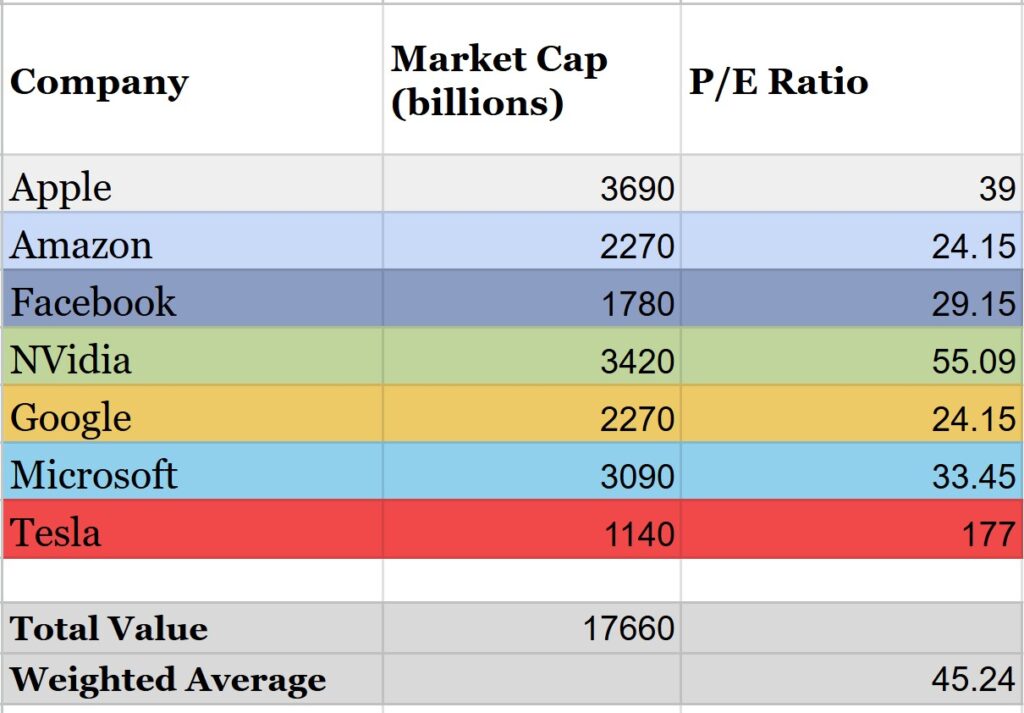
A deeper examination of the S&P 500 reveals that the current market euphoria is not broad-based. Approximately three-quarters of the recent market growth has been concentrated in just seven massive technology corporations: Apple, Nvidia, Microsoft, Amazon, Alphabet, Meta, and Tesla. Often referred to as the "Magnificent Seven," these highly profitable firms have captured intense investor enthusiasm due to their leadership in cutting-edge technology sectors. Collectively, these seven companies account for more than 25 percent of the entire market’s capitalization—exceeding $17.6 trillion—and trade at significantly higher valuation multiples, with a weighted average P/E ratio hovering around 45.
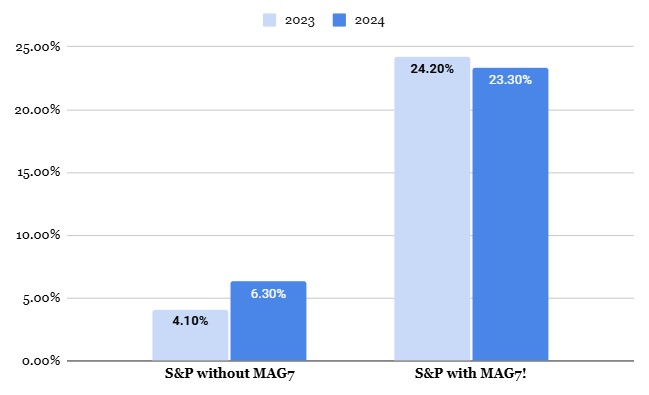
Excluding these seven tech giants and analyzing the remaining 493 companies in the index reveals a much more moderate P/E ratio of approximately 20. This stark divergence indicates that while market participants anticipate stable macroeconomic conditions ahead, they are pricing in exceptionally rapid growth specifically for the largest technology conglomerates.
The unifying catalyst behind this elite tech boom is the sudden, unexpected leap in Artificial Intelligence capabilities, which has equipped software with human-like reasoning across a rapidly expanding range of professional disciplines. This technological breakthrough has ignited a spending frenzy across corporate America. Six of the Magnificent Seven companies are currently committing hundreds of billions of dollars toward the construction of massive data centers packed with specialized supercomputers. Meanwhile, Nvidia sits at the center of this capital expenditure wave as the primary manufacturer of these essential hardware systems, allowing the company to command extraordinary pricing power.
Beyond foundational AI infrastructure, industries across the commercial spectrum are projecting a historic era of productivity enhancements and accelerated earnings growth. Modern AI systems can now process entire legal contracts to identify loopholes, diagnose medical conditions from imagery, optimize pharmaceutical drug design, and power humanoid robotic laborers. The overarching economic thesis is that humanity is on the precipice of acquiring an infinite workforce of highly intelligent digital employees capable of operating continuously, thereby eliminating the historical constraints of finite human intelligence and labor supply.
While many market participants and technology observers believe these transformations will eventually materialize, the precise timeline remains highly uncertain. Key questions persist regarding whether corporate earnings will ultimately match current forecasts, or if unforeseen cost overruns, intense competitive pressures, and regulatory hurdles will emerge.
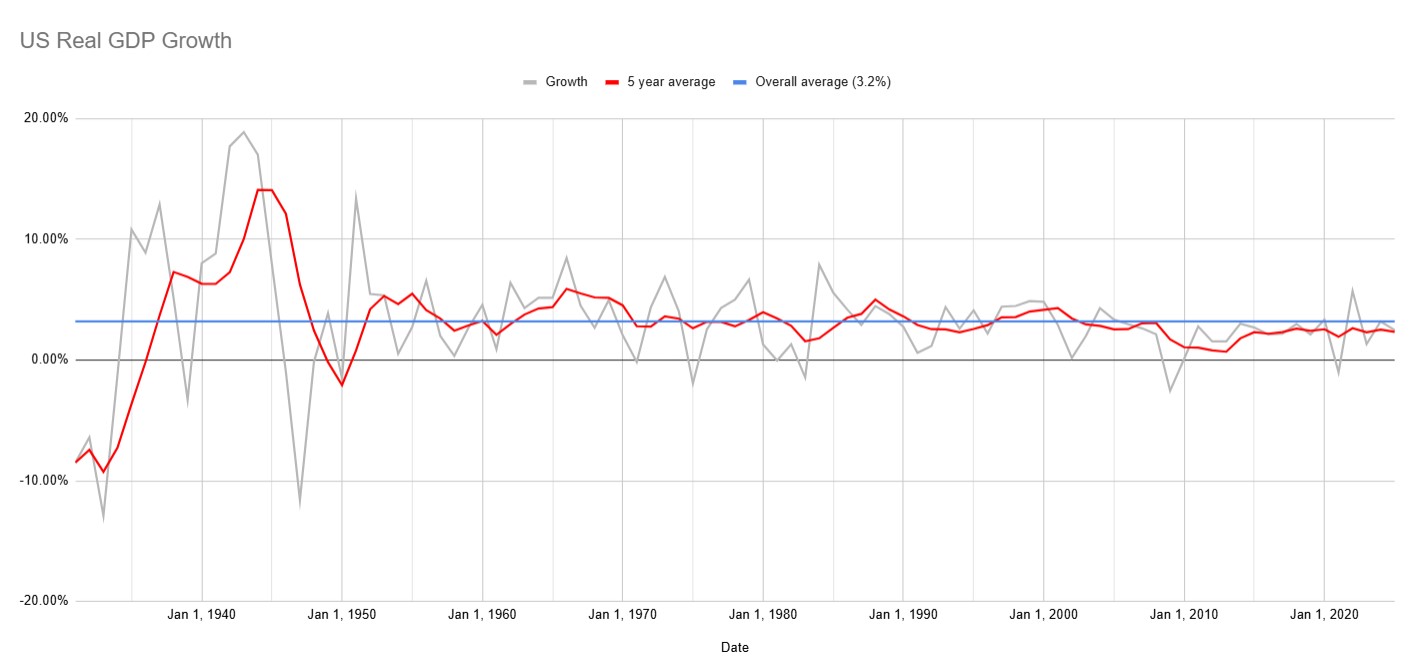
Historical economic data provides a stabilizing perspective against short-term market euphoria. Over many decades, long-term United States economic growth has averaged a remarkably steady three percent annually after adjusting for inflation. Interestingly, recent decades have actually experienced slightly slower-than-average gross domestic product growth, providing even less empirical justification for the elevated equity valuations observed today.
While long-term stock ownership remains fundamentally sound, investors must reconcile themselves to a period of potentially compressed returns compared to historical averages when equities were acquired at lower valuations. Market corrections, panics, and cyclical downturns remain inevitable features of the financial system. Attempting to time these fluctuations by liquidating portfolios in anticipation of lower entry points historically proves detrimental to long-term wealth accumulation.

Even if the broader market eventually returns to more typical valuation multiples, the underlying economy is expected to continue growing, dragging corporate earnings upward alongside it. Future investors may simply choose to pay a more modest multiple for those earnings, mirroring the real estate investor who eventually adjusts price expectations when selling an income-generating property.
Broader asset allocation models offer alternative perspectives on the global investment landscape. Major institutional asset managers regularly publish long-term return forecasts spanning ten-year horizons. Recent projections from institutions such as Vanguard suggest that international equities and fixed-income bonds could potentially outperform domestic United States stocks over the coming decade. This outlook is supported by valuation disparities, such as international equity funds trading at significantly lower price-to-earnings ratios compared to the domestic market. However, market strategists note that such predictions have frequently lagged behind actual performance in recent years, largely due to the concentration of the AI boom within domestic technology markets.
Alternative portfolio strategies, including diversified multi-asset models utilized by digital robo-advisors, seek to smooth out market volatility by distributing capital across a wider array of global equities, emerging markets, and fixed-income instruments. While historical back-testing demonstrates that a purely domestic, large-cap growth portfolio has outperformed diversified alternatives over the past decade, proponents argue that global market cycles eventually revert toward historical means.
At the same time, legendary market figures have signaled caution in the current economic environment. Prominent long-term investors have maintained substantial levels of uninvested cash reserves, indicating that attractive bargains are scarce while equities trade at elevated valuation multiples. For individual homeowners, the calculus regarding mortgage debt versus equity investing has also shifted amid higher prevailing interest rates, turning guaranteed debt elimination into an increasingly attractive alternative to holding excess cash.
Ultimately, long-term financial guidance consistently emphasizes patience, disciplined and continuous investing, and a deliberate detachment from sensationalized daily news cycles. Experts suggest that individuals redirect the mental energy typically spent worrying about market fluctuations toward physical activities and personal well-being, which remain reliable cornerstones of a balanced life.