


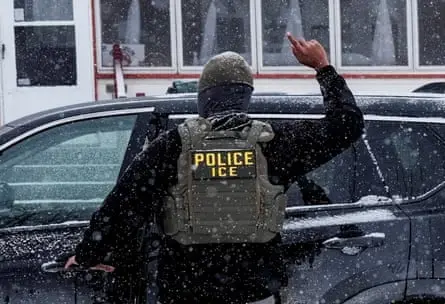
As hundreds of masked and heavily armed US federal agents besieged the streets of Minneapolis, turning the midwestern city into the frontline of the Trump administration’s unprecedented crackdown on immigration, independent photographer John Abernathy was documenting one of the daily protests. In the midst of the chaos, Immigration and Customs Enforcement (ICE) agents tackled him to the ground.
A widely circulated photograph of him sprawled on the pavement, pepper spray streaming down his face, captured the raw violence with which ICE agents had for weeks treated undocumented immigrants and the thousands of US citizens who had come out to their defense. It also served as a stark and alarming reminder that members of the press were not immune to the agency’s increasingly aggressive and confrontational tactics.
The escalating hostility toward the media is part of a broader, volatile climate documented by the US Press Freedom Tracker. In 2025 alone, the organization recorded 32 arrests and 170 assaults against journalists across the country, with the vast majority of these incidents occurring during tense protests and demonstrations. Statistics and field reports indicate that the situation has shown little sign of improvement, with reporters continuing to face physical obstruction, detainment, and harassment while trying to cover government operations.
Journalists who are themselves immigrants have at times also become direct targets of these hardline enforcement policies. Estefany Rodríguez, a Colombian reporter covering immigration for a Spanish-language media outlet based in Nashville, Tennessee, experienced this firsthand when she was arrested in March. She was subsequently held in ICE detention centers across Louisiana and Alabama for two weeks before an immigration judge finally ordered her release. Rodríguez had been reporting on immigration arrests at a local courthouse just a day before federal agents surrounded her car—which was clearly marked with her news outlet’s logo—and placed her under arrest.
The targeting of reporters such as Abernathy and Rodríguez helped inspire a massive, multi-outlet international investigation. Coordinated by Forbidden Stories, the project involved staff journalists from two dozen newsrooms spanning 16 countries. The resulting investigative reports shed light on the secretive deals that the Trump administration has struck with third countries, primarily located in Africa and Latin America, to take in deportees whom the United States is otherwise unable to send back to their countries of origin.
The domestic fallout for journalists covering these operations has been severe. In Georgia, ICE agents arrested Mario Guevara, an Emmy award-winning journalist originally from El Salvador. Guevara had lived in the Atlanta area for nearly two decades, where he ran an independent Spanish-language news outlet and frequently documented immigration enforcement operations live on TikTok. Guevara was out covering a "No Kings" protest in June 2025 when he was taken into custody. He subsequently spent more than 100 days in detention, the majority of that time spent isolated in solitary confinement.
"They didn’t want me to hear the stories of other fellow prisoners, and that’s why they locked me up alone," Guevara told Forbidden Stories during interviews following his ordeal.
Guevara was ultimately deported to El Salvador last October, leaving behind his wife and children, who remain in the United States. Despite being forced out of the country, he has continued his work, reporting on US immigration enforcement from abroad. He remains firmly convinced that he was targeted specifically because of his journalism rather than any legitimate administrative infraction.

"ICE had a personal campaign against me," he said, noting that federal agents repeatedly questioned why he insisted on documenting their activities given that he was not a US citizen. "ICE arrested and deported me because of my journalistic work, I’m sure."
When contacted for comment, a spokesperson for the Department of Homeland Security strongly rejected Guevara’s claims, calling allegations that he was arrested or isolated in detention due to his profession "completely FALSE." The spokesperson maintained that Guevara was originally arrested by local authorities for obstruction of law enforcement and was deported because an immigration judge had issued a final order of removal against him more than a decade prior.
"If you come to our country and break our laws, we will arrest you and you will NEVER return," the DHS spokesperson added.
The hostility faced by journalists is not confined to US soil. Reporters attempting to investigate the real-world impacts of the Trump administration’s third-country removal policy have also encountered severe resistance from authorities in those destination countries—particularly in nations where press freedom is already heavily restricted or suppressed.
In Cameroon’s capital, Yaoundé, last February, four journalists—including three on assignment for the Associated Press—were briefly detained while attempting to report at a state-run compound. The facility was being used to hold African migrants who had been recently deported from the United States. The journalists were accused of criminal trespassing, and their professional equipment and personal phones were confiscated and held for a week. During intense questioning by authorities, the reporters were warned that they would be "crushed" and would "disappear without a trace," one of the detained reporters later told the Committee to Protect Journalists.
Nalova Akua, one of the journalists caught up in the detention in Cameroon, told Forbidden Stories that he and his colleagues were targeted because they were getting too close to exposing the human and logistical consequences of a secretive collaboration with the US government—an arrangement that Cameroonian officials would evidently prefer to keep entirely out of the public view.
These accounts highlight the personal risks reporters are willing to take to keep the public informed about high-stakes government policies. During the raid in Minneapolis, when John Abernathy realized he was about to be tackled to the ground by federal agents, he quickly tossed his camera to a fellow photographer in a desperate bid to save the visual evidence he had just captured.
"It deserves to be seen, what’s going on around here," he had previously told the Guardian.