



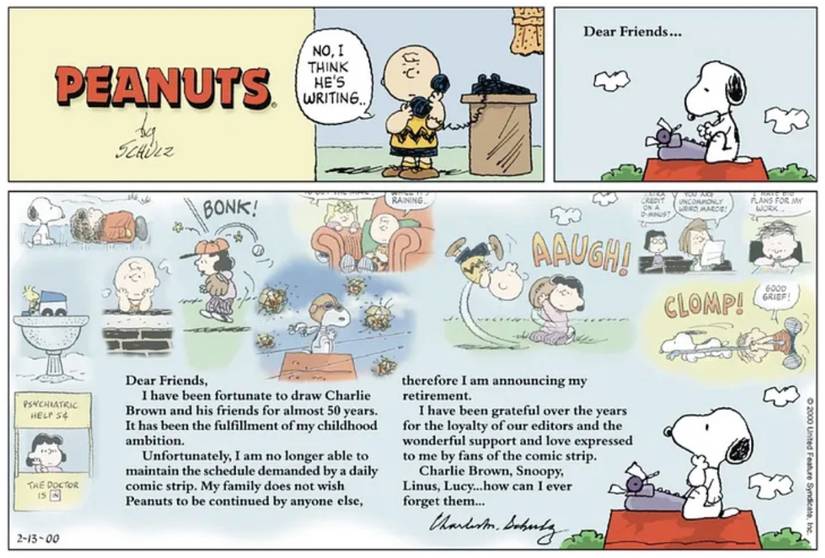
American cartoonist Charles Schulz passed away on February 12, 2000, at the age of 77. The very next day, the final installment of the legendary Peanuts comic strip was published in newspapers across the United States, officially bringing a close to a remarkable 50-year run that introduced generations of readers to Charlie Brown, Snoopy, and the rest of the beloved neighborhood gang.
At a glance, this timing might seem deliberately orchestrated—a poetic final bow timed precisely for the day after the creator’s passing. However, the reality of the comic syndication business reveals it to be a poignant coincidence. Peanuts strips, particularly the expansive Sunday editions, were routinely created, submitted, and scheduled weeks in advance.
Schulz had publicly announced his retirement two months prior, in December 1999, following a series of strokes and a battle with advancing colorectal cancer. He had drawn his final daily and Sunday strips shortly after making that retirement public. While Schulz was acutely aware of his failing health and impending death, he could not have known with absolute precision the exact date he would die. Consequently, through the machinery of newspaper syndication schedules, he essentially penned his own cultural obituary, with his final published comic strip appearing just 24 hours after his death.

The striking synchronicity of the timeline felt entirely fitting for a man whose work left such a profound, enduring imprint on American and global culture. Over the course of half a century, Schulz produced nearly 18,000 individual Peanuts strips. While many relied on gentle humor, recurring gags, and sweet childhood observations, others possessed an unexpected emotional depth and philosophical weight. Among these stands a specific storyline from February 1966, which features what many consider to be Schulz’s finest and most resonant quote—a towering achievement for such a prolific and celebrated career.
Charlie Brown and the Spelling Bee
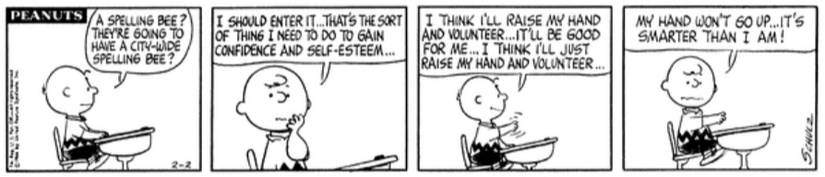
The philosophical high-water mark in question was part of a multi-part narrative arc centered on Charlie Brown participating in a school spelling bee. The storyline began on February 2, 1966, and extended through February 20, running for 16 consecutive daily strips. Because Sunday editions required a much longer lead time and a broader audience that often only read the weekend comics, Sunday strips during such arcs typically needed to be more self-contained while still serving the ongoing narrative.
In the storyline, a hopeful Charlie Brown eagerly volunteers to represent his class in the school spelling bee. True to his luckless nature, however, his moment in the spotlight is short-lived. When it comes time for his very first assigned word, a nervous and stressed Charlie Brown famously botches the spelling of "maze," rendering it "m-a-y-s." Overwhelmed by embarrassment and defeat, he returns to his desk and slumps down with his head resting on the wood. When his teacher instructs him to sit up and face forward, a frustrated Charlie Brown snaps back at her, leading to a trip to the principal’s office. After serving his brief punishment, he returns to the classroom and offers his teacher a humble apology.

Yet, the true gem of the entire 16-part sequence did not occur at the microphone during the spelling bee itself, but rather near the very beginning of the arc during the second strip. The strip opens with a characteristically incredulous Lucy, who cannot fathom why Charlie Brown would willingly subject himself to potential public humiliation by volunteering for a spelling bee in the first place.
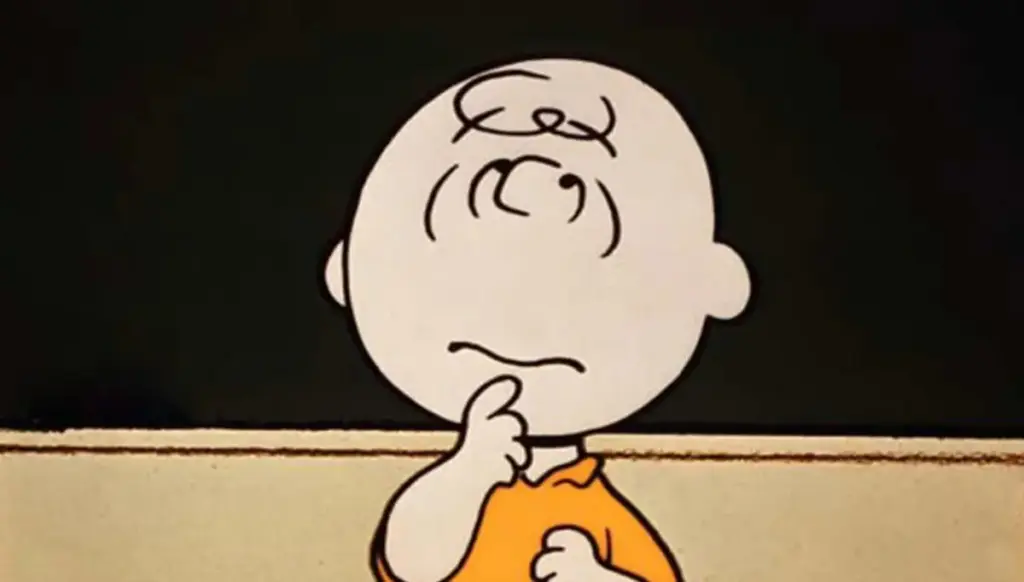
Faced with Lucy’s sharp skepticism and disbelief, a defensive and impassioned Charlie Brown shouts back at her, defending his right to participate. "Well, what’s wrong? What’s wrong with trying?! I can try, can’t I?" he demands. Then, in a moment that transcends the petty playground dynamics of childhood, Charlie Brown delivers a line of startling clarity:
"What’s the good of living if you don’t try a few things?"
It is a remarkably brilliant piece of writing—a statement that pairs profound existential wisdom with disarming simplicity. It cuts to the absolute core of human vulnerability, ambition, and perseverance, offering a perspective that adults often spend a lifetime trying to master.
Yet, within the context of the comic strip, the profundity of the statement completely escapes both characters. Lucy and Charlie Brown are portrayed as children navigating the awkward landscape of growing up, and they are not written to possess self-aware philosophical insight. Such moments of accidental wisdom occurred frequently throughout the rich history of Peanuts. However, historical evidence suggests that even Charles Schulz himself may have failed to recognize the exceptional brilliance of the words he had just put into Charlie Brown’s mouth.
Charlie Brown on the Big Screen
The expansive 20-part spelling bee storyline later served as the primary narrative foundation for the very first feature-length Peanuts film, titled A Boy Named Charlie Brown, which premiered in theaters on December 4, 1969. The film, written by Schulz himself, remains a significant milestone in the history of the franchise, successfully expanding the original newspaper storyline to fill an 85-minute feature while incorporating musical numbers and expanded subplots.
Despite Schulz’s direct involvement in adapting his own work for the silver screen, certain elements from the original newspaper strips were left behind in the transition. Curiously, that iconic, deeply philosophical line—"What’s the good of living if you don’t try a few things?"—did not make it into the final movie.
Whether Schulz omitted it because it failed to fit the narrative pacing of the film or because he simply did not view it as uniquely special among his thousands of strips remains unknown. Regardless of its absence from the big screen, the statement stands on its own. It matches the wisdom of venerated philosophers, leaders, and thinkers, touching on the fundamental motivation behind human existence. After all, as Schulz’s enduring work continually suggested, what truly is the point of being here if we do not dare to try a few things along the way? Charles Schulz certainly took that chance, and American culture was forever changed as a result.