
Talks regarding the sale of a majority stake in legendary German camera manufacturer Leica Camera AG have officially concluded, leaving the company to maintain its current ownership structure and business strategy for the foreseeable future.
The discussions, which first came to light in January through reports from Bloomberg, indicated that the iconic brand’s controlling owners were exploring options to sell a major portion of the company for roughly $1.2 billion. However, according to a wide-ranging feature published this week by The Wall Street Journal titled "These $10,000 Cameras Are a Rare European Manufacturing Success," those potential acquisition conversations have ended. A source familiar with the matter confirmed that deal talks have ceased, providing reassurance to photography enthusiasts who had grown concerned about the potential impact of external corporate influence on the heritage brand.
The collapse of the sales discussions preserves the status quo for a company that has experienced a remarkable renaissance over the past two decades. Under the stewardship of majority owner Andreas Kaufmann, who utilized his family inheritance to rescue Leica when it was facing severe financial distress more than twenty years ago, the brand successfully navigated the treacherous transition from analog photography to the digital era. Today, the Kaufmann family maintains control of Leica through ACM Projektentwicklung GmbH, which owns a 55 percent stake in the enterprise. Meanwhile, private equity firm Blackstone Inc., which acquired its 45 percent minority stake back in 2011 during a much earlier stage of the company’s modern development, appears to have weighed its options for cashing out before ultimately stepping back from a transaction.
During the initial reports earlier this year, Bloomberg noted that alternative investment firms such as China-based private equity house HSG and Sweden’s Altor Equity Partners had expressed interest in the luxury camera maker. With the talks now concluded, those prospective buyers will not be moving forward, leaving Leica firmly anchored to its current leadership framework.
The Wall Street Journal’s deep dive into the company highlights both its storied history—including celebrations surrounding the centenary of the first 35mm commercial camera format—and its current financial robustness. Although a remarkable four-year streak of consecutive revenue growth recently came to an end this year, Leica remains in a position of exceptional financial health, pulling in annual revenues close to $670 million.

A cornerstone of this modern stability has been the strategic utilization of production facilities outside of Germany. While Leica continues to manufacture its renowned M-series rangefinder cameras in its historic Wetzlar, Germany factory—producing roughly 45 units per day—its manufacturing footprint in Portugal has served as a vital engine for operational efficiency. The Portuguese factory, which celebrated its 50th anniversary in 2023, has long been cited by Kaufmann as a critical factor in managing manufacturing costs while upholding the meticulous craftsmanship that defines the brand.
Even as it preserves its ownership structure, Leica is actively positioning itself for a changing technological and market landscape. The brand has increasingly leaned into high-profile partnerships, expanding its presence in the consumer technology sector through collaborations in the smartphone and home electronics markets. Earlier this year, Leica announced a strategic alliance with Chinese image sensor manufacturer Gpixel to co-develop next-generation image sensors, signaling that the company is heavily investing in advanced optical and digital capabilities for its future product roadmap.
Balancing this forward-looking innovation with the traditional craftsmanship that commands price tags near $10,000 for its flagship models remains a delicate enterprise. Speaking with The Wall Street Journal, Kaufmann reflected on the unique challenges and philosophies of European manufacturing. "There are two things anyone who produces anything in Europe should care a lot about: materials and design," Kaufmann told the publication, while voicing a distinct critique of modern industrial aesthetics in other sectors. "And unfortunately, there are almost no European cars I could imagine buying today because they all look so ugly."
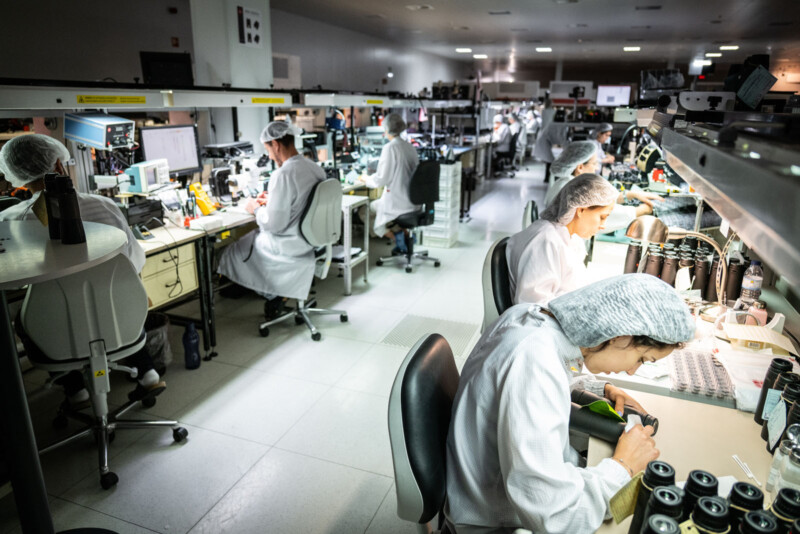
Despite the distinct identity that has allowed Leica to thrive where other European manufacturing ventures have stumbled, industry analysts note that the company’s business model is exceptionally difficult to replicate. Hand-assembling high-end cameras is inherently costly, yet Leica has built a resilient ecosystem that extends far beyond the initial point of sale.
The company exercises tight control over its retail distribution, selling approximately half of its entire inventory directly through its proprietary network of global Leica Stores. This direct-to-consumer approach is supported by an expanding international footprint of cultural spaces and Leica Galleries dedicated to promoting photographic art, as well as an internal auction house ecosystem that regularly commands staggering prices for rare vintage gear and limited editions, such as a recent black paint Leica MP model that fetched nearly $700,000.
By keeping ownership stable under its current stakeholders, Leica avoids the strategic disruptions that often accompany major corporate buyouts. As the company continues to refine its digital sensor technology, manage its boutique manufacturing operations in Germany and Portugal, and expand its global retail and cultural footprint, it moves forward into its next chapter entirely on its own terms.