

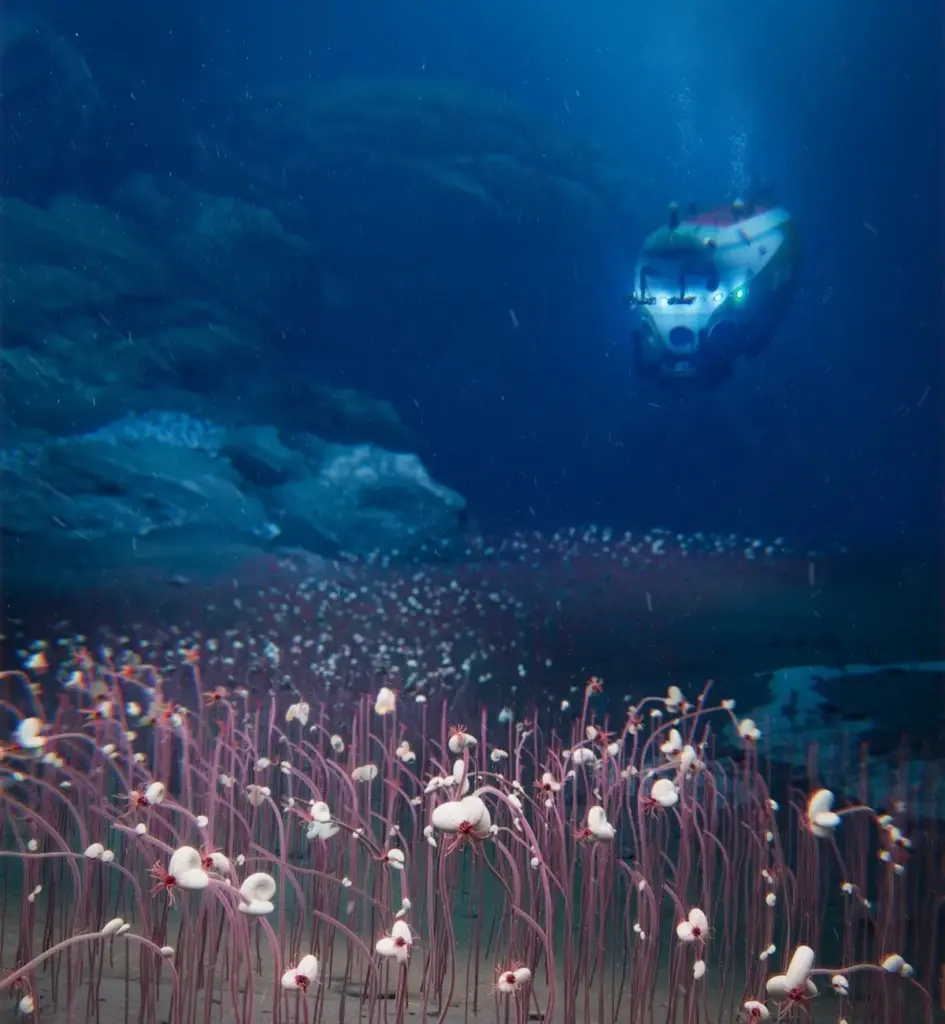
Researchers exploring the deepest, most remote environments on Earth have made a groundbreaking discovery, uncovering thousands of mollusks, worms, and other marine animals living nearly six miles below the surface of the Pacific Ocean.
Published in the journal Nature, a new study details how a Chinese scientific team utilizing the manned submersible Fendouzhe documented the deepest and most extensive animal communities ever observed. Operating within the harrowing depths of the Mariana Trench, the Kuril-Kamchatka Trench, and the western Aleutian Trench, the researchers found that life is not only present in these extreme hadal zones, but thriving in astonishing abundance.
The discovery challenges long-held assumptions about the limits of biology, ocean carbon cycling, and the ability of complex organisms to survive in environments historically considered completely desolate and alien.
A Hidden World Powered by Chemistry
Hadal trenches—the deepest regions of the ocean floor, plunging from depths of roughly 3.6 miles down to nearly seven miles—represent some of the least explored and understood habitats on Earth. For decades, scientists theorized that these sunless depths might harbor chemosynthesis-based communities, but actual documentation of such complex ecosystems has remained exceptionally rare.
Unlike surface-dwelling ecosystems that rely on photosynthesis to convert sunlight into energy, the newly discovered creatures survive in total darkness. Instead of plants and sunlight, these communities are sustained by hydrogen sulfide-rich and methane-rich fluids. These chemical compounds are transported along fault lines traversing deep sediment layers in the trenches, where methane is produced microbially from deposited organic matter, as indicated by isotopic analysis conducted by the researchers.
Using a process called chemosynthesis, specialized microbes consume these chemicals, forming the foundation of a food web that supports a vibrant array of larger invertebrates. Video footage captured during the expeditions revealed expansive fields of tubeworms growing up to a foot long, alongside dense mounds of clams and mollusks. Scientists also observed free-floating marine worms, spiky crustaceans, sea lilies, sea cucumbers, and other invertebrates clustering around snow-like microbial mats where methane production is most active.
Unprecedented Abundance in the Deepest Valley on Earth
The Fendouzhe submersible dove into the western Pacific’s Mariana Trench 23 times over the course of the research period. The Mariana Trench plunges to depths that extend even farther than the height of Mount Everest.
According to the study’s findings, the newly discovered communities primarily consist of siboglinid Polychaeta and Bivalvia, stretching across a staggering distance of 1,553.4 miles at depths ranging from 3.6 to 5.92 miles.

“What makes our discovery groundbreaking is not just its greater depth — it’s the astonishing abundance and diversity of chemosynthetic life we observed,” said study co-author Mengran Du, a marine geochemist with the Institute of Deep-sea Science and Engineering at the Chinese Academy of Sciences. “Unlike isolated pockets of organisms, this community thrives like a vibrant oasis in the vast desert of the deep sea.”
Lead author Xiatong Peng noted that given the geological similarities shared among other hadal trenches around the world, such chemosynthesis-based communities might be significantly more widespread than previously anticipated. The findings suggest that an untold abundance of life may be thriving in hostile, high-pressure conditions far below the surface of the world’s oceans.
For the researchers who piloted the submersible, the descents offered a rare glimpse into a hidden realm.
“Diving in the submersible was an extraordinary experience — like traveling through time. Each descent transported me to a new deep-sea realm, as if unveiling a hidden world and unraveling its mysteries,” Du reflected.
Context and Conservation Concerns
While early marine studies occasionally uncovered single-cell organisms thriving on the seafloor, discovering large, complex animal communities at these extreme depths is a major scientific milestone. Past expeditions had identified marine invertebrates such as tubeworms living inside hydrothermal vents, but typically at much shallower depths within Earth’s crust.
The publication of these findings coincides with intense international debates regarding deep-sea mining. Governments and regulatory bodies are currently discussing the controversial prospect of extracting valuable minerals from the ocean floor. Ocean scientists and conservationists have repeatedly warned that industrial mining in these little-explored environments could permanently destroy fragile marine ecosystems in some of the last truly wild, untouched zones on the planet. Despite ongoing talks, the International Seabed Authority has yet to adopt comprehensive rules governing the emerging industry.
Human exploration of the deepest parts of the ocean remains remarkably limited. Though the first explorers briefly visited the bottom of the crescent-shaped Mariana Trench in 1960, only a handful of individuals have made the descent in the decades since. Among them was Hollywood director James Cameron, who completed a solo trip in 2012 and memorably described the environment as "desolate" and "alien."
As researchers continue to analyze data and footage from expeditions like those of the Fendouzhe, our understanding of Earth’s most extreme ecosystems is undergoing a profound transformation. The new study demonstrates that even in the darkest, most pressurized trenches on the planet, life finds a way to endure and flourish.