




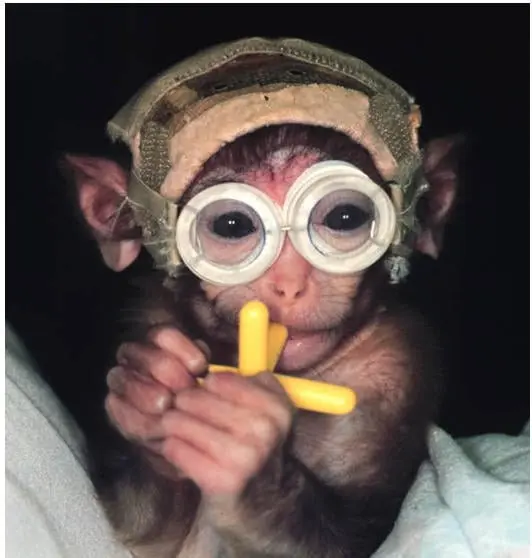
SEATTLE — For nearly three decades, University of Washington (UW) experimenter Mark Walton has conducted invasive and controversial research on monkeys, utilizing millions of dollars in taxpayer funds. According to documents recently obtained by People for the Ethical Treatment of Animals (PETA), Walton’s continued experimentation on infant and adult primates is driven less by groundbreaking scientific necessity and more by the institutional pressure to secure grants, publish papers, and retain his laboratory space.
The documents shed light on long-running animal testing protocols at the Washington National Primate Research Center, detailing a series of procedures that involve separating newborn monkeys from their mothers, surgically altering their eyes, and subjecting them to prolonged physical restraint.
The disclosures have intensified public scrutiny surrounding the funding mechanisms of university-affiliated research facilities, where career advancement and financial self-preservation can intersect with animal welfare controversies. In records obtained via public disclosure requests, Walton makes explicit admissions regarding the professional pressures governing academic research in the biomedical sector.
By Walton’s own written admission, "I have to publish papers to stay funded, and there is the risk of my lab space getting [taken] away if I never run experiments."
This cycle of academic dependency has kept the laboratory operational for nearly thirty years, resulting in a continuous pipeline of trials involving non-human primates. Critics argue that such admissions expose a fundamental conflict of interest within taxpayer-funded institutions, where the incentive structure rewards publication volume over actual scientific advancement or human clinical relevance.
Slicing Baby Monkeys’ Eyes
Among the most controversial aspects of Walton’s laboratory work are his long-term vision experiments involving infant monkeys. These protocols begin shortly after birth, when experimenters remove days-old infant monkeys from their mothers, severing the natural maternal bond during a critical period of development.
Once separated, the young animals are subjected to acute physiological modifications. According to the PETA findings, some infant monkeys have the tendons in their eyes surgically sliced, while others are forced to wear vision-distorting goggles for the first three months of their lives. These interventions are designed to permanently alter visual processing pathways.
As the animals mature, the experimental procedures become increasingly invasive. Laboratory personnel routinely perform cranial surgeries on the monkeys, slicing open their scalps to install permanent recording chambers and inserting metal coils directly inside the animals’ eyes. To ensure immobility during testing, the monkeys are strapped into specialized laboratory chairs, secured by a metal post surgically screwed directly into their skulls.
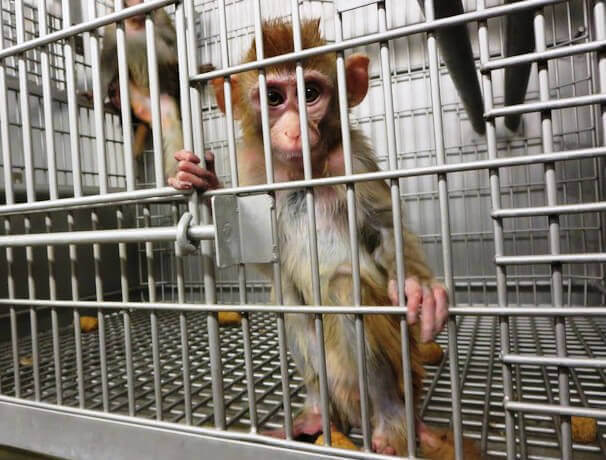
Once restrained in total darkness, the monkeys are subjected to repetitive tasks. Experimenters project a laser dot onto a screen and provide drops of applesauce as a reward whenever the animals direct their gaze toward the target. Observers and animal advocates have frequently drawn unfavorable comparisons between these repetitive, confined trials and carnival games, questioning their validity as high-level biomedical investigations.
Pushed to the Brink
The psychological toll of these laboratory environments on the primate subjects is a central concern for welfare organizations. Ethologists and animal behaviorists note that depriving infant monkeys of maternal comfort and natural social development reliably produces severe psychological distress, often leading to abnormal behavioral patterns.
Internal laboratory notes obtained by PETA indicate that the animals housed in Walton’s facility exhibit pronounced symptoms of stress, anxiety, and extreme self-mutilation. The records highlight two specific monkeys, identified as Sonic and Goose, whose self-injurious behavior became severe enough to draw the attention of the lead experimenter.
However, archival notes reveal that Walton’s primary concern regarding the self-mutilation was not the welfare of the animals, but rather the potential disruption to his research data. He noted that the excessive biting threatened the "usability" of the subjects in ongoing and future experimental trials.
Furthermore, laboratory meeting notes indicate that Walton acknowledged systemic issues within the primate center itself, suggesting that the housing conditions and daily environment were contributing factors to the animals’ psychological deterioration. Writing on the phenomenon of self-biting, he noted that it implied "something going wrong here at the primate center that is making this more likely to happen."
Despite recognizing that the facility’s environment was likely driving the animals to self-harm, Walton did not recommend removing Sonic, Goose, or other affected primates from the testing rotation. Instead, records show he sought and received permission to continue subjecting them to ongoing brain scans, invasive surgeries, eye-coil implants, physical restraint, and trials.
What You Can Do
The revelations regarding Walton’s laboratory highlight broader questions concerning the oversight and public financing of animal research at major academic institutions. The Washington National Primate Research Center remains a focal point for national debates over the ethics of primate experimentation, with advocacy groups continuously challenging the allocation of federal funds toward studies that they argue yield limited translational value for human medicine.
As discussions continue regarding the future of taxpayer-funded animal research, organizations like PETA are intensifying campaigns to redirect resources toward human-relevant, non-animal methodologies, urging institutional reforms at the University of Washington and similar facilities across the country.