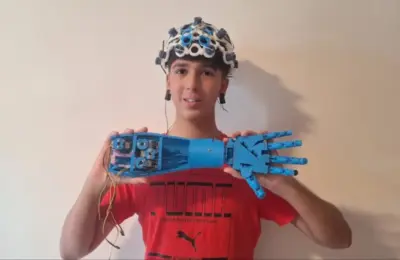



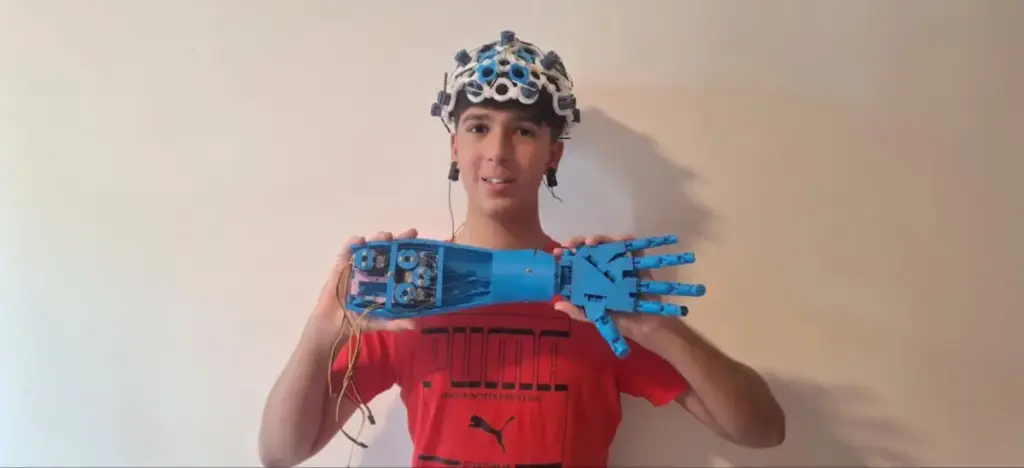
Aarav Sharma is still hard at work. For those who followed the coverage earlier this year in July, Sharma was introduced as a talented young creator who began building a sophisticated, 3D-printed, brain-controlled robot arm when he was just 14 years old. Since then, the young innovator has continued to push the boundaries of accessible technology, expanding his research and development efforts far beyond robotic movement into a comprehensive communication system designed to bridge human thought with digital interaction.
Enabled by a sponsorship from OpenBCI, an open-source brain-computer interface platform, Sharma has successfully built and tested a six-command Steady State Visually Evoked Potential system. To understand the mechanism, it helps to think of the technology as an internal form of eye tracking, though driven entirely by neurological responses rather than physical eye movements. As Sharma explains, SSVEP is a specialized type of brain-computer interface where different visual targets flash at distinct, predetermined frequencies. When a user focuses their attention intently on one specific target, an EEG headset worn on the head detects the matching electrical response in the brain, rapidly converting that specific neurological frequency into a corresponding digital command.

Developing an interface that operates smoothly on neurological signals alone presents significant engineering and signal-processing challenges, particularly regarding speed and accuracy. To address the speed constraint and enhance overall usability, Sharma integrated word suggestions powered by an OpenAI language model. While the artificial intelligence assists by predicting and suggesting words to speed up the process, the human user maintains total control of the final output at all times. During preliminary testing, this thoughtful integration yielded impressive performance metrics, allowing test subjects to compose and transmit full, coherent sentences in under five seconds.
Refining the underlying system required rigorous data collection and performance analysis. Detailing his methodology for offline data collection, Sharma explained that a user completes roughly 60 trials where the system explicitly prompts them to focus on one of the six flashing targets. Following these trials, Sharma meticulously tests how system accuracy fluctuates when utilizing varying amounts of raw EEG data. He utilizes time-frequency representation graphs to verify the accurately detected frequencies and employs a confusion matrix to observe which targets are occasionally being confused by the algorithm, allowing him to continuously tune and improve the reliability of the system.
Looking toward the future of the project, Sharma is already planning the next evolution of his user interface. While current testing relies on a standard computer screen to display the flashing targets, his ultimate goal is to transition the entire UI to augmented reality glasses. Moving the technology to AR glasses would create a vastly more portable, practical, and everyday-use experience for individuals who might rely on assistive communication technologies.

Those interested in following the ongoing development of Sharma’s brain-computer interface projects, including his earlier work and newer innovations, can find additional documentation and updates at his official project portfolio website, aaravinnovate.com/bci-neurova.