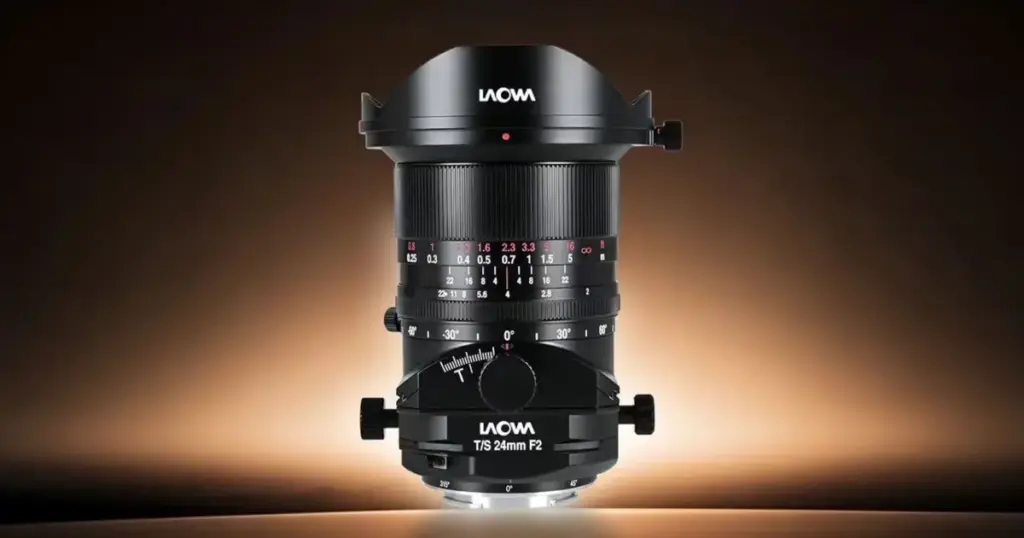
Venus Optics is once again expanding the boundaries of specialized optics with the upcoming release of a groundbreaking tilt-shift lens. While the product has not yet received its official, formal announcement for the United States market, the Laowa T/S 24mm f/2 is already making waves across the global photography community. As recently reported by industry outlet Canon Addict, the new optic has quietly made its debut in China, where it is currently rolling out through domestic channels and select online international retailers like AliExpress, albeit at a minor premium compared to its domestic launch pricing.
This release marks another significant chapter in the quiet renaissance of tilt-shift photography, a niche sector that has enjoyed a notable resurgence in recent years largely driven by Venus Optics’ aggressive and innovative lens development. For decades, perspective-control lenses were viewed as ultra-specialized, highly expensive tools reserved primarily for architectural and studio photographers who relied on large camera systems or legacy DSLR platforms. By introducing affordable, high-performance manual-focus alternatives across a wide variety of lens mounts, Laowa has successfully democratized tilt-shift photography for a modern generation of mirrorless and medium-format shooters.
However, the new Laowa T/S 24mm f/2 stands out even within the brand’s expanding catalog due to one exceptionally unique specification: its maximum aperture. Traditional wide-angle tilt-shift lenses historically maxed out at f/3.5 or slower. For instance, Nikon famously manufactured the PC-E Nikkor 24mm f/3.5D ED tilt-shift lens for its legacy F-mount DSLR lineup, while Canon offered the EF 24mm f/3.5L II USM tilt-shift lens for its own ecosystem of full-frame DSLR cameras. While these lenses were industry workhorses revered for their optical sharpness and precise mechanical movements, their slower maximum apertures severely limited their versatility in low-light environments.
An f/2 aperture is more than a full stop faster than the industry standards established by legacy manufacturers. This substantial increase in light-gathering capability promises to unlock entirely new creative and technical possibilities for contemporary mirrorless camera owners. Landscape and architectural photographers who frequently work during the critical hours of dawn and dusk will benefit immensely from faster shutter speeds and lower ISO settings. Furthermore, the wider aperture opens up exciting new frontiers for astrophotography—a genre that has traditionally been entirely off-limits to users of traditional tilt-shift lenses due to the extreme light loss and tracking limitations imposed by slower f/3.5 or f/4 optical designs. Capturing starry nightscapes over vast architectural landmarks or sweeping landscapes with precise control over the focal plane is now a distinct possibility.
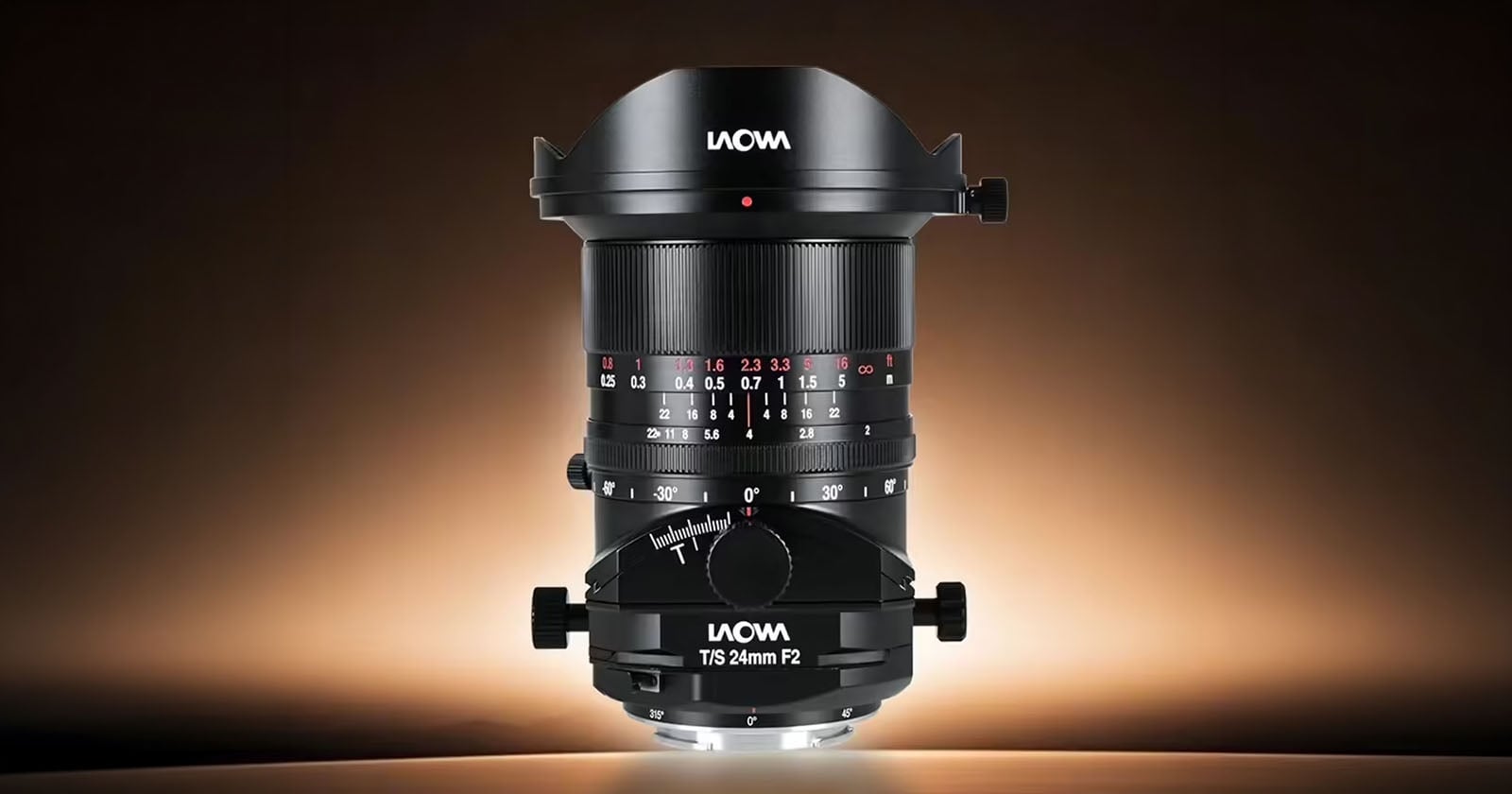
True to Venus Optics’ reputation for broad system compatibility, the new Laowa 24mm f/2 T/S is engineered to support a remarkably diverse array of camera systems. The lens will be made available for full-frame mirrorless mounts including Sony E, Nikon Z, Canon RF, and Leica L-Mount. In addition, the company is releasing versions tailored for medium-format camera systems, specifically Fujifilm GFX and Hasselblad XCD mounts. With previous medium-format lenses from various third-party manufacturers, photographers occasionally faced frustrating compromises, such as a reduced range of physical movement due to image circle limitations. However, initial reports from Canon Addict indicate that the new 24mm f/2 T/S does not suffer from restricted movement ranges when mounted on medium-format bodies, ensuring full creative utility across all supported platforms.
Beneath its rugged exterior, the lens boasts a complex and sophisticated optical construction. The Laowa 24mm f/2 T/S features 13 distinct elements arranged thoughtfully across 10 optical groups. This advanced formula incorporates an impressive array of specialized glass to combat chromatic aberrations, distortion, and optical vignetting, including five extra-low dispersion (ED) elements, two aspherical elements, and four high-refractive-index glass elements. Controlling the light passing through this elaborate optical assembly is a robust 14-bladed aperture diaphragm, which is designed to produce smooth, circular bokeh and aesthetically pleasing out-of-focus sunstars when stopped down.
Weighing in at 860 grams, or approximately 30.3 ounces, the lens strikes a balance between robust mechanical construction and field-ready portability. It is designed to accept standard 77mm front screw-on filters, a practical feature that saves photographers from needing to invest in bulky, specialized square filter holder systems. In terms of mechanical capabilities, the lens offers a generous shift range of plus or minus 12mm, alongside a tilt range of plus or minus 10mm. Additionally, the lens incorporates an integrated rotating lens mount mechanism. This thoughtful design feature allows photographers to swiftly and seamlessly switch between horizontal landscape orientation and vertical portrait orientation without having to loosen or readjust their tripod head or bracket setup.
Pricing and availability details further highlight Venus Optics’ aggressive market strategy. According to reports from Canon Addict, the official retail price within the Chinese market is set at RMB 7,650, which translates to approximately $1,140 USD based on current exchange rates. This positioning makes it exceptionally competitive for an ultra-fast, wide-angle perspective-control optic, though final pricing for Western markets may ultimately vary to accommodate regional distribution, import duties, and local tariffs. For comparison, the existing Laowa 17mm f/4 Zero-D Tilt-Shift currently retails in the United States for around $1,249, suggesting that the new 24mm f/2 variant will launch at a similarly compelling price point once it officially arrives in North America and Europe.
While Venus Optics has not yet provided a definitive timeline for the global rollout of the Laowa T/S 24mm f/2, anticipation is already building within the photographic community. As mirrorless camera technology continues to mature, the demand for specialized, high-performance optics that push technical boundaries remains strong. When this lens finally sees a wider international release, it is expected to capture the attention of landscape, architectural, and experimental photographers alike, filling a unique void in the current optics market with a combination of speed, mechanical precision, and versatility that has simply not been available before.