


New York — President Donald Trump used his address to the 81st United Nations General Assembly on Tuesday to deliver a characteristically defiant speech, weaving together robust defenses of his aggressive foreign policy, domestic economic boasts, and stark warnings to foreign adversaries. Speaking before an international body he has frequently rattled during his second term, Trump commanded the global stage against a backdrop of ongoing geopolitical crises, including the active U.S.-Israeli war on Iran, the protracted conflict in Ukraine, and shifting diplomatic alignments across the Western Hemisphere.
The address set the tone for a whirlwind day of bilateral meetings and high-stakes diplomatic maneuvers in New York, where Trump interacted with leaders from four continents, sparred with the media, and advanced controversial trade and security arrangements.
Trump’s UN Remarks: A Mixture of Domestic Triumph and Foreign Ultimatums
Opening his speech to commemorate the nation’s 250th anniversary, Trump focused heavily on his domestic record rather than traditional multilateral diplomacy, pointing to tax cuts, stock market highs, crime rates, and aggressive immigration enforcement. Quickly pivoting to foreign affairs, he defended the military campaign he launched against Iran earlier this year alongside Israel, framing it as a long-overdue response to an unaddressed nuclear threat.
Re-issuing the stark threats that have become a hallmark of his administration’s foreign policy, Trump declared that Iran must choose between "potential greatness or obliteration."
"Will a deal be made with Iran that lets them rebuild and create a far greater country than it ever was before?" Trump asked the assembly. "Or do I annihilate the Islamic Republic, and do it quickly, never giving them a chance to kill and destroy people and countries again?"
Trump hedged his rhetoric by expressing confidence that a deal could be reached following the upcoming U.S. midterm elections—an argument he has frequently taken to American voters.

The speech drew immediate domestic backlash. Senate Minority Leader Chuck Schumer sharply criticized Trump’s remarks, accusing the president of posing as a peacemaker while threatening wholesale destruction. Schumer announced that Senate Democrats would force another vote on a War Powers Resolution to end the conflict and protect U.S. troops.
Despite persistent reports from defense officials and the Department of Defense inspector general regarding strategic inventory shortfalls and munitions bottlenecks due to the intense missile expenditure in the Middle East, Trump took to social media prior to his address to dismiss the concerns. Writing on Truth Social, he called critics of the supply chain "cowards and traitors," insisting that the United States possesses more munitions than it could ever use.
Latin America, "Spoils," and the Cartel Crackdown
Turning to Latin America, Trump offered an unvarnished defense of his administration’s aggressive posture in the region, highlighting the January midnight raid that resulted in the capture of Venezuelan dictator Nicolás Maduro. Defending the subsequent oil deal struck with Maduro’s successor, interim president Delcy Rodríguez, Trump invoked the centuries-old adage, "To the victor belong the spoils."
The arrangement channels a share of Venezuela’s immense oil wealth directly into the U.S. treasury. Trump is slated to meet personally with Rodríguez later in the week.
Continuing his hardline focus on the region, Trump equated drug cartels with Islamist terrorist organizations, labeling them "the ISIS of the Western Hemisphere." Defending controversial drone strikes on boats in the Caribbean and Pacific, he argued that cartels should be "killed, exiled or detained as enemy combatants without the possibility of release." He further accused the Mexican government of being effectively controlled by cartels, calling it "unacceptable" for the United States to share a border under such conditions and demanding that Mexico reclaim control of its soil.
Later in the day, during a meeting of the "Shield of the Americas"—an anti-drug cartel coalition comprising 14 Latin American and Caribbean nations governed by right-wing or far-right leaders—Trump formally asked member states to designate narco-terrorists as common threats and apply crushing sanctions against all 24 U.S.-designated foreign terrorist organizations. He also celebrated recent right-wing political shifts in the region, highlighting the electoral victory in Colombia of Abelardo de la Espriella.

Unprecedented Greenland Security Deal Signed
In a major diplomatic development, Trump used his UN platform to herald an "unprecedented agreement" regarding Greenland’s security, finalized alongside Danish Prime Minister Mette Frederiksen and Greenland’s Prime Minister Jens-Frederick Nielsen.
Trump announced that the deal grants the United States permanent control over security and defense needs in the territory, including plans to construct two major military bases in the Arctic. "No US adversary will ever be permitted to establish a military presence in Greenland any more, or make sensitive investments there without our express written approval," Trump said.
Frederiksen praised the agreement as beneficial for the United States, Greenland, Denmark, and NATO, emphasizing that adversaries would be barred from gaining influence in the territory while preserving the territorial integrity of the Kingdom of Denmark and Greenland’s right to self-determination. Nielsen echoed those sentiments, calling it a "win-win" agreement that firmly cements Greenland’s loyalty to the Western alliance.
Diplomatic Engagements: UK Relations and Iranian Mediation
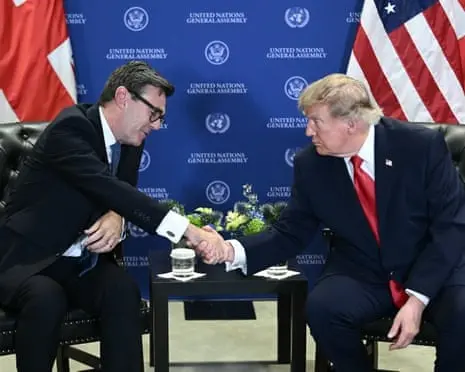
On the sidelines of the UN General Assembly, Trump engaged in a series of bilateral discussions. He met with the United Kingdom’s new prime minister, Andy Burnham, striking a warm tone that marked a distinct departure from his often-testy relationship with Burnham’s predecessor, Keir Starmer. Trump praised Burnham as having "a lot of assets on his side" following wide-ranging discussions covering energy, immigration, and industry.
However, tensions remained over the proposed Chagos Islands deal, a pact negotiated by Starmer’s government to transfer sovereignty of the islands to Mauritius while maintaining the joint U.S.-UK military base at Diego Garcia for 99 years. Trump dismissed the arrangement, telling reporters, "I don’t support it. I think it’s a terrible deal."
In a press conference alongside Ukrainian President Volodymyr Zelenskyy, Trump also revealed that members of his diplomatic team—including Middle East special envoy Steve Witkoff and presidential son-in-law Jared Kushner—held a three-hour meeting earlier in the day with an Iranian delegation. While neither Witkoff nor Kushner shared specific details, both expressed optimism about the dialogue, which Iranian state media reported focused on conditions for reopening the Strait of Hormuz.

On the subject of Ukraine, Trump reiterated his optimism that the ongoing war with Russia would come to a swift end, noting that he had recently signed a powerful new sanctions law that he would use if necessary. "It’s time to stop the killing," he said.
Domestic Policy, Trade Wars, and Media Tensions
The flurry of international activity unfolded alongside significant domestic developments. During a joint press conference with Mehmet Oz, administrator of the Centers for Medicare and Medicaid Services, Vice President JD Vance announced that a White House task force had removed 760,000 enrollees from Affordable Care Act marketplaces over alleged fraud, a move projected to save $2.2 billion. Critics have alleged the task force disproportionately targets blue states.
Meanwhile, Trump endorsed growing calls from Republican lawmakers to consider a full or partial embargo on U.S. diesel fuel exports to combat skyrocketing prices impacting the domestic economy ahead of the midterm elections. Treasury Secretary Scott Bessent confirmed that the administration is evaluating the feasibility of the plan.
Trade tensions also spilled over into agriculture, with Trump announcing a push for a "massive" deal to purchase potash fertilizer from Belarus at prices substantially lower than those currently paid to Canada, his administration’s primary supplier amid an ongoing trade dispute with Ottawa.
Media friction followed the president to New York as well. Arriving at UN headquarters, Trump sparred briefly with a CNN reporter, questioning the network’s presence after his administration enacted a ban barring CNN, MS Now, and Politico from White House grounds. The ban has prompted a sweeping legal challenge and a solidarity protest by other major television news organizations, which have suspended their video coverage of the president’s appearances.
As the UN General Assembly continues, the administration faces mounting pressure on multiple fronts, balancing aggressive foreign interventions, complex trade realignments, and domestic political battles as the midterm elections draw closer.