


And the data it provided sheds light on the origins of fast radio bursts.
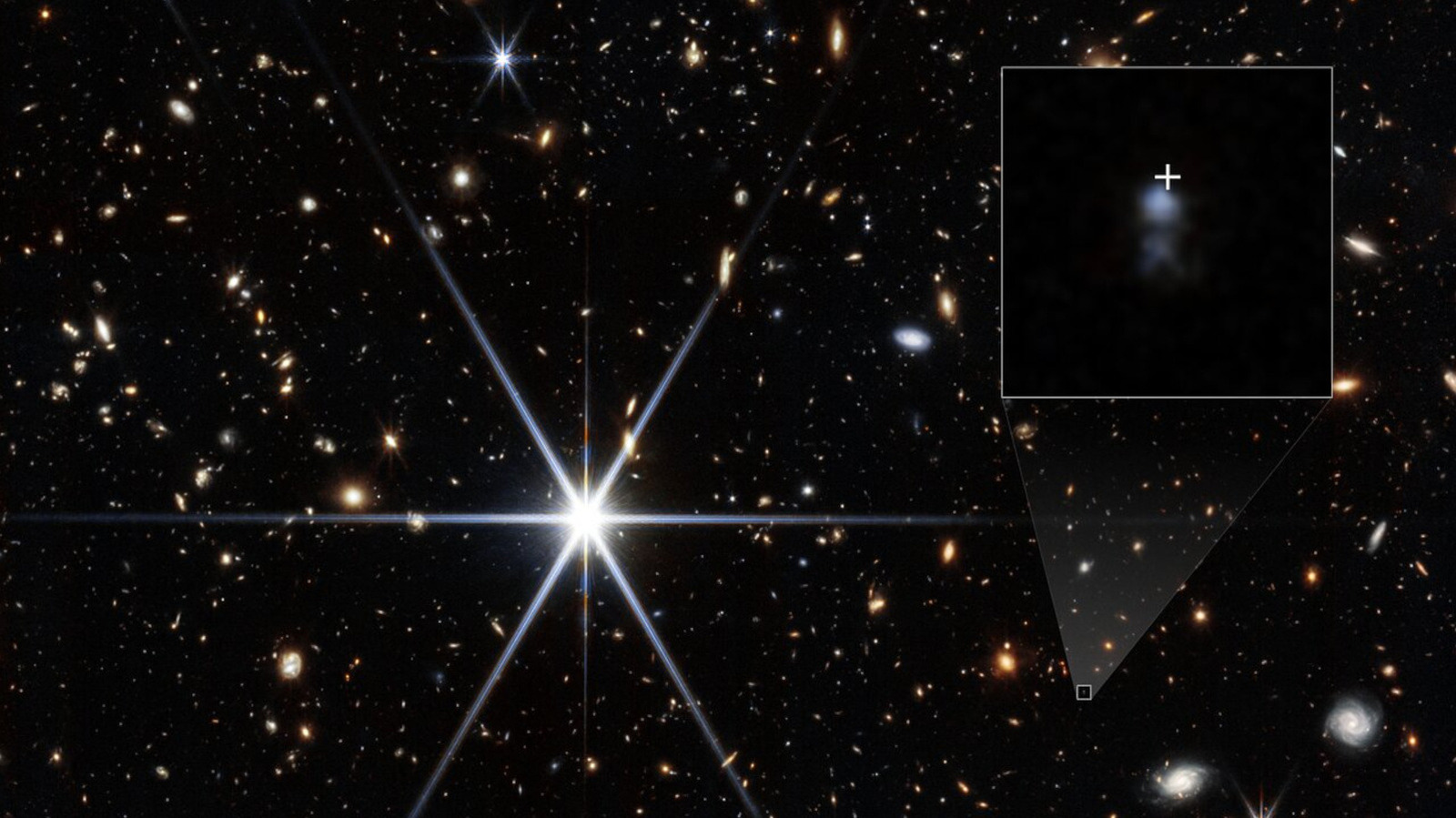
Back in 2024, scientists detected the farthest fast radio burst we’ve ever seen to date, thanks to observations by the MeerKAT ground telescope array. Fast radio bursts are ultra-fast radio waves from deep space, which last a fraction of a second but release as much energy as what the sun emits in three days. They were first discovered in 2007, and not much is known about them. Now, astronomers have used the James Webb Space Telescope to pinpoint the origin of the burst detected in 2024, and it could shed light on the phenomenon’s mysterious origins.
The breakthrough discovery offers unprecedented insight into events that occurred in the early universe. Webb’s advanced near-infrared instruments successfully detected a distant galaxy located precisely in the region of space from which the high-energy burst had originated. Based on careful measurements of the way its light stretches across the vast expanse of space—a phenomenon known as cosmological redshift—astronomers determined that the fast radio burst occurred just 3 billion years after the Big Bang.
This finding places the event in a fascinating cosmic epoch. Its origin galaxy existed way back when star formation was at its absolute peak in the universe. In addition to its ancient vintage, the galaxy that produced this remarkable burst is also 1,000 times smaller than expected. This contrasts sharply with previous observations. The previous fast radio bursts we’ve detected took place billions of years later in massive, highly active star-forming galaxies, leading scientists to rethink the diverse environments capable of producing such extreme cosmic phenomena.
To understand the significance of this discovery, it helps to examine the leading scientific theories regarding how fast radio bursts are produced in the first place. Currently, astronomers and astrophysicists work primarily with a couple of prominent hypotheses. One major theory proposes that these intense radio waves are generated by the catastrophic merger of two neutron stars. However, stellar evolution dictates that it takes billions of years before two neutron stars—which are the incredibly dense, collapsed cores of massive supergiant stars—can spiral inward and finally collide. Because of this required timeline, the merger theory implies that such bursts should only be able to come from older, more mature galaxies.
Another competing theory suggests that the bursts can come from massive stars exploding in a brilliant supernova and leaving behind magnetars. Magnetars are a rare and exotic type of neutron star that possess extraordinarily powerful magnetic fields, capable of driving high-energy emissions across the electromagnetic spectrum.
The data gathered by the James Webb Space Telescope provides a critical clue in testing these competing ideas. "Our work suggests that it’s very unlikely that this fast radio burst was produced by a merger," said Manisha Caleb from the University of Sydney, Australia, who served as lead author on the study published in the journal Science.
In other words, their meticulous work shows that the origin of this particular burst was likely a supernova, providing strong support for the theory that fast radio bursts can indeed stem from a certain type of violent star explosion rather than requiring the ancient timescales associated with binary neutron star mergers. By connecting this distant, ultra-fast signal to a remarkably small and ancient host galaxy, researchers have taken a major step forward in decoding the physics behind one of the universe’s most enigmatic signals.