


Published November 2, 2026 05:05PM
For seven agonizing hours, 60-year-old Canadian climber Eric Le Bourhis stood frozen on a patch of rock and ice no bigger than a coffee table, high in New York’s Adirondack Mountains. Stranded in the dark with no room to sit and his legs growing steadily weaker, Le Bourhis became an unexpected model subject for search and rescue professionals after triggering his satellite distress beacon on October 22.
The ordeal began earlier that day on Mount Colden, a rugged 4,714-foot peak near Lake Placid. Le Bourhis was ascending a well-known technical route called the Trap Dike, a steep, rocky passage that winds through a dramatic ravine before opening onto broad, exposed slopes near the summit. Having climbed the route before, he was familiar with its Class 4 demands, which require the continuous use of both hands and feet and carry the constant risk of a fatal fall.
According to the official rescue report, Le Bourhis encountered unexpected ice as he neared a critical juncture of the climb and paused to put on his crampons to secure his footing. In an unfortunate twist, the bag containing the traction devices slipped from his grasp and slid rapidly down the steep mountainside.
Left without crampons, Le Bourhis lacked the traction needed to continue upward. Compounding the emergency, the wet rock he had successfully navigated moments earlier had rapidly frozen as temperatures dropped, rendering the descent equally perilous. He was effectively trapped on the mountainside with minimal maneuvering room.
A cluster of scrubby trees stood just seven feet away, offering a potential route to safety, but reaching them required executing a dangerous jump across a slick, vertical expanse of ice. In a video interview subsequently released by the New York State Department of Environmental Conservation, Le Bourhis recalled agonizing over the life-or-death decision.
"I agonized over that, should I try to jump this gap? Should I jump? Should I not jump? Should I activate the beacon?" Le Bourhis said. "Finally, when I saw the sun was setting, I decided to activate the beacon."
Resisting the impulse to leap proved to be a critical choice. According to Chris Boyer, executive director of the National Association for Search and Rescue, moments of intense desperation frequently push stranded adventurers to make impulsive decisions that escalate minor emergencies into fatal tragedies.
"The more you move, the more desperate you get, and the worse the decisions you make are," Boyer told Outside. "You start to take on more risk about, can I make it across this stream? Can I climb this area? Things like that. So we want to minimize their risk and maximize their survivability and findability."
Seven Hours With Nothing to Look At
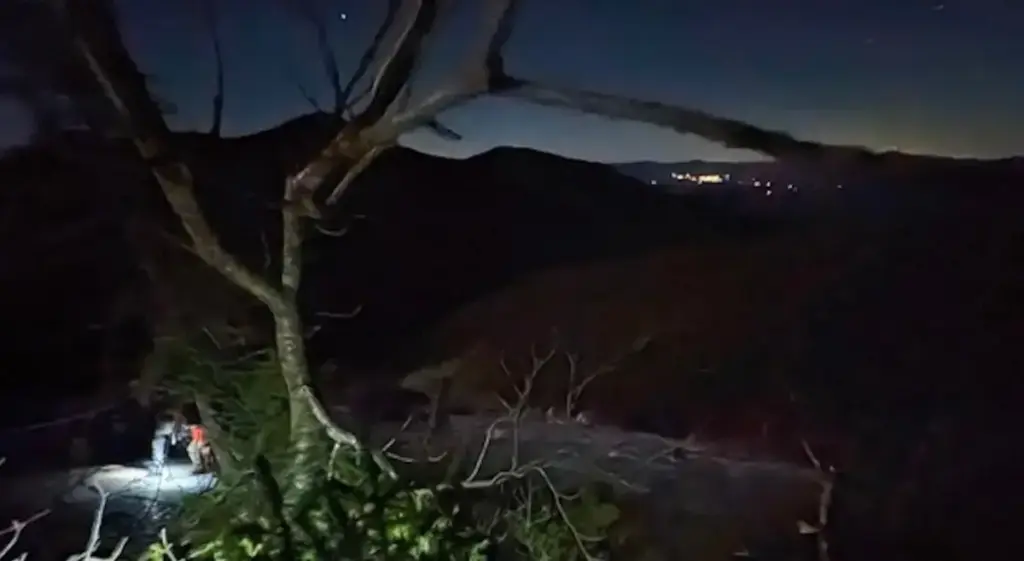
After losing his gear, Le Bourhis activated his satellite distress signal just as evening settled over the high peaks. Dispatch received the SOS at 6:22 P.M., but left standing on his tiny ledge, the stranded climber had no immediate way of knowing whether help was on the way or how long he would have to endure the elements.
With zero space to sit down or stretch his aching muscles, Le Bourhis spent the next seven hours fighting fatigue by desperately trying to keep his legs steady on the slippery incline.
"I wanted to entertain myself by looking at Lake Placid, or maybe the lights of people coming for me," he said. "लेकिन I didn’t even have that as entertainment because it made me a bit wobbly. So I just put my headlamp on low and looked at the ground right in front of me for hours and tried to stay upright."
Boyer noted that such psychological strain is a common hazard in backcountry emergencies. When panic sets in, stranded individuals frequently convince themselves that rescue is impossible and that they will succumb to starvation or hypothermia before anyone notices they are missing.
"That flight response kicks in," Boyer said. "All those things start to manifest, and that can do weird things to you. You think, ‘Nobody’s going to come find me, no one knows I’m missing, and the only way for me to survive is to walk out on my own.’"
While staying put is standard survival advice, Boyer clarified that the rule is not absolute. Wilderness travelers facing immediate, catastrophic threats such as avalanches or lightning strikes must prioritize moving to safety. In the absence of an immediate physical threat, however, remaining stationary provides search teams with a reliable last-known location, preventing confusion that arises when a subject wanders away from a mapped route.
Why Rescuers Say There’s No Shame in Calling
Relief finally arrived at 1:16 A.M. on October 22, when New York State forest rangers reached Le Bourhis’s precarious perch. In footage shared by the DEC, one ranger can be seen venturing onto the hazardous, ice-glazed slope to secure the exhausted climber to a sophisticated rope system. Once safely harnessed, the team guided him off the rock face and into the shelter of the trees.
What followed was a grueling, punishing uphill bushwhack through the dark forest, followed by a long trail descent. The grueling rescue operation officially concluded at 8:00 A.M., nearly 14 hours after Le Bourhis transmitted his initial distress signal.
Forest Ranger Nate Jeffery, who participated in the overnight mission, praised the Canadian climber for maintaining exceptional composure despite the series of mishaps that left him stranded.
"I don’t think there’s too many subjects that could pull off the composure to stay calm and collected and maintain their position on that ledge for that long," Jeffery said in a DEC video interview.
Despite carrying a personal locator beacon for emergencies, Le Bourhis admitted he never genuinely anticipated needing it, a realization that brought a heavy wave of emotional aftermath once he was safe.
"I felt a huge rush of guilt and shame," he said. "Well, why did I have a beacon then? I don’t know. But I never thought I would have to use it."
Boyer emphasized that backcountry visitors should discard any lingering hesitation or embarrassment about requesting professional help during an emergency. Search and rescue operations across the United States rely heavily on dedicated individuals who train rigorously for precisely these scenarios.
"Ninety-nine percent of search and rescue personnel in the U.S. are volunteer. They live for this," Boyer said. "They beg for this. They train hard. They get certifications. They spend personal money on gear. They prepare for this, and they want to help. They’re an altruistic service that’s available, and don’t feel bad about calling them."