



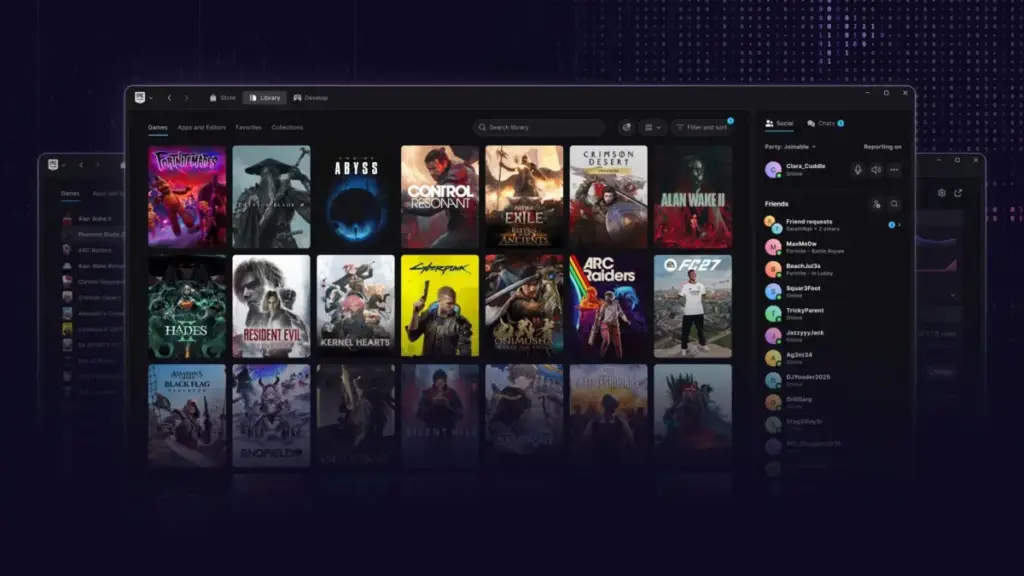
Epic Games has released a completely overhauled preview version of its desktop application, marking a major turning point for the company’s primary digital storefront and Steam competitor. Built from the ground up utilizing artificial intelligence and modern development techniques colloquially known as "vibe coding," the new Epic Games Launcher is currently available for users to download in an early preview state.
According to official communications from the company, the software is presently light on features as it enters its initial phase of public testing. However, the preview build already incorporates the foundational components expected of a modern video game launcher, including dedicated store, library, and social panels, alongside the Unreal-focused developer page designed for creators and industry professionals.
"Rebuilt Entirely From the Ground Up"
The decision to redesign the software stemmed from a desire to address long-standing performance criticisms directed at the legacy application. Martin Keely, vice president and general manager of the Epic Games Store, elaborated on the scope of the overhaul in an interview, emphasizing that the update is far more than a simple skin or surface-level patch.
"It’s been rebuilt entirely from the ground up," Keely explained. "So this is a completely new tech stack, a complete new rewrite of both the shell, which has the download manager, library, and the app itself, as well as the new store architecture. So features like discover and product detail pages, those have all been rewritten."
For years, the previous iteration of the Epic Games Launcher faced criticism from users who found it sluggish, resource-heavy, and slow to navigate compared to established market alternatives. By discarding the legacy architecture, Epic Games has sought to eliminate these bottlenecks, creating a streamlined foundation designed to scale effectively across a wider variety of consumer hardware.
Dramatic Performance and Speed Improvements
The primary focus for this initial phase of the launcher’s release is raw performance and speed. Epic Games has shared internal benchmarks comparing the new application directly against Valve’s Steam client, highlighting substantial gains in boot times and responsiveness.
According to the company’s metrics, the new launcher boots from a cold start in 5.47 seconds, which Epic claims is approximately 46% faster than Steam under comparable conditions. Furthermore, when resuming the application from the Windows system tray, the reaction time drops to just 0.36 seconds—marking a 14% improvement over competing platforms. While individual load times will naturally fluctuate depending on a user’s unique hardware specifications, the architectural shift promises a significantly snappier experience for most players.
Library performance has received an even more dramatic upgrade. Keely noted that the user’s game library now loads roughly thirty times faster than it did in the previous launcher architecture. Despite these sweeping performance enhancements, the application maintains a remarkably compact footprint, requiring only about 300 megabytes of storage space. Keeping the resource footprint small was a deliberate choice by the development team to ensure smooth operation across the diverse hardware configurations utilized by the global PC gaming community.

Expanding to Linux and Broadening Platform Support
In addition to performance upgrades, the preview release brings a significant expansion in platform compatibility. While previous versions of the launcher were strictly confined to Windows and macOS, the new preview build introduces official support for Linux for the very first time.
This platform expansion carries major implications for ecosystem availability, including the eventual arrival of Fortnite on Linux distributions. However, integration will not happen instantaneously. Epic Games noted that it must first complete the process of rebuilding its proprietary Easy Anti-Cheat system to function natively within the Linux environment.
"Once it’s working with a critical mass of distro maintainers, we’ll bring Fortnite to Linux via the Epic Games Launcher," the company outlined in its official blog post. This careful, measured rollout is intended to ensure robust security and stability before opening the game to the broader Linux gaming community.
Quality of Life Additions and Future Roadmap
Beyond raw speed and expanded operating system support, the preview version introduces several practical quality-of-life adjustments aimed at personalizing the user experience. The application features improved customization options, allowing users to rearrange the top navigation bar to display tabs in their preferred order. Additionally, the game library can now be filtered using a more comprehensive array of categories to help users organize their digital collections efficiently.
Looking ahead, Epic Games has outlined its priorities for subsequent development phases. Keely highlighted game discovery as a major focal point for upcoming updates, noting that the store’s expanding catalog requires more sophisticated tools to connect players with titles that genuinely match their tastes.
"The other piece that we’re going to be working on is how to improve game discovery in a way that is relevant to each player," Keely said. "We have a pretty large library and sometimes there’s great games that will be relevant for someone, so making sure that we continue to improve the merchandising components of how we make game discovery more possible and make that more social so that people can recommend games to each other and make that easy to share."
These upcoming initiatives build upon a broader roadmap previously outlined by the company earlier in the year, during which Epic promised dramatically faster boot times, improved user review systems, and enhanced store functionality.
While the introduction of a rebuilt, high-speed launcher addresses technical complaints that have persisted for years, industry observers note that winning over a entrenched player base will require sustained effort. Technical optimization represents a crucial milestone, but overcoming longstanding consumer loyalty to competing ecosystems remains a formidable challenge for the Epic Games Store as it continues to evolve.