

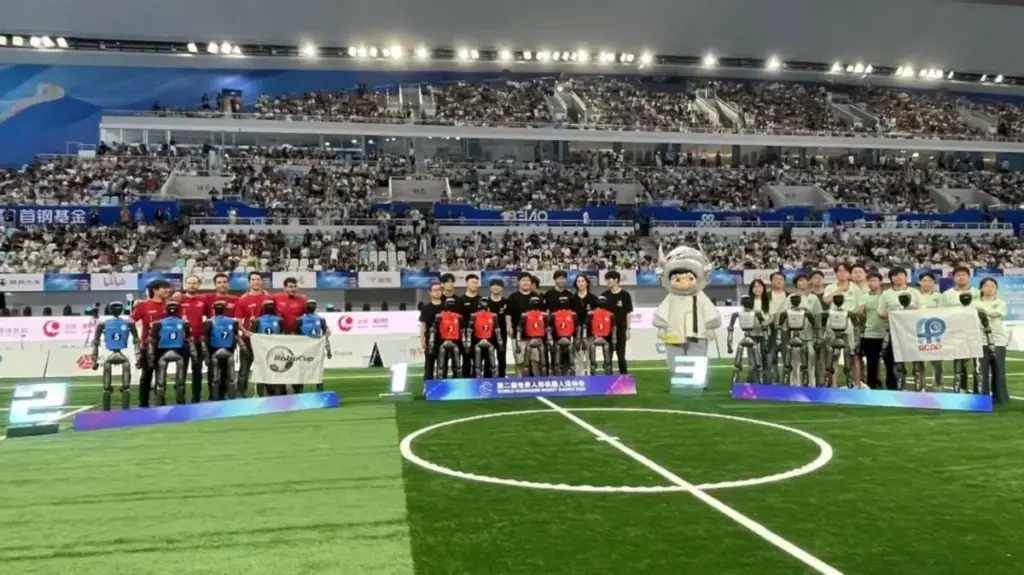
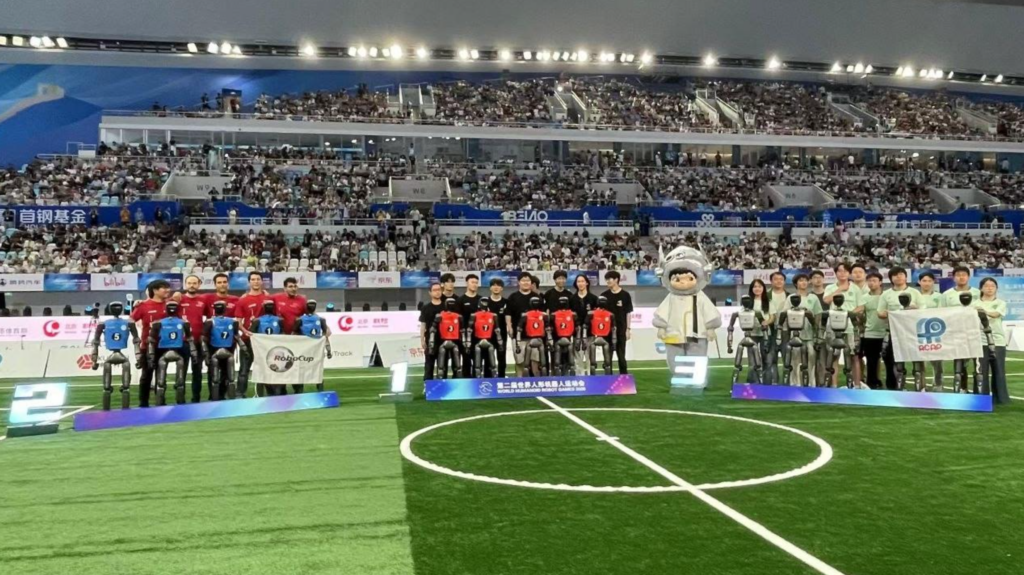
The world of robotics reached a historic milestone this summer when twenty-two humanoid robots walked onto a football pitch in Incheon, South Korea, to play the first-ever 11-a-side match in RoboCup history. Played on July 5, 2026, as an exhibition following the official competition, the landmark game featured teams from Germany—B-Human from Bremen and HTWK Robots from Leipzig—battling it out without remote controls on a full-sized pitch for a single half of play. B-Human ultimately secured a 4-0 victory, but the final score was secondary to the sheer technical achievement of staging the match at all. This autumn, the exact challenges that defined that historic game—balance, vision, autonomy, and extensive debugging—are coming directly to the public stage at Maker Faire Rome.
When the RoboCup initiative first introduced its humanoid competition in Fukuoka, Japan, back in 2002, the participating robots tackled limited, highly isolated challenges rather than attempting to play a continuous game of football. Twenty-four years of relentless engineering, software iteration, and hardware development separate those early demonstrations from the sophisticated 11-a-side match seen in Incheon. Designing a robot to play soccer requires translating complex kinematic vectors, precise wheel velocities, and intricate directional forces into real-time actions. An autonomous mobile robot must constantly navigate its environment, track a fast-moving ball, and execute powerful kicks on a crowded field, all while managing the fundamental physics of bipedal motion.
The overarching vision behind RoboCup, which was established in 1997, has always been audaciously clear: by the middle of the twenty-first century, a team of fully autonomous humanoid robots should be capable of defeating the reigning human World Cup champions under standard FIFA rules. While that goal still sounds improbable to many observers, that near-impossible nature is precisely the point. Football serves as an ideal benchmark for robotics research because virtually nothing on the pitch remains static. The ball moves continuously, opposing players shift dynamically, and the robot itself must maintain delicate balance on two legs while simultaneously calculating its location and deciding its next move. There is no hardcoded sequence of movements that can successfully navigate an unpredictable match.

A competitive robot must locate the ball, determine its exact coordinates on the pitch, recognize teammates and opponents, select an optimal tactical action, move fluidly without falling over, and react instantly when another player claims the ball first. Furthermore, all of these complex subsystems must operate in seamless harmony. Superior computer vision is of little use if the robot’s physical frame cannot turn quickly enough to intercept a pass. A brilliantly trained kicking motion becomes completely useless if the robot misjudges the precise position of the ball by even a few centimeters. Enhancing the walking gait can inadvertently introduce new calibration errors for localization, and a single component change can render yesterday’s software code entirely obsolete, requiring fresh tuning.
For hardware developers and software engineers, robot football provides an ultimate testing ground where an entire interconnected system is evaluated simultaneously under pressure. The 2026 season also brought structural evolution to the RoboCup organization itself, merging the former Standard Platform League and Humanoid League into the newly minted Humanoid Soccer League. In the Middle Division of this new setup, prominent teams like B-Human and HTWK Robots competed using the K1 humanoid platform developed by Booster Robotics.

Utilizing the same basic hardware platform, however, does not equate to identical performance on the pitch. B-Human engineered its own specialized motion systems for the K1 platform, introducing custom routines for running, shooting, and recovering from falls. Instead of relying solely on the manufacturer’s default movement packages, the team leveraged deep reinforcement learning to train these complex behaviors. This distinction highlights a crucial reality of modern robotics: purchasing an off-the-shelf humanoid platform removes the massive engineering burden of designing every individual joint, gearbox, and structural chassis component from scratch, but it does not instantly deliver a functional footballer.
Transforming hardware into an athlete still requires extensive software architecture, behavioral training, rigorous control systems, continuous testing, field tuning, and countless hours spent discovering that a movement routine that appeared flawless in a digital simulator behaves entirely differently once real-world motors, batteries, friction, and gravity enter the equation. B-Human’s rigorous approach paid off during the official 2026 season, where the team captured the RoboCup Middle Division title by defeating HTWK Robots 6-0 in the official final before returning to the pitch for their experimental 11-a-side exhibition.

For spectators, robot football becomes vastly more compelling when attention shifts beyond the final score and focuses on the intricate mechanics occurring in the seconds before a robot reaches the ball. Observers can analyze how a machine successfully located the ball, how it calculated its own foot positioning relative to that object, why it chose a specific approach angle, and how rapidly it adapted when an opposing robot crossed its planned trajectory. When a machine inevitably falls over—an event that remains common even at the highest levels of competitive robotics—watching how it assesses the situation, decides on a recovery motion, and returns to active play offers a transparent look at autonomous decision-making in action.
A competitive match bundles together formidable challenges spanning computer vision, localization, motion planning, bipedal locomotion, machine learning, control theory, and multi-agent coordination among several autonomous machines. It also exposes a hard truth that every hardware developer eventually learns through experience: the physical world possesses its own immutable laws and unpredictable variables. A digital simulator never has to contend with a loose electronic connector, a battery that loses charge halfway through a critical run, or a foot that slips because the playing surface differs slightly from the testing laboratory. Real-world machines must confront all of these friction points constantly, which is why observing mechanical failures can be just as educational as witnessing a successful goal.

From October 23 to 25, Maker Faire Rome will host the first Italian Open RoboCup Humanoid Soccer Tournament as an official RoboCup Regional Event at the historic Gazometro Ostiense venue. The upcoming Rome event will showcase both the Middle and Large Divisions, featuring dynamic 3-v-3 and 5-v-5 matches depending on the specific teams and robot platforms participating. In addition to the competitive matches, the event will feature technical testing sessions, public demonstrations, and specialized RoboCup Humanoid Soccer workshops. This setup provides attendees with an experience far removed from polished promotional videos, as real robots must actively contend with finding the ball, maintaining balance, making split-second tactical choices, and cooperating with teammates while an opposing team attempts to disrupt their strategy. Some attempts will succeed brilliantly, while others will prompt engineers to reach immediately for their laptops to debug code—both outcomes forming an essential part of the developmental narrative.
Equally valuable is the opportunity to engage directly with the researchers, students, and engineers standing beside the hardware. At an exhibition like Maker Faire Rome, the machine represents only half of the presentation, with the human creator offering crucial context on why an earlier design iteration failed and why the current version incorporates an entirely redesigned knee joint. These multidisciplinary teams combine expertise across mechanics, electronics, artificial intelligence, computer vision, and control engineering, demonstrating that a seemingly simple movement on the pitch is often the culmination of weeks spent refining a gait or troubleshooting why a physical robot refuses to match its simulated counterpart.

This collaborative, iterative ethos makes RoboCup a natural fit for the culture of Maker Faire Rome. While a competitive tournament provides structure and excitement, the underlying cycle remains universal to all makers: build the prototype, test its capabilities, identify the flaws, modify the design, and try again. RoboCup’s ambitious goal of fielding a team capable of challenging human World Cup champions remains decades away, and whether autonomous machines will actually be ready to face FIFA professionals by 2050 is a question only time can answer. For now, the journey itself provides a compelling reason to watch as engineers systematically build their path toward the future.