

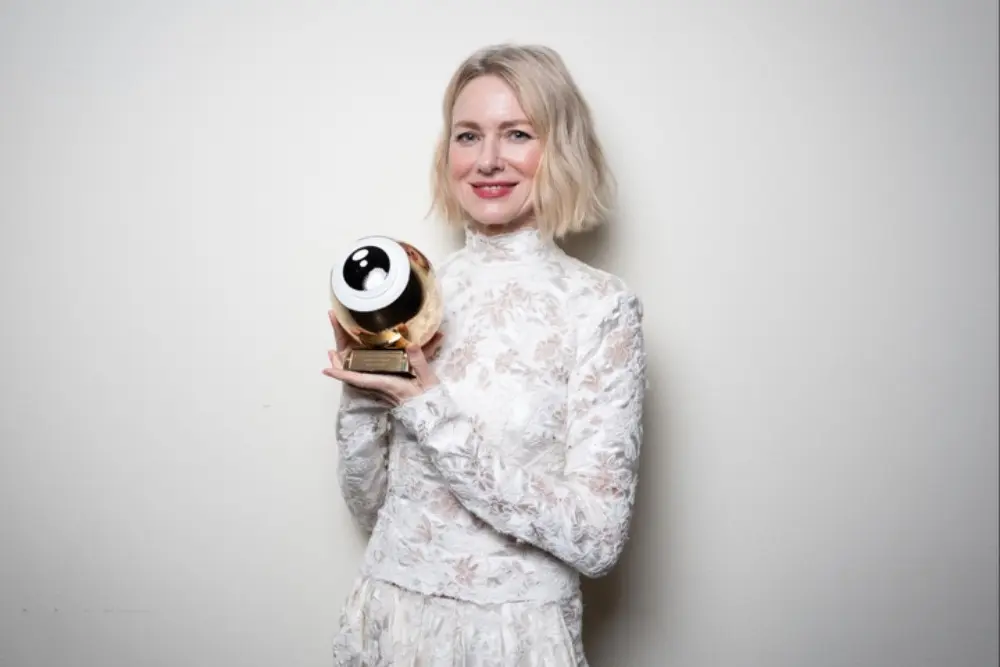
Naomi Watts has reached the upper echelon of international cinema, but the celebrated actress wants the world to know that the journey to stardom was far from an overnight success story. Taking the stage at the prestigious Zurich Film Festival, where she was honored with the coveted Golden Eye Award, Watts offered a raw, unvarnished look back at the arduous first decade of her career—a grueling period marked by near-constant rejection, mounting financial panic, and an existential crisis over who she was supposed to be to please Hollywood casting directors.
Reflecting on those difficult early years characterized by frustrating dry spells, Watts described a time when desperation clouded her every move. Before crossing paths with visionary director David Lynch, the actress felt trapped by the industry’s rigid expectations and her own internal pressures.
“It was a grind. That 10 years before I met David, I became so locked up and I felt worthless,” Watts recalled to the audience in Zurich. She shared a particularly stinging memory of an intervention with her agent at the time. “My agent pulled me aside and she said: ‘We need to have a heart-to-heart. Honey, you are too intense. You are freaking people out.’ I went: ‘Yeah, no shit.’ I was desperate! I was behind on my rent; I was getting evicted. I didn’t know what to bring to this room.”
That desperation manifested in a frantic cycle of self-reinvention designed entirely to second-guess the capricious whims of the casting room. Watts explained how exhausting it was to constantly morph herself into whatever she believed executives were looking for at any given moment, shedding her authentic self in the process.
“They told me I wasn’t funny last week, so now I am trying to be funny. They told me I wasn’t sexy—I’m trying to be sexy. You reshape yourself and try to read the tone of what is needed,” she said. “That’s how it went and I couldn’t be myself anymore. I was either an extreme version of myself or a diluted version of myself. It took a genius like David Lynch to see beyond all that weirdness I built up, undo it and get to the real me.”
Fortunately, the resilience required to survive those lean years had been forged during her childhood. Growing up, Watts moved frequently, an experience that taught her how to adapt to unfamiliar environments on the fly. Yet, through all the instability, her core motivation remained rooted in an artistic passion rather than a hunger for celebrity status.
Emphasizing the importance of emotional stamina in the arts, she noted, “You also have to know why you love it. Are you in it for the right reasons? My goal wasn’t just to be famous. I loved disappearing into these characters. I really cared and continued to investigate. I still do. There’s always more to learn.”
Those years of struggle ultimately gave way to a career-defining moment when she crossed paths with David Lynch in her late twenties. That meeting permanently altered her trajectory, leading directly to her breakout role in the 2001 surrealist masterpiece Mulholland Drive. Looking back at the film that put her on the map, Watts expressed enduring pride in its legacy and the profound impact it continues to have on audiences worldwide.
“That film gave me the most incredible role that affected people. To this day they still watch it. It’s still on these ‘bests’ lists. I’m just very, very proud to be a part of that film,” she said.
During her masterclass at the festival, Watts also revealed how pivotal encouragement from fellow actor and longtime friend Nicole Kidman sustained her during the darkest hours of uncertainty. Kidman had offered words of wisdom that took years for Watts to fully comprehend: “All it takes is one thing, one thing could change everything.”
“That didn’t make sense to me for a very long time,” Watts admitted. “Until David Lynch, and then it became very real.”
The momentum generated by Mulholland Drive opened doors to vastly different cinematic landscapes, though navigating those opportunities sometimes required taking risks against her own initial instincts. Immediately following her critically acclaimed arthouse breakthrough, Watts was approached to star in the horror classic The Ring. Initially, she resisted the project, questioning whether jumping into a commercial Hollywood horror film was the right move so soon after establishing her dramatic credibility.
“I tried to say ‘no.’ There’s no certainty to anything you do, ever,” she remembered. “My agents were excited about this. I said: ‘Wait. I just got this critical acclaim, so I want to instantly go into a Hollywood blockbuster-y movie?!’ I fought with my agent at the time. I didn’t know it was going to be a massive hit! I woke up the horror genre, in a way. It was a lucky, lucky break.”
Subsequent roles, such as her searing, raw performance in Alejandro González Iñárritu’s 21 Grams, continued to showcase her formidable dramatic range. Describing the intense atmosphere of that particular shoot, Watts noted how exhaustion and creative friction can sometimes yield extraordinary artistic breakthroughs. “Extraordinary things can happen when you get tired and irritable from doing things too much,” she remarked.
Delving into the psychological themes that consistently draw her to certain scripts, Watts pointed to universal human struggles as the guiding force behind her career choices. Grief and identity, she explained, are the twin pillars of her artistic exploration, themes that trace their roots back to her transient childhood.
“If there’s any theme in my work, it’s grief. It’s why I do what I do: I’m trying to figure out the meaning of my life. Another one is identity. I love the story [that asks]: ‘Who are you?’ That also comes from my moving around as a kid. I was always on the outskirts of the group, trying to find my way in.”
That lifelong fascination with identity and hidden truths heavily influences her recent work, including her role in Ben Shirinian’s 1960s-set drama The Housewife. In the film, Watts portrays a woman who projects the image of a picture-perfect suburban homemaker while harboring a dark, harrowing post-war past. It is a level of psychological complexity that tested her limits even as an experienced veteran.
“I never played a character like this, even though I look for flawed women and I’m not afraid of unlikeable. But this was extreme,” she explained, adding that the intense psychological weight of the project followed her away from the set. “I knew what I was stepping into. I knew it was going to be a daunting, haunting understanding. A character like that comes to you at night, in your dreams.”
As she brought her masterclass to a close, Watts reflected on the long-term personal growth that accompanied her professional maturation. She confessed that it took decades to let go of an obsessive need to seek validation from others, realizing ultimately that true strength comes from authenticity rather than constant accommodation.
“Vulnerability is a superpower. It has taken me a long time to know that, and own that. I wish I’d learn earlier on to be more myself and [care] less about pleasing people. Some people are born with that level of confidence—I was never that person,” she said. “I still have a lot of self-doubt, but I don’t pretend it’s not a real thing. I try to see it as a gift. It’s more effective than just bullshitting your way through it all.”
That same philosophy of radical honesty has recently driven Watts to speak out publicly about other deeply personal experiences, most notably menopause. Encountering the physiological transition early in life without adequate information or cultural context, Watts initially felt isolated and confused. However, open communication with her partner—fellow actor Billy Crudup, whom she has since married—helped her reframe the narrative entirely.
Recalling a moment of vulnerability in their bathroom, where she sat crying while attempting to remove an estrogen patch, Watts admitted she was terrified that her partner would be turned off by the reality of aging and hormonal changes. Instead, Crudup responded with immediate support and curiosity. When she confessed her anxieties, telling him she feared he would no longer want to be with her, his response was reassuring.
“Hold on. It’s great that you are taking care of yourself. Why are you ashamed?” he told her. “It was so sweet… And sexy. I felt safer than I ever felt.”
That empowering conversation inspired Watts to take control of the narrative, leading her to found Stripes Beauty, a brand specifically tailored to support women navigating perimenopause and menopause. For Watts, breaking the cultural taboo surrounding the topic is a collective responsibility that requires mutual understanding and open dialogue across the board.
“Menopause became a huge topic of conversation, because I went through it early on in my life and had no clue what was happening with my body. Once I talked about it with my partner, who is now my husband, and he was supportive, I went: ‘How about I just own the story?’ I’m in on the joke, although it’s not actually a joke. Why do we just suffer, instead of getting some normalcy? Just own it,” Watts urged. “Men have to be curious and compassionate. And our job, ladies, is to share the story.”