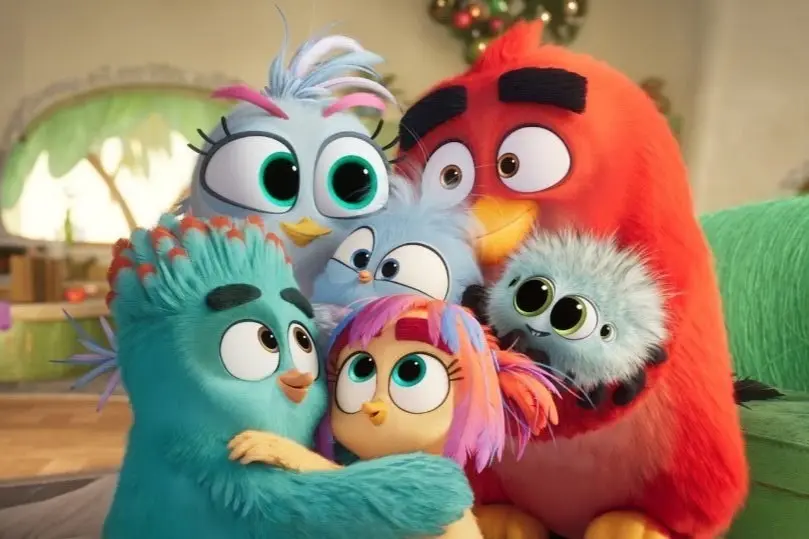
The red-feathered hero of The Angry Birds Movie 3 looks reassuringly familiar to audiences worldwide, but behind his classic appearance lies a massive technical undertaking. DNEG Animation had to rebuild much of the iconic character from the ground up to bring the global franchise back to theaters under Paramount Pictures. As the studio reconstructed Red’s digital fur, facial rigging, and dynamic expressions, it also developed an innovative production system that ultimately automated character-effects work on roughly 75% of the film’s shots, marking a significant technological leap for the studio.
Speaking at the View Conference in Turin, DNEG VFX supervisor Patrick Harboun shed light on the meticulous process of transferring and upgrading the beloved intellectual property. “He’s similar by choice,” Harboun told attendees, emphasizing the delicate balance between modern technological advancement and fan expectations.
The upcoming Paramount release, directed by John Rice, reunites Jason Sudeikis’ hot-tempered Red with Silver, voiced by Rachel Bloom. In the new installment, the central duo must navigate the trials and tribulations of parenthood alongside their latest grand adventure. DNEG takes over animation duties for the third outing, succeeding Sony Pictures Animation, which produced the first two cinematic installments of the massively popular mobile game adaptation.
Rebuilding Red From a Plucked Chicken Model
The technical handover from previous productions was anything but straightforward. Proprietary grooming, rigging, and surfacing tools that had been custom-built for the earlier films could not simply be copied or transferred into DNEG’s modern animation pipeline.
“We had to start from this. A plucked chicken version of Red,” Harboun joked during his presentation, displaying an intentionally bare digital model to the audience. Before the team could even begin reconstructing Red’s signature plumage, they realized that even his underlying geometric framework required a comprehensive reworking to fit their newly established standards.
The final visual result was carefully calibrated to avoid any radical redesigns that might alienate long-time fans. Red’s feathers were given a slightly softer appearance, while his expressive eyes and iconic beak acquired firmer, more toy-like surface qualities. “Once an IP becomes popular, it kind of belongs to the fans, and we have to respect that,” Harboun explained. “We can’t just add our own spin just to give our mark.”
To maintain total consistency with the established aesthetic, the studio scrutinized the earlier movies frame by frame. Animators painstakingly analyzed past footage to decode what Harboun referred to as the "unwritten rules of animation" for the franchise. The team cataloged specific details, including the exact angles of Red’s beak, the specific geometry of his narrowed eyes, and the precise boundaries beyond which a stretched facial expression would cease to feel like the authentic character. These gathered insights were transformed into a comprehensive internal style guide and a reusable library of facial expressions that could be utilized across the entire animation floor.
Introducing New Characters and Solving Technical Challenges
While Red and Silver retained their classic looks, the production team found significantly more room for visual and technical experimentation with the introduction of over 20 new characters. Among the fresh faces are Red and Silver’s children: the aspiring athlete Glider, voiced by Walker Scobell; the temperamental daughter June, played by Emma Myers; and the youngest member of the family, baby Olly, voiced by Psalm West. The family dynamic is rounded out by an unusual household pet—a spider named Fuzzy, voiced by James Austin Johnson.
“The goal was to make a spider that even an arachnophobe would love,” Harboun noted, highlighting the studio’s focus on universal appeal and charm across all character designs.
Baby Olly, in particular, created a distinctive technical challenge for the animation and rigging departments. Because of his design, Olly’s glasses effectively serve as his animated eyes, complete with moving eyelids and eyebrows integrated directly into the eyewear. To solve this problem, DNEG’s technical team engineered a specialized solution nicknamed “Pancake Eyes.” This system involved duplicating and flattening portions of the baby character’s facial rig directly behind the lenses, then restoring curvature dynamically to allow expressions to respond naturally to the character’s exaggerated squash-and-stretch movements without clipping or visual distortion.
Automating Character Effects Through Human Learning
The most significant efficiency gain during the production of The Angry Birds Movie 3 came through a streamlined performance-effects process. This system built directly upon DNEG’s earlier technical pipeline work for The Garfield Movie.
Under this workflow, once a character’s fundamental animation was fully approved by the directors and supervisors, the proprietary system automatically simulated selected effects on fur, feathers, and physical deformations. It would then instantly render a preview and flag specific shots that required bespoke, hands-on attention from an artist. As the production crew encountered new challenges throughout the schedule, they continuously refined and improved reusable templates for each individual character.
“It’s not machine learning, it’s human learning,” Harboun strongly underlined during his presentation, taking care to stress that human artists maintained complete control over those templates and systems.
Early in the production cycle, roughly 25% of the film’s shots could successfully pass through the automated processing pipeline. By the later, more demanding stages of the project, that figure had climbed dramatically to 75%. “This frees up a lot of artists for hero work,” Harboun explained, clarifying that the percentage specifically applies to character-effects processing rather than implying that shots were animated or completed entirely without human artists.
DNEG also engineered several other clever technical inventions to handle complex physical interactions. These included a secondary, normally invisible layer of fur that dynamically appears whenever characters stretch or contort their bodies, preventing unsightly bald patches from forming during fast-paced physical comedy. Additionally, the studio developed intuitive one-click tools for building digital ropes, hay stacks, and various props. These assets allowed animators to manipulate environment pieces independently, without needing to repeatedly call upon separate studio departments for minor adjustments.
Balancing a Tropical Color Palette and Expanding Bird Island
Production designer Jeanie Chang’s heavily saturated tropical color palette posed yet another distinct challenge for the lighting and compositing teams. Detailed lighting references were painted directly over layout images so that artists could easily match the intended artistic compositions. However, because different characters possessed drastically contrasting color schemes, they still required individual, highly specific lighting adjustments within the exact same cinematic scene to maintain visual clarity.
“In every given situation, Red always needs to be red,” Harboun pointed out, emphasizing the continuous calibration required to keep characters readable against vibrant backgrounds.
Beyond the technical updates to returning favorites, the film also significantly expands the cinematic geography of Bird Island by introducing Pigtropolis, a bustling, fully realized city built specifically for its pig residents. Harboun also revealed behind-the-scenes details about the production process, noting that the entire opening sequence of the movie was shifted from a night setting to a daytime setting late in production to better serve the narrative tone.
As the film prepares for its December 23 theatrical release, Harboun offered a final piece of advice for moviegoers, recommending the format best suited for appreciating the studio’s detailed digital craftsmanship. “I’m usually not a fan of 3D, but I really recommend that you check out the 3D version,” he said.
For DNEG and the creative team behind the sequel, technical innovations ultimately only serve their true purpose when they reinforce what audiences already know and love. The characters may have been entirely rebuilt from the ground up and their underlying production workflows thoroughly reinvented, but their familiar, beloved identities remain the bedrock of the franchise’s enduring success.