



The Open Source Hardware Association (OSHWA) has announced its latest batch of official certifications, bringing a diverse array of community-verified creations into its growing global database. Operating a free certification program designed to validate that hardware projects fully comply with the community-established definition of open source hardware, OSHWA continues to serve as a vital pillar for transparency, collaboration, and maker culture worldwide.

Whenever creators, educators, engineers, and hobbyists encounter the official OSHWA certification logo, they are guaranteed that the underlying hardware meets a rigorous, community-backed standard. This standard ensures that design files, schematics, and documentation are openly available for the public to inspect, modify, distribute, and manufacture.
With the addition of September’s newest entries, the comprehensive OSHWA certification database now boasts an impressive total of 3,431 individual certified projects. The latest monthly update introduced 30 new certifications spanning a wide range of technological disciplines, stretching from educational physics apparatuses to advanced USB protection tools and specialized manufacturing enhancements. According to the organization, the September batch featured an exciting mix of both fresh innovators and returning creators who continue to contribute to the open-source ecosystem.

Among the standout additions to the September database is the Photogate V2, registered under the unique identifier UID AR000006. Developed as a low-cost photogate specifically tailored for physics education, this innovative device aims to make laboratory experiments more accessible to classrooms around the world. Powered by an ESP32-based controller, the unit incorporates infrared sensing technology, an integrated user interface, and customizable, 3D-printable mechanical components. By leveraging open-source principles and affordable parts, educators and their students can easily fabricate and deploy the hardware themselves, offering a practical and cost-effective way to bring hands-on experimental physics directly into modern educational environments.
Another notable project making waves in the maker community is ChamberFlux, registered under UID US002855. Specifically engineered for the growing community of 3D printing enthusiasts, ChamberFlux provides a straightforward chamber-circulation model designed to significantly improve air transport and management inside closed-chamber 3D printers. The system is thoughtfully designed to integrate seamlessly with existing printer filtration mechanisms, thereby adding an extra layer of environmental protection and air quality control to the workspace. For operators looking to minimize potentially unpleasant or harmful airborne particles generated during intensive printing sessions, this open-source model offers a practical, community-driven hardware solution.

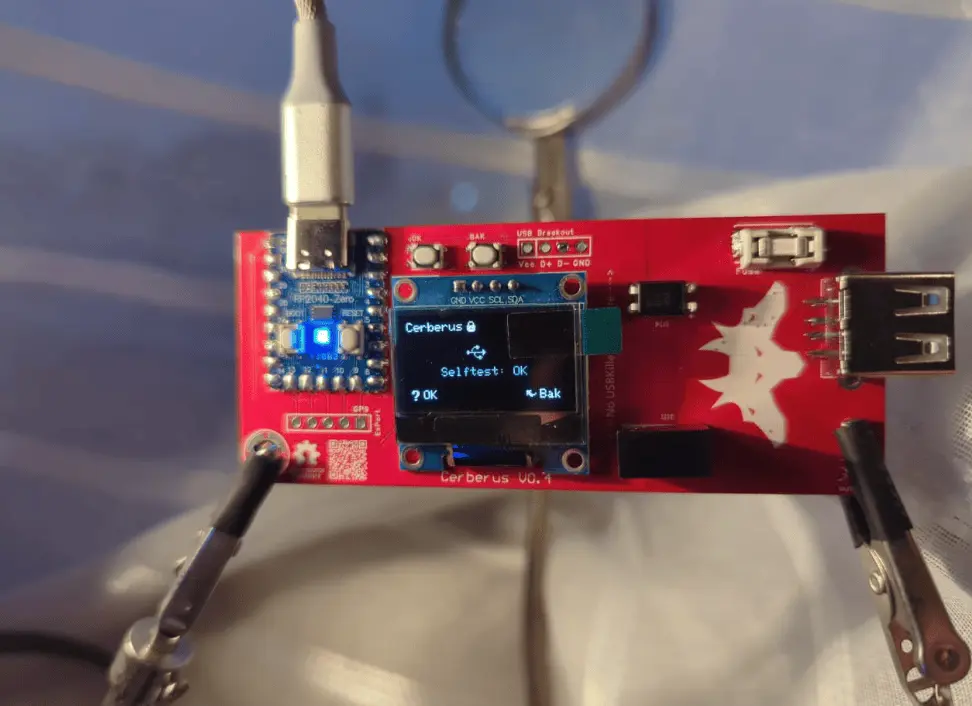
Rounding out the September highlights is the Cerebus, a pocket-sized security tool registered under UID MX0000041. Designed for individuals who frequently interact with unknown or untrusted hardware, the Cerebus allows users to plug in suspicious USB devices and observe their immediate behavior before connecting them to a primary computer. Equipped with an onboard OLED screen and a colorful LED indicator, the device helps users analyze what a storage medium or peripheral attempts to do the moment power and data connections are established. This portable safeguard provides an effective method for diagnosing potential threats, helping users avoid the hazards of sudden voltage spikes or unexpected data offloading when handling unfamiliar hardware.
As the open-source hardware movement continues to expand across industries and educational sectors, OSHWA encourages creators and developers to participate in the certification process. Innovators interested in validating their own hardware can submit their projects directly through the official OSHWA application portal. Additionally, enthusiasts and community members looking to stay informed about the latest developments can follow the organization’s dedicated certification updates bot on Mastodon to track new entries as they join the global database.