

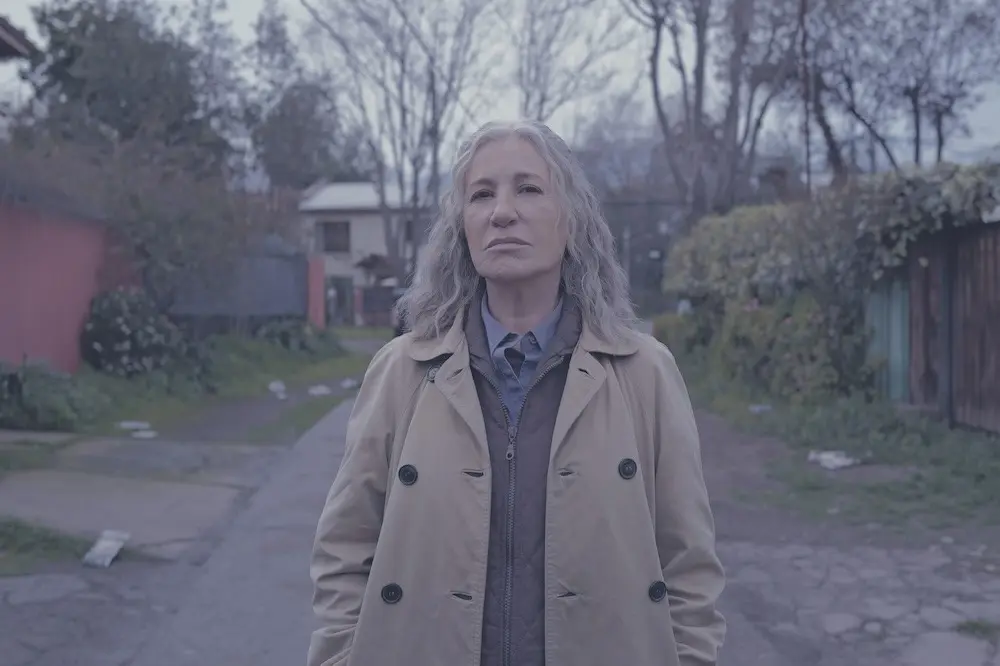
At the center of this world is Ema, brought to life in a fantastic, world-weary performance by Mercedes Morán. Characterized by dry eyes and an even drier wit, Ema serves almost as an emblem of the Piedrabuena housing project, though her personal rage has long since transformed into a resilient brand of resignation. This resignation is only occasionally tempered by quick, sharp flashes of amusement that spark across her otherwise weary expression—or perhaps otherworld-weary, given her daily reality. Ema rarely sleeps anymore, kept awake by the relentless chorus of screaming ghosts who, for the time being at least, are audible only to her.
A retired doctor who left medicine under a cloud of dark mutterings regarding a controversial triage decision she made during the height of the COVID-19 pandemic, Ema no longer technically resides in Piedrabuena full-time. She maintains a spacious apartment in a considerably nicer, more affluent part of the city that she is currently looking to rent out. However, she has recently returned to her roots to care for her aging mother through the painful, terminal stages of a debilitating illness. It is precisely here that the audience is first introduced to Ema, viewed from above as the camera hovers like an overhead lamp or a watchful angel inside the cramped attic room of her mother’s house, which sits right beside the looming Piedrabuena housing projects. Ema holds the bedridden woman’s frail, pale blue hand as she passes away—not particularly quietly, nor entirely peacefully. Then, moments after death, the corpse’s eyes snap open.
It is not her mother, exactly, but rather a fuzzy, translucent facsimile. The visual effect My Sad Dead employs to summon these spirits is all the more convincing for its deliberate lack of flashy digital manipulation. Working alongside his ace regular director of photography, Sergio Armstrong, Larraín adopts an unusual, low-contrast color palette that blanches the images down to a flat, pinkish-gray. Through this aesthetic choice, both the living and the deceased share the exact same lifeless pallor found on the magnolia walls of a mortuary waiting room.
Even so, viewers are never left guessing who among the characters is alive and who has crossed over into the post-alive state, and this distinction extends far beyond the obvious physical markers. While some ghosts carry the stark visual trauma of their demise—staggering about with half their heads blown away or bleeding copiously from ragged, ripped-open chest wounds—the real differentiator lies in their behavioral demeanor. Ema rarely encounters the kind of quiet, dignified, and expected deaths that come with old age; instead, those who have suffered a violent end retain a childlike confusion and disorientation. They are frequently depicted as trapped in inescapable psychological loops, doomed to endlessly relive, and re-experience, the final moments of their demise without ever possessing the power to change the outcome.
Ema is thoroughly exhausted by the endless parade of dead souls and has long since abandoned any hope of convincing the living that her extraordinary abilities are genuine. Consequently, her coping mechanism is simple: she mostly ignores the ghosts, and the ghosts mostly ignore her, creating a fragile equilibrium. That delicate status quo is abruptly shattered, however, when her estranged sister Lidia, portrayed by Alejandra Flechner, flies in from Seattle alongside her husband for an extended visit. They bring with them their troubled, morbidly obese teenage daughter, Julia, played by Carolina Álvarez. It is during this family reunion that Ema discovers young Julia possesses the exact same uncanny gift, realizing her niece can also commune directly with the spirits of the dead.
And Julia does not just passively see or hear them; she truly and fully connects with them. Miserable, deeply stigmatized by her peers, and facing the looming threat of being institutionalized by her hapless parents, Julia loudly and lustily indulges in physical intimacy with the no-longer-with-us. While it may not technically qualify as necrophilia—given that she is engaging with the lingering spirits of the dead rather than their physical remains—Larraín’s camera does not avert its gaze from these strangely moving copulations. The film displays a profound fascination not just with the non-corporeal realm, but equally with the flesh itself: its gratification, its mortification, and ultimately, through an increasingly ethereal narrative refrain, its slow putrefaction and inevitable decomposition.
The Piedrabuena neighborhood itself is constructed with octagonal clusters of flats arranged rigidly around a central water tower, an architectural feature that resembles a massive fist raised defiantly against the sky. Despite this tight grouping of human lives, the neighborhood completely lacks a genuine sense of community. The residents occasionally gather together in a disused recreation center, but these assemblies invariably devolve into angry rants complaining about immigrants, drug addicts, thugs, and the urgent necessity of vigilante justice. At one meeting, a local man casually suggests mounting the heads of thieves on spikes—a remarkably grisly image that Larraín, for once, chooses to spare the audience. This restraint stands in stark contrast to the visceral violence depicted elsewhere in the film: a bungling burglar tumbling from a roof to impale himself crunchily on a security railing; a trio of pretty, giggling teenage girls being riddled with bullets in a rapid-fire gang hit; and a young woman dying an agonizing death from an infected dog bite that she deliberately concealed because she simply could not afford to miss a single day of work.
While Ema lacks the ability to fix these restless, tormented ghosts, she occasionally possesses just enough capacity to distract them from the lingering shock and pain of their abrupt passings. This unique talent suddenly thrusts her into high demand when the local water supply becomes mysteriously contaminated. Overnight, the entire population of Piedrabuena begins to hear the very same terrifying sounds Ema has endured alone for years: the endless screams, the sudden gunshots, and the desperate cries for help that previously went completely unanswered.
In the hands of a different filmmaker, such a premise would easily form the foundation of a supernatural television procedural. Yet, Ema has zero interest in solving cold case mysteries or bringing murderers to swift justice. My Sad Dead explicitly rejects the conventions of traditional supernatural dramas like Medium. Furthermore, its unexpected provenance as a television project—initially conceived as a streaming miniseries before being substantially re-cut into an expansive 186-minute feature film for a competition bow at the San Sebastián Film Festival—serves as proof that cinematic storytelling transcends the physical dimensions of the screen upon which it is viewed. Every single scene is undeniably cinematic, densely loaded with rich textures, underlying subtext, and observational nuance. If any direct comparison can be made, it might be found in Krzysztof Kieślowski’s monumental Dekalog, which was also nominally produced as a television project and similarly confined to the claustrophobic ecosystem of a single housing complex.
Ultimately, however, the true parallel lies in the film’s distinct mood and psychological effect. Larraín co-wrote the screenplay alongside Anastasia Ayazi and Guillermo Calderón, working from the foundational literary inspiration of Mariana Enriquez’s writings. Their outstanding script successfully balances a hundred minor narrative side-stories alongside its primary plotline. While nearly all of these peripheral vignettes are inherently harsh, grotesque, terrifying, or profoundly sorrowful, the overall viewing experience of My Sad Dead remains mordantly funny and strangely uplifting. Perhaps this unique alchemy stems from the film’s embrace of sheer weirdness. Perhaps it comes from the way it manages to render a waterlogged ribbon of human skin detaching from a shin and floating away as something deeply, strangely beautiful. Or perhaps it simply functions as a vital, poetic reminder that feeling profound sadness over death—whether your own or someone else’s—is merely an upside-down affirmation of just how deeply happy you are to be alive.