

Researchers at the Massachusetts Institute of Technology have developed a revolutionary new technique that allows them to transform immune cells into powerful cancer fighters directly inside the living body. This breakthrough has the potential to make advanced treatments for both cancer and autoimmune diseases significantly easier to produce, administer, and make accessible to patients worldwide.
The innovative method focuses specifically on natural killer, or NK, cells. These are a vital type of immune cell naturally equipped to recognize and destroy harmful cells within the body. When properly engineered, these cells can target both cancerous T cells and rogue T cells that mistakenly attack healthy tissue, a destructive process that contributes heavily to conditions such as aggressive forms of lymphoma and autoimmune hepatitis.
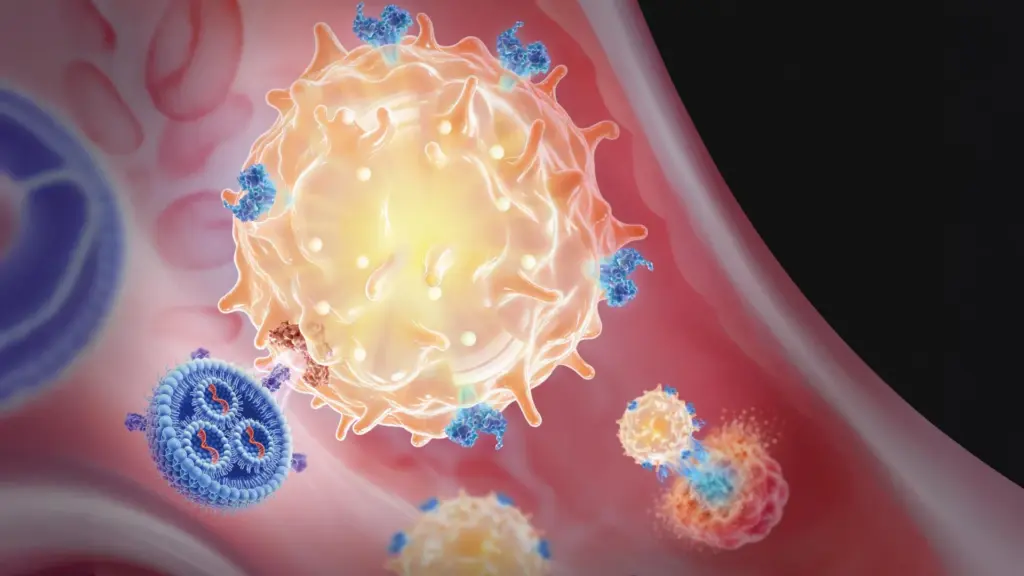
For years, the standard approach to cellular immunotherapy has required extracting immune cells from a patient, shipping them to a specialized laboratory, and modifying them extensively outside the body. In contrast, the MIT researchers bypass this complex logistical chain by using tiny, highly engineered particles made of fatty molecules. These microscopic vehicles deliver genetic instructions directly to the patient’s native NK cells. These instructions, carefully carried by messenger RNA, direct the cells to produce specialized proteins that help them accurately identify and eliminate diseased T cells.
The resulting modified cells, known as chimeric antigen receptor natural killer (CAR NK) cells, could eventually be deployed against a diverse array of difficult-to-treat diseases. By carrying out the delicate engineering process entirely inside the body, this new in vivo approach could eliminate much of the time, financial expense, and technical complexity that currently encumbers the manufacturing of personalized immune cell therapies.
"The manufacturing challenges with CAR NK cells are significant. The idea here is you can deliver a nanoparticle that will modify your own NK cells with a CAR construct and teach them to attack tumor cells," explains Daniel Anderson, a professor in MIT’s Department of Chemical Engineering and a member of MIT’s Koch Institute for Integrative Cancer Research and Institute for Medical Engineering and Science.
Anderson serves as the senior author of the groundbreaking research, which has been published in the prestigious scientific journal Nature Biotechnology. The lead authors of the study are MIT postdoctoral researcher Yuang Chen and graduate students Julia Monkovic and Haseeb Mughal. Furthermore, Robert Langer, MIT’s esteemed David H. Koch Institute Professor, also contributed vital expertise and support to the study.
Why Current Cancer Immunotherapies Are So Complex
Immune cell engineering has already fundamentally transformed treatment options for certain types of cancer, offering new hope to patients who previously faced poor prognoses. Over the past decade, the U.S. Food and Drug Administration has approved seven distinct cancer therapies that utilize genetically modified T cells, commonly referred to as chimeric antigen receptor, or CAR, T cells.
These pioneering treatments function by equipping a patient’s T cells with specially designed artificial receptors that are meticulously programmed to recognize particular biological markers, known as antigens, present on the surface of other cells. When an engineered T cell encounters its designated target—such as a specific protein associated with tumor growth—it becomes rapidly activated and launches an aggressive attack against the cell carrying that specific marker.
CAR T cell therapies have proven to be especially effective against aggressive blood cancers arising from B cells. These include certain forms of leukemia and lymphoma, as well as multiple myeloma, marking a major milestone in modern oncology.
However, preparing and administering these life-saving treatments involves several complicated, labor-intensive steps. Medical professionals must first collect a substantial blood sample from the patient and safely transport it to a specialized manufacturing facility. Once there, highly trained technicians carefully separate the T cells from the rest of the blood components, genetically modify them to produce the desired artificial receptors, and cultivate a sufficiently large population of engineered cells for therapeutic use. Once this intricate process is complete, the finished cells must be carefully transported back to the hospital and infused directly into the patient’s bloodstream.
Natural Killer Cells Offer a Different Way to Fight Cancer
In light of these manufacturing hurdles, scientists have recently been exploring whether natural killer cells could be engineered in a similar fashion to treat various malignancies. One particularly important advantage of NK cells is their unique potential to treat cancers and autoimmune conditions that involve abnormal T cells.
Attempting to use traditional CAR T cells against diseased T cells creates a major biological hurdle. Because both the engineered therapeutic cells and their intended targets belong to the same category of cells—namely, T cells—the modified cells may frequently recognize and destroy one another. This friendly fire phenomenon, known as fratricide, can severely undermine the overall efficacy of the treatment.
Natural killer cells naturally avoid this dangerous complication because they belong to an entirely different lineage of immune cells. They can be programmed to aggressively hunt down and neutralize harmful T cells without triggering the same risk of engineered cells attacking each other.
"NK cells can treat these T cell malignancies—not only T cell cancer, but also T cell autoimmune diseases," notes co-lead author Yuang Chen.
Producing CAR NK cells outside the body through conventional methods, however, still requires much of the specialized laboratory equipment, skilled labor, and extensive quality control processing associated with traditional CAR T cell manufacturing. To overcome these persistent limitations, the MIT research team investigated whether NK cells could instead be engineered directly "in vivo," meaning within the living environment of the patient’s body.
"If a patient can just get an infusion of nanoparticles, it would dramatically simplify the process and reduce costs," Anderson points out.
Although researchers worldwide are actively developing advanced CAR NK cell therapies for both cancer and various autoimmune disorders, none have yet received official approval from the FDA.
How mRNA Nanoparticles Reprogram Immune Cells
To turn this ambitious concept into reality, the MIT team designed specialized lipid nanoparticles (LNPs) capable of safely transporting messenger RNA directly into natural killer cells circulating in the body. The mRNA acts as a molecular blueprint, carrying precise instructions for producing a chimeric antigen receptor that directs the modified immune cell toward a predetermined disease target.
Crucially, this versatile technology can be readily adapted to recognize different surface proteins depending on the specific disease being treated. For instance, the researchers can easily provide instructions for a receptor designed to recognize CD19, a prominent protein found on B cells, or CD3, a protein present on T cells, including those rogue populations responsible for destructive autoimmune attacks.
To ensure that the microscopic nanoparticles successfully reach the correct immune cells amidst a sea of other biological components, the scientists engineered the surfaces of the particles by covering them with specific antibody fragments. These biological fragments are designed to recognize and tightly attach to specific receptors found on the surface of NK cells, effectively guiding the delivery of the genetic instructions precisely where they are needed most.
Once a nanoparticle successfully enters an NK cell, the enclosed mRNA directs the rapid production of the new artificial receptor. This cellular upgrade equips the natural killer cell with the newfound ability to recognize and ruthlessly attack its intended pathological target.
Following the design and optimization of the delivery system, the researchers rigorously tested whether this innovative approach could efficiently reprogram NK cells and whether the resulting modified cells could successfully combat cancer and autoimmune disease in rigorous animal models.
Reprogrammed Immune Cells Eliminate Tumors in Mice
The initial laboratory experiments yielded exceptionally encouraging results. After injecting the tailored nanoparticles into mice, the researchers successfully modified approximately 80 percent of the natural killer cells they were targeting, demonstrating remarkable delivery efficiency.
Buoyed by this success, the team investigated whether these newly engineered cells could actively seek out and destroy tumors. In experimental models involving mice with an aggressive form of melanoma, three out of the five animals treated with the nanoparticle therapy designed to direct NK cells against the cancer experienced complete tumor remission.
The researchers also tested the novel technique against human T cell lymphoma by utilizing specialized humanized mice. These unique animal models receive careful transfusions of human blood cells, temporarily equipping them with immune systems that share crucial characteristics with human physiology.
In this complex model, the treatment produced substantial and rapid tumor destruction. Following a series of five injections of the specialized nanoparticles, the tumors were completely eliminated from the subjects.
Importantly, these therapeutic results were directly comparable to those achieved with traditional CAR NK cells produced through conventional, labor-intensive methods—which involve collecting NK cells from the body, modifying them outside the patient in a specialized laboratory, and then reinfusing them back into the animals.
This direct comparison strongly suggests that generating CAR NK cells directly inside the living body could offer identical cancer-fighting capabilities while entirely avoiding the complicated, expensive, and time-consuming manufacturing processes currently required by standard cellular therapies.
A Single Injection Reverses Autoimmune Liver Damage
Beyond oncology, the MIT researchers were eager to determine whether their cutting-edge technology could also be deployed to successfully treat autoimmune diseases, a broad class of conditions in which the body’s immune system mistakenly turns against healthy, vital tissues.
To test this hypothesis, the team focused heavily on autoimmune hepatitis, a debilitating chronic condition in which abnormal, autoreactive T cells attack hepatocytes, which are the main functional cells responsible for the liver’s critical metabolic and detoxifying operations. By carefully designing nanoparticles that instruct native NK cells to recognize and neutralize these harmful T cells, the scientists sought to determine whether they could successfully halt the destructive autoimmune response at its source.
The targeted treatment successfully eliminated the autoreactive T cells in mice suffering from the disease. Even more encouragingly, the animals’ heavily damaged liver tissue demonstrated a remarkable capacity to heal and regenerate once the harmful immune cells were successfully removed from the environment.
Crucially, these profound medical improvements occurred after just a single nanoparticle injection, clearly demonstrating the broad therapeutic potential of the approach far beyond the realm of cancer treatment.
"This study is an excellent example of the power of nano delivery systems and their ability to potentially treat cancer and other diseases," remarks Robert Langer.
A New Direction for Cancer and Autoimmune Treatments
Building upon these initial successes, the research team firmly believes that reprogramming natural killer cells directly inside the body could eventually provide entirely new treatment options for a much wider range of debilitating medical conditions that currently lack effective long-term solutions.
Among the specific diseases the researchers hope to target in future studies are multiple sclerosis and rheumatoid arthritis, both of which are notoriously complex conditions that involve harmful, chronic immune responses driven by dysfunctional T cells wreaking havoc throughout the body.
Although the current findings are undeniably promising, the researchers emphasize that all experiments thus far have been conducted in murine models. Further extensive research, safety evaluations, and clinical trials will be fundamentally necessary to determine whether the technique is both safe and similarly effective when translated to human patients.
If future clinical developments prove successful, this pioneering technology could make engineered immune cell treatments considerably more accessible to the general public. By replacing a lengthy, centralized laboratory manufacturing process with the direct, streamlined delivery of genetic instructions through targeted nanoparticles, modern medicine may soon take a transformative leap forward in the ongoing fight against cancer and autoimmune disorders.
The research described above received generous financial support and funding from Sanofi, the Marble Center for Cancer Nanomedicine, and a Koch Institute Support Grant provided by the National Cancer Institute.