
In the pantheon of comforting American desserts, few creations command as much reverence—or demand as much culinary precision—as a traditional, from-scratch apple pie. Elevating this timeless classic from a simple household dessert into a masterful work of pastry art requires a careful balance of structural integrity, deep flavor development, and meticulous technique. For bakers looking to master the craft of seasonal baking, a new comprehensive recipe and procedural blueprint has emerged, detailing the exact methods required to produce a transcendent Bourbon-Caramel Honeycrisp Apple Pie encased in a rich, flaky cream cheese and butter crust.
The anatomy of this exceptional dessert relies on two distinct phases: the engineering of a remarkably tender and flaky pastry dough, and the preparation of a complex, spice-infused caramel apple filling that achieves the ideal balance of sweetness, acidity, and unctuous richness.
The Foundation: Crafting the Cream Cheese and Butter Crust
Every great pie begins with its crust, and this particular formulation introduces cream cheese into the traditional all-butter paradigm to enhance both flavor and workability. The process begins with the careful dry-ingredient integration. Bakers whisk together all-purpose flour, a precise measure of kosher salt—specifying either Diamond Crystal or Morton for exact salinity—and a touch of baking powder in a spacious mixing bowl.
The introduction of chilled cream cheese, cut precisely into one-inch pieces, forms the initial fat layer. By rubbing the cold cream cheese directly into the dry ingredients with the fingers, the mixture assumes a characteristically shaggy appearance, coating the dairy fats in flour before they can melt. Following this, cold unsalted butter, sliced into half-inch thicknesses, is tossed into the bowl. Instead of traditional pastry blenders, the method calls for manually tossing the butter to coat it in flour and then flattening the pieces between the fingers until they reach approximately the size of chickpeas. This deliberate preservation of distinct butter flakes is crucial; as the pie bakes, the water content in these butter pockets will evaporate, creating the signature airy layers that define a superior pastry.
Hydrating the dough requires restraint and cold temperatures. By creating a well in the center of the flour and fat mixture and pouring in ice-cold water, the baker can gently toss the components with a fork or hands to distribute the moisture evenly. A brief, minimal kneading process directly in the bowl brings the mass together, allowing for some remaining dry bits to ensure the dough is not overworked.
Lamination and gluten development are handled through a precise rolling and folding sequence on a surface lightly dusted with rice flour or all-purpose flour. The dough is rolled into a half-inch-thick rectangle, folded in half, rotated ninety degrees, and folded once more. Repeating this rolling and folding process builds internal layers akin to puff pastry, ensuring a sturdy yet delicate structural framework. The final dough is then divided in half, patted into half-inch-thick disks, wrapped tightly in plastic wrap, and subjected to a mandatory chilling period of at least two hours, though a twelve-hour rest in the refrigerator is strongly encouraged to allow the flour to fully hydrate and the fats to firm up completely. For forward-planning bakers, this dough can also be frozen for up to a month if double-wrapped in plastic and thawed overnight in the refrigerator prior to use.
The Filling: Building Complex Depth with Bourbon and Caramel
While the pastry rests, the filling undergoes a sophisticated flavor transformation that moves far beyond standard sliced apples and sugar. The process initiates on the stovetop within a medium Dutch oven or heavy-bottomed pot. Granulated sugar and water are combined, covered, and brought to a boil over medium heat without stirring. This initial covering allows steam to dissolve any stray sugar crystals on the sides of the pot.
Once the sugar is fully dissolved—typically within four to seven minutes—the lid is removed to initiate the caramelization process. Occasional swirling or stirring of the pot ensures even heat distribution as the syrup transitions through shades of amber, ultimately reaching a deep golden brown after roughly ten to twelve minutes of attentive cooking.
At this critical juncture, the aromatic and flavor elements are introduced directly into the hot caramel. The mixture receives the finely grated zest of a single lemon, a generous quantity of peeled, cored, quartered, and thinly sliced Honeycrisp apples, a splash of bourbon, unsalted butter, kosher salt, and ground cinnamon. Because the introduction of cold and room-temperature ingredients to hot caramel can cause a temporary seizing effect, the pot is covered and allowed to simmer. As it cooks, the hardened caramel dissolves back into the liquid released by the apples. The fruit cooks down until tender while retaining its structural integrity and a mostly translucent appearance, a process taking between fifteen and eighteen minutes.
To ensure the pie slice cleanly upon serving rather than collapsing into a watery pool, a thickening agent is introduced. A slurry of heavy cream, cornstarch, and cool water is whisked together in a small bowl until completely smooth, then poured into the bubbling apple mixture. The filling continues to cook, stirred frequently, until it thickens significantly—about five minutes. The finished filling is then transferred to a large bowl to cool before being covered and thoroughly chilled in the refrigerator for a minimum of forty-five minutes.
Assembly, Latticework, and Baking
The final assembly brings the chilled components together with architectural precision. The first disk of dough is permitted to rest briefly at room temperature before being rolled out on a flour-dusted surface into a twelve-inch round roughly a quarter-inch thick. After brushing away excess flour, the pastry is wound around a rolling pin and unfurled into a standard nine-inch pie pan, such as a traditional spun iron dish. Lifting the edges allows the dough to slump naturally into the contours of the pan without stretching, which prevents shrinkage during baking. The edges are trimmed to leave a one-inch overhang, and the pan is returned to the refrigerator for fifteen minutes.
The second disk of dough undergoes a different treatment to create the decorative lattice top. Rolled into a large rectangular sheet measuring eighteen by twelve inches and roughly an eighth-inch thick, it is transferred to a parchment-lined baking sheet. To achieve a uniform and professional finish, the surface of the dough is brushed with a thin film of cold water and evenly coated with remaining granulated sugar, gently pressed into the dough by hand before any cutting takes place. This pre-coating technique ensures absolute coverage across the strips. After another brief fifteen-minute chill, the dough rectangle is measured with a ruler and sliced into uniform one-inch-wide strips.
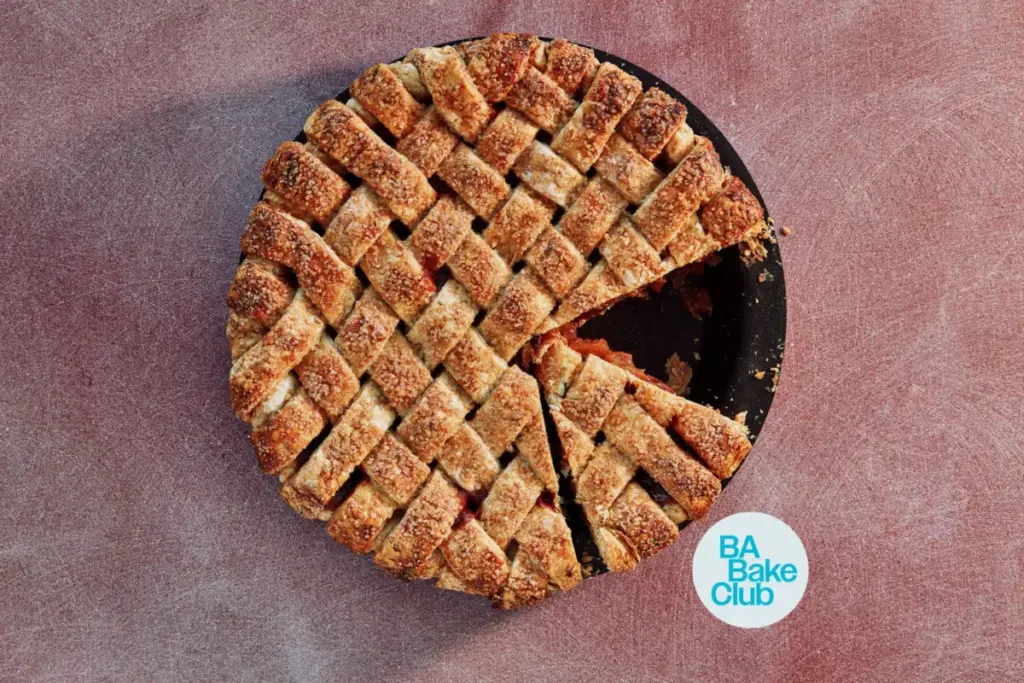
With the oven preheated to 375 degrees Fahrenheit and a baking rack positioned in the center, the chilled filling is spooned into the prepared bottom crust and smoothed into an even layer. The lattice is constructed by laying five to eight strips evenly across the surface in one direction, then weaving a second set of five to eight strips over and under the first to create a classic interwoven pattern.
The overhang of the lattice is trimmed to match the bottom crust, and the edges are firmly pressed together to seal. A final trim leaves a quarter-inch overhang, which is then folded up and over the lattice so the crust sits flush with the edges of the pan. Bakers can then crimp the edges according to preference using lightly floured fingers.
To manage any bubbling fruit juices that inevitably escape during the baking process, the pie pan is placed atop a rimmed baking sheet lined to catch drips. The pie begins its journey in the oven at 375 degrees, baking until the crust is set and golden, which takes approximately forty-five to fifty minutes. The oven temperature is then reduced to 350 degrees, and the pie continues to bake until the crust achieves a deep, rich golden brown and the filling bubbles vigorously up through the lattice openings for an additional forty to fifty minutes.
Upon removal from the oven, patience remains the final requirement. The pie must be transferred to a wire rack and allowed to cool undisturbed in the pan for at least four hours. This resting period allows the cornstarch-thickened bourbon caramel and apple juices to fully set, ensuring that when the dessert is finally sliced, each portion maintains its structural form. For those managing a holiday schedule, the filling can be prepared up to two days in advance and kept chilled, while the fully baked pie can be successfully stored loosely covered at room temperature for up to one day prior to serving.