


Federal land managers are intensifying their search for vandals who defaced irreplaceable cultural heritage sites in the desert landscape surrounding Moab, Utah. The Bureau of Land Management (BLM) announced that it has launched a formal investigation into acts of vandalism discovered at two distinct, ancient rock-art locations, where modern names were deeply carved directly into petroglyphs dating back roughly 1,500 years.
The recent incidents have sparked widespread concern among historic preservation officials, tribal descendants, and law enforcement agencies who warn that the permanent damage threatens the fragile history written across Utah’s sandstone cliffs. According to the BLM, the vandalism took place at the Bear Panel, a well-known cultural site situated along Highway 279 near the winding course of the Colorado River, and at a secondary panel positioned near Hell’s Revenge, a rugged and heavily trafficked four-wheel-drive trail within the Sand Flats Recreation Area.
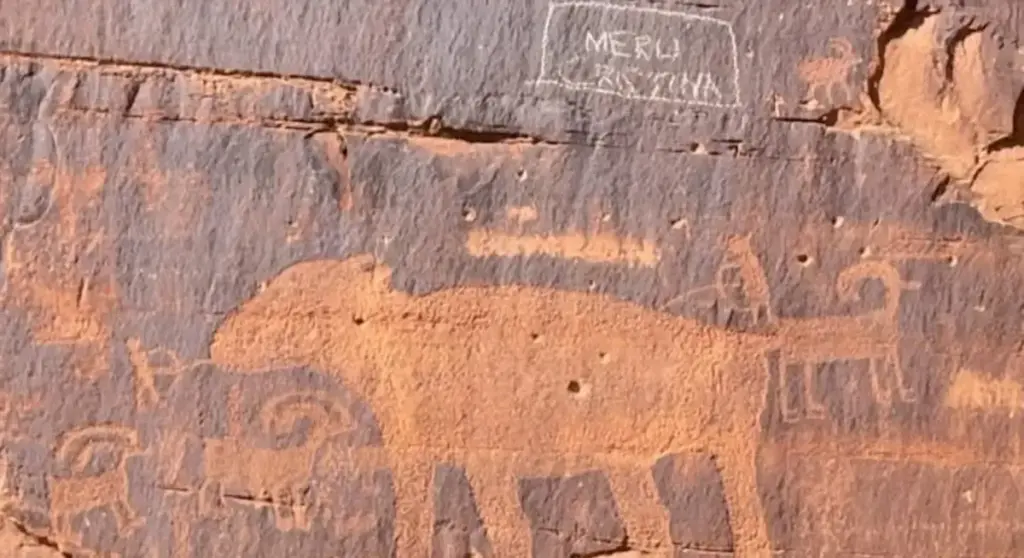
Photographs released by the BLM illustrate the extent of the damage. At the Bear Panel, the name “Meru” was crudely scratched into the stone immediately beside ancient, meticulously crafted carvings of a large bear and a bighorn sheep. At the second location near Hell’s Revenge, vandals carved the name “Craig W” directly across multiple ancient petroglyph figures, obliterating centuries-old artistry with a few thoughtless strokes.
State and federal officials have expressed profound dismay over the incidents, noting that the targeted panels hold immense historical and spiritual significance. Chris Merritt, Utah’s state historic preservation officer, emphasized the deep cultural impact of the destruction during an interview regarding the ongoing investigation.
“These images are a physical expression of the past, their connection to their ancestors and to that landscape,” Merritt told reporters. “They will now forever be scarred by someone’s thoughtlessness, and that hurts the continuation of culture.”
Merritt explained that the artwork across both damaged sites originates from approximately 1,500 years ago, representing the rich cultural traditions of the Ancestral Puebloan and Fremont peoples, as well as the heritage of more recent Indigenous communities. These panels are not isolated historical artifacts, but rather vital components of a vast and interconnected cultural landscape where Indigenous peoples historically lived, farmed, traveled, and forged enduring spiritual bonds with the desert environment.
As of the BLM’s latest updates, the agency has not publicly identified any suspects connected to either of the two recent vandalism cases. Representatives from the Moab BLM office told local newspaper The Times-Independent that agency specialists planned to treat the graffiti in the days following the initial announcement, though experts cautioned that the nature of the carving means some of the resulting disfigurement and structural alteration may be completely permanent.
Under federal statute, specifically the Archaeological Resources Protection Act, the defacement and unauthorized alteration of protected archaeological sites on public lands constitute serious offenses. Violators face steep legal penalties, including fines of up to $20,000 and potential prison sentences of up to two years, depending on the severity of the damage and the cost of remediation.
Can the Damage Be Repaired?
Restoring vandalized petroglyphs is a delicate, highly technical process that presents distinct engineering and conservation challenges at each individual site, according to state historic preservation officials.
At the location near Hell’s Revenge, where vandals scratched modern names directly across ancient carvings, the remediation process is fraught with difficulty. Merritt noted that standard maintenance techniques—such as mechanically scrubbing the stone surface or attempting to mask the unauthorized marks with matching pigments—carry an unacceptable level of risk. Any aggressive intervention could inadvertently abrade, erode, or permanently alter the original prehistoric artwork hidden underneath or immediately adjacent to the graffiti.
The Bear Panel presents an entirely different set of physical preservation hurdles. Conservation specialists inspecting that site identified a natural structural crack in the sandstone cliff face situated just below the freshly carved letters. Because of this geological feature, aggressively scraping or grinding away the rock to remove the name “Meru” could widen the fracture, creating an entry point for moisture and rainwater. Over time, seasonal temperature fluctuations and freeze-thaw cycles could cause the weakened sandstone to crack further, potentially leading to the loss of a much larger section of the historic panel.
“Five minutes of damage could take weeks of repair to do carefully to preserve the subsurface imagery and the rock face,” Merritt said. He emphasized that any physical remediation work undertaken by the agency must involve extensive, respectful consultation with descendant tribal communities who maintain a living cultural connection to the landscape.
Protecting Rock Art in Popular Recreation Areas
The discovery of the carved names near Moab highlights a broader, increasingly troubling trend across the American Southwest. Merritt noted that rock-art vandalism has seen a noticeable upswing throughout Utah in recent years, a troubling development that preservationists believe is tied directly to surging visitation rates on public lands and the rapid expansion of outdoor recreation.
“We’ve always had folks going back to the 19th century scraping their initials on the panels, but what we’re seeing within five or six years is a pretty significant increase in the scale and distribution, hitting archaeological panels that have never had graffiti before,” Merritt said.
This latest pair of investigations follows a similar incident earlier in the year. In March 2026, the Grand County Sheriff’s Office launched an inquiry into separate acts of vandalism involving graffiti carved directly into ancient petroglyphs near Tusher Tunnel, located along a popular off-highway vehicle route northwest of Moab.
To combat the rising tide of heritage site destruction, Utah officials are leaning heavily on public education and community involvement. The state continues to promote its “Protect Our Past” campaign, alongside a dedicated statewide network of volunteer site stewards who routinely monitor vulnerable archaeological locations, report suspicious activities, and assist land managers with documentation. In certain sensitive areas, targeted installations of protective signage and physical fencing are also utilized to deter casual vandalism and remind visitors of the irreplaceable nature of the resources.
Legal consequences for past offenders demonstrate that federal and state authorities are actively pursuing prosecutions. In November 2025, a federal court sentenced a Utah woman who vandalized ancient petroglyphs on BLM land near Wire Pass to 12 months of probation. In addition to probation, she was ordered to pay $14,853 in combined fines and financial restitution, and the court prohibited her from entering BLM-administered public lands for the entire duration of her sentence, according to a U.S. Department of Justice news release.
“These aren’t victimless crimes,” Merritt said. “We need to find ways to catch, prosecute, and convict these folks, so it sends a message to future visitors that this is not acceptable in Utah or anywhere you visit heritage sites.”
Federal land managers are urging anyone who may have witnessed suspicious behavior near the Bear Panel or the Hell’s Revenge site, or who possesses information regarding the identity of the vandals, to come forward. Individuals with relevant details are encouraged to contact Moab BLM Law Enforcement at 435-259-2131.